You count them out of the box, get to 78, and something about the number seems deliberate. Then you read somewhere that it encodes an ancient mystical system, and somewhere else that the 22 majors match the 22 letters of the Hebrew alphabet, and you cannot tell which parts are history and which are someone's nineteenth-century idea.
Why are there 78 tarot cards and not 60 or 100? This post gives you the documented answer, which involves Egyptian card games, a polo stick, and a fifth suit invented to win tricks. You will also get the honest account of where the mystical numbering came from and when, plus the practical part: how knowing the structure lets you read a card you have never seen before, using its position in the system rather than a memorized meaning.
The four suits arrived in Europe already assembled
The 56 minor arcana are older than tarot. Playing cards reached Europe in the late fourteenth century, and the closest known ancestor is the Mamluk deck from Egypt, a surviving example of which is held at the Topkapı Palace in Istanbul. It had four suits: cups, coins, swords, and polo sticks.
Europeans had no polo. So the polo sticks became batons, staves, or wands depending on the region, which is why the suit that means drive and action in modern readings is a picture of a stick. The Mamluk deck ran ten numbered cards plus three court cards per suit, giving 52. When these decks were copied and adapted across Italy, France, and Spain, some traditions added a fourth court figure, the Queen.
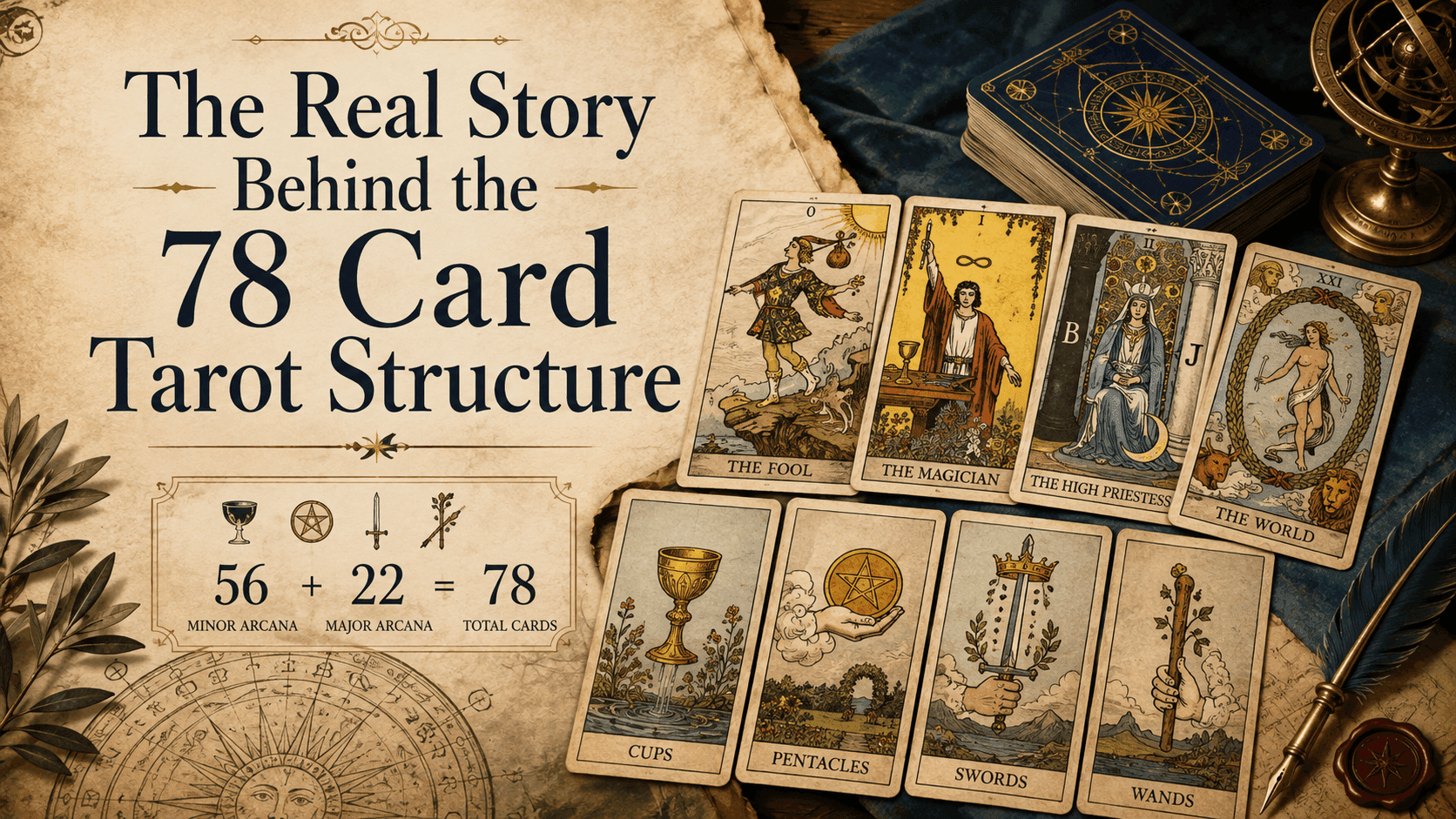
That fourth court card is where 56 comes from. Ten pips plus four courts is fourteen, and fourteen across four suits is 56. No symbolism required, just a card maker adding a figure to a court.
So why are there 78 tarot cards?
The remaining 22 exist because someone in fifteenth-century northern Italy wanted a better game. Around the 1440s, card makers began adding a fifth suit of picture cards to the standard pack. These were the trionfi, or triumphs, and the word survives in English as "trumps."
They did exactly what trumps do in a card game today: they outranked the four ordinary suits. In a trick-taking game, a permanent trump suit changes the strategy completely, and 21 numbered trumps gave enough of them to matter. The Fool sat outside that ranking as a special card, usually exempt from the ordinary rules of following suit, which is why it still carries an unnumbered or zero position in modern decks.
Here is the arithmetic in full:
- 4 suits × 10 numbered cards = 40
- 4 suits × 4 court cards = 16
- 21 numbered trumps + 1 Fool = 22
- Total: 78
Tarot was a game for its first three centuries, played across Italy, France, and central Europe, and versions of it are still played today. The divinatory reading of these cards came much later.
78 was not inevitable
This is worth knowing because it undercuts the strongest claim you will read about the number. Early decks varied. Minchiate, a Florentine variant, ran to 97 cards with an expanded set of trumps covering the virtues, the elements, and the zodiac. The Cary-Yale Visconti deck, one of the oldest surviving fragments, appears to have carried extra court figures, giving six per suit rather than four.
What settled the count was standardization, particularly the Tarot de Marseille pattern that became widespread in France, which fixed both the trump sequence and the 78-card total in the form most later decks inherited. Even the best-known fifteenth-century Visconti-Sforza set survives incomplete, with a few trumps missing, which tells you something about how casually these packs were treated before anyone considered them sacred.
So if a source tells you 78 was chosen to encode a specific esoteric structure, it is describing a meaning applied afterward rather than the reason the number exists. That is not a reason to dismiss the meaning. It is a reason to know which is which.
Where the mystical numbering came from, and when
The occult reading of tarot has a traceable start date. In 1781, the French scholar Antoine Court de Gébelin published an essay claiming the cards preserved ancient Egyptian wisdom, a theory with no evidence behind it that has since been thoroughly discarded. It was enormously influential anyway. Within the same decade, the cartomancer known as Etteilla was publishing methods for reading the cards and producing decks designed for that purpose.
The Hebrew alphabet correspondence came later still, developed by nineteenth-century French occultists including Éliphas Lévi, who connected the 22 trumps to the 22 letters. It is a genuinely interesting system and many readers use it productively. It is also a nineteenth-century overlay on a fifteenth-century game structure, not the origin of it.
The layer most beginners actually learn came last. The Rider-Waite-Smith deck of 1909, illustrated by Pamela Colman Smith and accompanied by Waite's 1911 guide, gave the minor arcana full narrative scenes for the first time in a widely circulated deck. Readers still disagree about how much weight to give any of these layers, and that disagreement is normal rather than a sign that someone has it wrong.
What the structure gives you at the table
Knowing where 78 comes from is not trivia if you use it as a coordinate system. Every minor card tells you three things before you look at the picture: which suit, which number, and whether it is a pip or a court. Every major tells you it belongs to the trump sequence, the cards that traditionally outrank everything else.
Imagine someone called Leila, three weeks into learning, pulling the Nine of Swords for a Tuesday morning check-in. She does not know this card. But she knows it is a minor, so it is describing circumstances rather than a large turning point. She knows swords traditionally cover thought, language, and conflict. She knows nine sits near the end of the numbered run, where a suit's quality reaches its most concentrated form.
Before opening any book, she has a working hypothesis: this is thinking at its most intense, close to its limit. Then she looks at the image, a figure sitting up in bed with their face in their hands, and connects it to the fact that she has been awake at 4am rehearsing an argument. The structure got her most of the way there.
This is the argument for a daily one-card pull as a study method. Each pull is a small exercise in placing a card within a system you already understand, so you build the map by walking it rather than memorizing 78 unrelated pictures.
The common mistake here is exactly that: treating the deck as 78 separate things to learn. It is really a 4 by 14 grid plus a sequence of 22, which is a far smaller amount of information. Do learn the grid first. Do not start with flashcards.
The takeaway worth keeping
Why are there 78 tarot cards? Because a fifteenth-century card game added a trump suit to a deck that had already travelled from Egypt to Europe, and a standard pattern later fixed the count. The mystical structures came after, added by identifiable people at identifiable dates, and they are worth studying as long as you know they are additions rather than foundations.
Today, do this: lay out one full suit, ace through king, in order, and look at how the images change as the numbers climb. Ten minutes with fourteen cards will teach you more about the deck's logic than an hour of reading about any of it, including this post.