SwordsAir
Tarot Card Meaning

Nine of Swords

The Nine of Swords means anxiety, worry, and mental anguish. Explore its upright and reversed meanings, symbolism, and daily-pull guidance.

Nine of Swords tarot card
At a glance

Quick Keywords

Upright
  • anxiety
  • worry
  • sleeplessness
  • mental anguish
  • fear
  • dread
  • overthinking
Reversed
  • releasing anxiety
  • facing a fear directly
  • seeking support
  • worry exaggerated beyond reality
  • gradual relief
Symbolism

What's in the Image

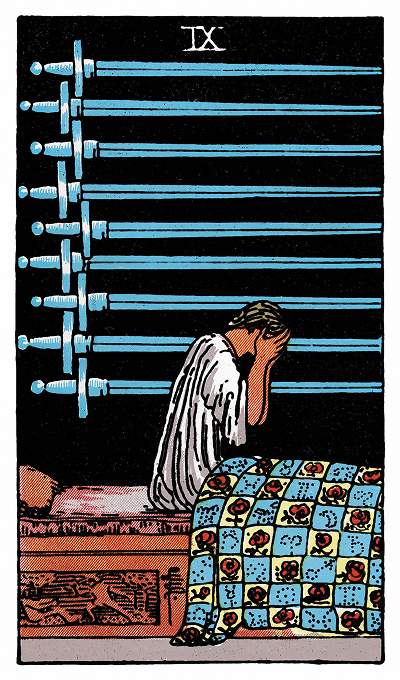
The Nine of Swords — Rider-Waite-Smith version
Rider-Waite-Smith
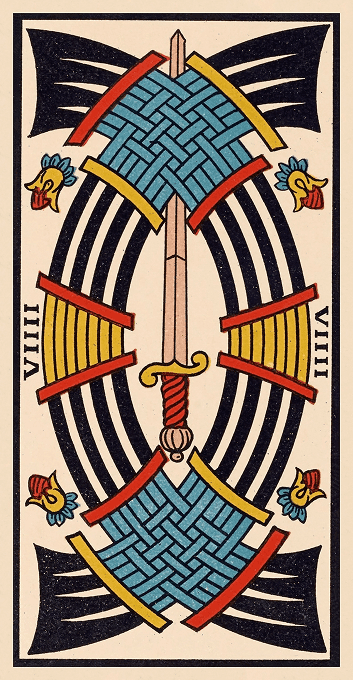
The Nine of Swords — Marseille version
Marseille
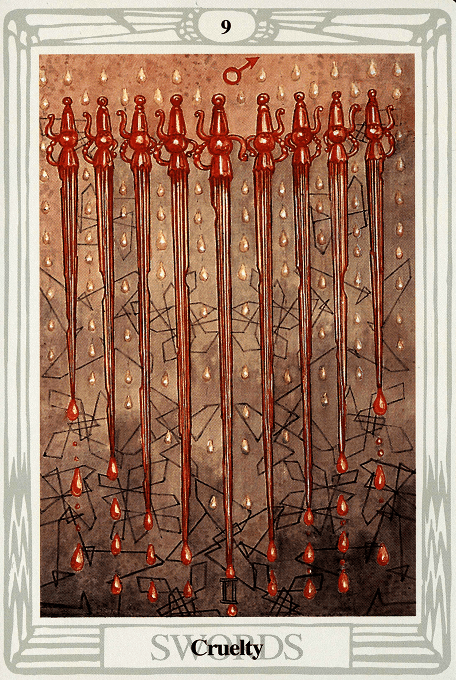
The Nine of Swords — Thoth version
Thoth

In the Rider-Waite-Smith deck, a figure sits upright in bed at night, head in hands, apparently woken by distress, while nine swords hang on the wall behind them in a horizontal row. The bed's carved panel below shows a small scene of one figure appearing to overcome another. The core message concentrates in three details: the figure's posture, hands covering the face, suggesting overwhelming distress rather than calm rest, the swords arranged neatly on the wall rather than actively threatening, indicating the fear may be more present in the mind than in immediate physical danger, and the carved panel beneath the bed, often read as a subtle hint that the anguish shown may be more resolvable than it currently feels. Together these describe intense anxiety or mental distress, often most acute in quiet, isolated moments like the middle of the night.

Waite's 1911 notes describe this card in terms of "death," "failure," and miscarriage of plans among its darker possible readings, but he specifically cautions that "the true meaning is doubt," emphasizing that much of this card's suffering may stem from fear and worry rather than events that have actually occurred, a distinction modern readers sometimes miss when reading the card as confirmation that something terrible is definitely happening. Earlier decks, including the Tarot de Marseille, depict the nines of each suit without any illustrated scene, typically showing simply nine swords arranged decoratively, meaning the specific image of someone waking in distress is Waite and Smith's addition, chosen to represent psychological anguish directly rather than a plain suit symbol alone would convey.

Upright Meaning

The Nine of Swords represents intense anxiety or mental distress, often disproportionate to the actual circumstances at hand. Its essential energy is worry that feels overwhelming, particularly in quiet, isolated moments when there's little to distract from difficult thoughts.

In everyday situations, this often shows up as lying awake at night turning a problem over repeatedly, feeling consumed by worst-case scenarios, or experiencing a sense of dread that feels larger than the situation objectively warrants. It can also describe a period of genuine mental strain, where anxious thoughts feel difficult to quiet even when you recognize, on some level, that they may be exaggerated.

A nuance beginners often miss is that Waite's own notes specifically emphasize doubt and fear as this card's true center, rather than confirming that whatever is being feared has actually happened or will happen. The swords on the wall are still and orderly, not actively striking, suggesting the suffering shown here often lives more in anticipation and worry than in a fully realized crisis. Reading this card only as "something terrible is definitely about to happen" misses its more accurate, and often more useful, meaning: anxiety that deserves compassion and attention, but that isn't necessarily an accurate forecast of events.

Readers disagree somewhat on how much this card should be read as pointing to genuinely difficult circumstances versus primarily describing exaggerated worry disconnected from reality. Some traditions treat the Nine of Swords as validating real hardship or grief a person is going through, taking the distress at face value. Other, more psychologically focused readings lean into Waite's own emphasis on doubt, suggesting the card more often describes anxiety that has grown disproportionate to the actual situation. Both readings share the underlying theme of intense mental anguish; they differ mainly in how much weight to give the accuracy of the fear itself.

Reversed Meaning

Reversed, the Nine of Swords doesn't simply mean anxiety disappears instantly. The more useful distinction is between genuine relief that's developing and recognizing that a fear has been exaggerated without yet feeling calmer because of it. Genuine relief suggests real movement away from the intensity of worry, whether through time, support, or a change in circumstances that eases the underlying distress.

A different shadow expression involves recognizing, intellectually, that a fear has grown larger than the situation warrants, without yet feeling that recognition translate into calm. This can look like knowing a worry is probably exaggerated while still feeling its full emotional weight, a common and difficult middle stage rather than a finished resolution.

The reversed card can also point to seeking support: reaching out to someone else, whether a friend, family member, or professional, for help processing the anxiety described by the upright card, rather than continuing to face it entirely alone. This differs from both prior readings; here the emphasis is on the step of reaching outward rather than an internal shift alone.

It's worth noting that some readers don't use reversals at all, reading every card only upright and relying on surrounding cards for shading instead. If that's your approach, the genuine-relief, exaggerated-fear-recognized, and seeking-support readings above still apply, held as tensions that can appear within an upright Nine of Swords, particularly in a reading involving anxiety that's had some time and attention already.

In a daily reading

Nine of Swords in a Daily Reading

As a single morning card, the Nine of Swords is worth reading as a gentle reminder that a worry keeping you up at night may be larger in your mind than in reality. It's a good day to notice anxious thoughts without immediately assuming they reflect the full truth of a situation.

Say you pull this card before a day that includes revisiting a worry that's been keeping you awake, like concern over an unresolved situation at work or in a relationship. The Nine of Swords doesn't confirm the worst-case scenario; it suggests treating the anxiety with compassion while questioning whether it's giving you a fully accurate picture of what's actually happening.

A daily-pull scenario

A Daily-Pull Scenario

Imagine pulling the Nine of Swords on a morning after a restless night spent worrying about an upcoming decision or conversation. A beginner's first instinct might be to read this as confirmation that the thing you're dreading will definitely go badly. A more useful reading treats the card as an invitation to notice how much of the distress comes from anticipation rather than anything that's actually occurred, since Waite's own notes describe doubt as this card's true center, meaning the useful next step is often examining the fear itself rather than assuming it accurately predicts the outcome.

Read with care

Common Misreadings

  • This card confirms my worst fear will come true.

    Waite's own notes specifically describe doubt as the card's true meaning, distinguishing it from a confirmed disaster. The swords on the wall are still, suggesting anticipated fear rather than an event that has already occurred.

  • This card means I should just ignore my anxiety.

    The card takes the distress shown seriously rather than dismissing it. It supports treating anxious feelings with compassion while also gently questioning whether they're giving an accurate picture of the situation.

  • Reversed always means I feel completely better now.

    Reversed can describe genuine relief, but it can just as easily describe recognizing intellectually that a fear is exaggerated without yet feeling calm, or simply the step of reaching out for support.

Combinations

Cards That Change Its Meaning

  • Nine of SwordsThe Star

    Amplifies the possibility of hope and healing, suggesting the anxiety described here is beginning to ease into a calmer, more open outlook.

  • Nine of SwordsTen of Swords

    Tempers ongoing anxiety with a sense that a difficult situation is reaching, or has already reached, its lowest, most exhausted point, suggesting relief may follow more directly.

  • Nine of SwordsThe Moon

    Redirects clear worry toward deeper uncertainty, suggesting the anxiety described here may be tied to something genuinely unclear or unresolved, rather than a fully imagined fear.

Sit with it

Questions for Reflection

  1. 1

    What worry has been keeping me up at night, and how much of it is based on something that's actually happened?

  2. 2

    Is there a fear I've been carrying that might be larger in my mind than the situation actually warrants?

  3. 3

    Who could I reach out to for support in processing a source of ongoing anxiety?

  4. 4

    What would it look like to treat my own anxious thoughts with compassion rather than immediate alarm?