Major ArcanaCard 0Air · Uranus
Tarot Card Meaning

The Fool

The Fool tarot card is the leap of faith — new beginnings, trust, and openness. Explore its upright and reversed meanings, symbolism, and daily-pull guidance.

The Fool tarot card
At a glance

Quick Keywords

Upright
  • new beginnings
  • spontaneity
  • innocence
  • trust
  • freedom
  • taking a leap
  • openness
  • unwritten potential
Reversed
  • recklessness
  • hesitation
  • naivety
  • poor planning
  • fear of the unknown
  • being reckless with trust
  • stagnation
  • scattered focus
Symbolism

What's in the Image

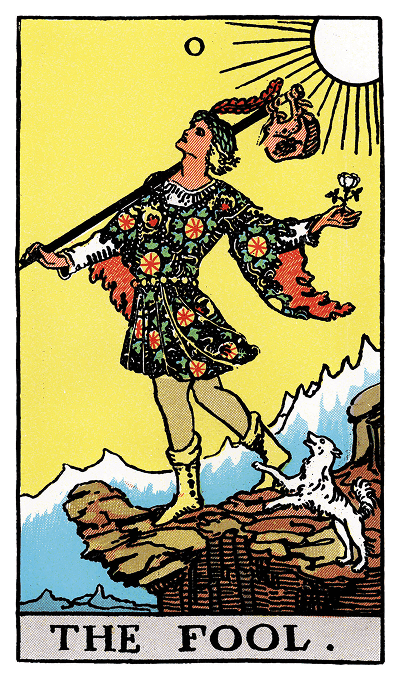
The The Fool — Rider-Waite-Smith version
Rider-Waite-Smith
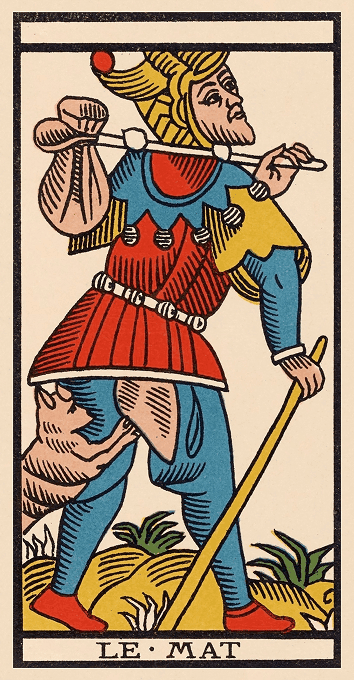
The The Fool — Marseille version
Marseille
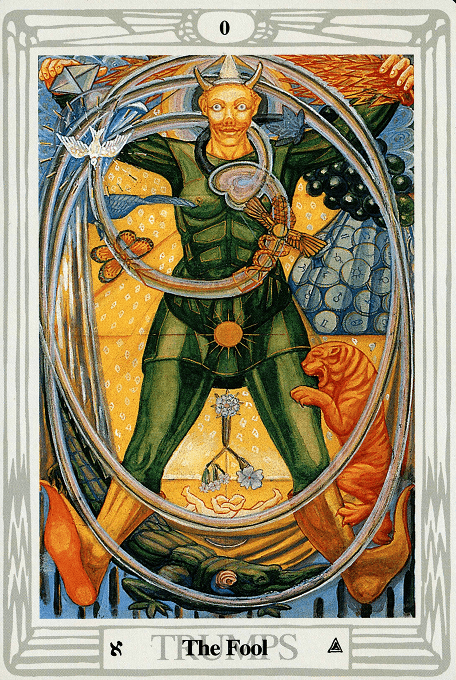
The The Fool — Thoth version
Thoth

In the Rider-Waite-Smith deck, a young figure walks near a cliff's edge, face turned toward the sky, a small white dog at his heels. He carries a knapsack on a stick and holds a white rose. Almost every modern reading of this card centers on that cliff edge and the figure's apparent unconcern about it: the tension between forward motion and unseen risk is the whole story in a single frame. Pamela Colman Smith drew him mid-step, weight already shifting forward, which is part of why the card so often gets read as "about to leap" rather than "already fallen."

It helps to know this image is a real departure from older decks. In the Tarot de Marseille, the Fool has no cliff at all. He's simply a wandering figure, sometimes torn at the knees, harassed by a small animal biting at his leg, moving through an ordinary landscape rather than toward a precipice. The danger in the Marseille version is social and physical (poverty, mockery, a dog attack), not existential. Waite's addition of the cliff reframed the card around risk and trust rather than wandering and low status, and that shift is largely why 20th- and 21st-century readers associate the Fool with bold new beginnings rather than a beggar's uncertain life.

Upright Meaning

The Fool's essential energy is a willingness to begin without a guarantee of how things end. This isn't foolishness in the everyday sense; it's the state of mind before overthinking sets in, when a choice still feels open rather than already narrowed by fear or precedent. Where most cards in the deck deal with consequences, choices, or accumulated experience, the Fool sits at the very start of the sequence, before any of that has happened yet.

In everyday situations, this card tends to surface around genuine firsts: a new job, a new city, a relationship in its early, undefined stage, or simply a day where the usual plan gets set aside. It can also show up more quietly, as an invitation to approach something familiar with fresh eyes instead of old assumptions.

A nuance beginners often miss is that the Fool isn't inherently naive about risk. It's about proceeding despite awareness of risk, not because of ignorance of it. Some popular teaching traditions frame the figure as blissfully unaware of the cliff; others argue Waite's own notes describe him gazing upward "as if unaware," which he treats as a manner of expression rather than a claim of actual ignorance. Readers disagree on how much of the Fool's confidence is genuine trust versus a kind of protective innocence, and it's worth sitting with that ambiguity rather than resolving it too quickly.

As card zero, the Fool is also sometimes read as standing outside the numbered sequence entirely, representing potential itself rather than a specific stage of experience, which is part of why it resists being pinned to one fixed meaning.

Reversed Meaning

Reversed, the Fool doesn't simply mean "bad beginning" or "stay where you are." That's a common oversimplification. The more useful distinction is between blocked energy and negated energy. Negation would just flip new beginnings into stagnation. Blocked energy is more specific: it's the state of wanting to leap but being unable to, often because fear, overplanning, or self-doubt has taken the place of trust.

This distinction matters in practice. A reversed Fool can point to recklessness: leaping without any real awareness of the cliff, ignoring signals a person would normally notice. That's nearly the opposite of hesitation, yet both get filed under "reversed Fool" in most popular guides. Context in the reading and in the person's actual situation is what separates the two.

Reversed can also describe naivety that's curdled into something less charming: trusting a plan or a person without having done any of the groundwork that trust usually requires. Here the shadow isn't spontaneity itself but spontaneity detached from any self-awareness about the stakes involved.

It's worth noting that some readers don't use reversals at all, and read every card only in its upright orientation, adjusting meaning through surrounding cards or context instead. If you're one of them, the "blocked" and "shadow" themes above are still worth holding in mind. They can appear as the more difficult, complicating side of an upright Fool, especially in a reading that already feels uncertain or unresolved.

In a daily reading

The Fool in a Daily Reading

If the Fool is your single card for the day, it's less a prediction and more a prompt to notice where you're being invited to start something without insisting on a full plan first. That could be a conversation you've been rehearsing instead of having, a task you've delayed until it feels "ready enough," or just an ordinary decision where you'd normally default to the familiar option.

Say you pull this card before a day that includes a first meeting with a new coworker or client. The Fool doesn't tell you how that meeting will go. It's a nudge to show up without over-scripting the interaction, and to notice afterward whether your hesitation earlier in the day was caution or just habit.

A daily-pull scenario

A Daily-Pull Scenario

Imagine pulling the Fool on a morning when you're deciding whether to sign up for a class you've been curious about but have put off for months. A beginner's first instinct might be to read this as blanket permission: "the universe says go for it, no questions asked." A more useful reading treats the card as a mirror rather than a verdict: it's asking what, specifically, has been holding the decision back. If the hesitation is thoughtful (cost, timing, genuine capacity), the Fool isn't overriding that. If the hesitation is really just discomfort with the unfamiliar, the card is naming that discomfort so you can look at it directly instead of letting it decide for you by default.

Read with care

Common Misreadings

  • This card guarantees a happy new beginning.

    The Fool describes an openness to starting, not an outcome. It says nothing about whether the beginning will go well; that depends on choices and circumstances the card doesn't specify.

  • The Fool means I should be careless or impulsive.

    The upright card is about willingness, not recklessness. Ignoring real risks or relevant information isn't what the card is describing; that reading belongs closer to the reversed, shadow side of the card.

  • Reversed always means don't do it.

    Reversed can mean hesitation, but it can just as easily mean recklessness or misplaced trust, sometimes the opposite problem. The specific shape of the block matters more than a flat "no."

Combinations

Cards That Change Its Meaning

  • The FoolThe Magician

    Amplifies the theme of beginnings by adding intention and skill to raw openness. Where the Fool alone is about willingness, this pairing suggests the willingness is paired with the tools or focus to act on it.

  • The FoolThe Hermit

    Tempers the Fool's outward motion with a call for reflection first. This combination often reads as "the leap can wait until you've sat with the decision a bit longer," complicating any urge to rush.

  • The FoolThe Tower

    Redirects the card's optimism toward unplanned, disruptive change rather than chosen beginnings. Here the "leap" isn't fully voluntary; something external forces the fresh start rather than the person choosing its timing.

Sit with it

Questions for Reflection

  1. 1

    What would it look like to begin this without waiting until I feel fully ready?

  2. 2

    Where am I mistaking caution for wisdom, or spontaneity for carelessness?

  3. 3

    What am I hesitant to leave behind in order to start something new?

  4. 4

    If this decision had no "wrong" answer, what would I actually choose?