
You bought the deck weeks ago. It is still mostly in the box, because every time you sit down to learn it you are faced with 78 cards and no obvious place to start, so you look up one card, lose interest, and put it away again.
This 30-day tarot challenge fixes the starting problem by giving you one small job a day and never more than ten minutes of it. By the end of the month you will know the structure of the deck, be able to read any card from its image without a lookup, recognize the 22 majors on sight, and put two or three cards together into an actual reading. What follows is the full month broken into four phases, the five-minute routine you repeat daily, and honest advice about what to do on the days you skip.
Before day one: your setup and the daily routine
You need three things: a deck with illustrated minor arcana, a notebook, and a fixed time of day. That first one matters more than it sounds. Decks in the Marseille tradition show the minor cards as plain arrangements of suit symbols, four cups, seven coins, no scene, which is a fine system but a hard one to learn from images. The Rider-Waite-Smith deck of 1909, illustrated by Pamela Colman Smith, gave every minor card a narrative picture, and the great majority of modern beginner decks follow that structure. Check the four of cups in any deck you are considering. If a person is in it, you are set.
Do not buy a deck with an unusual system for this month, however beautiful it looks. Do pick a time you are already reliably somewhere, since the whole method depends on the daily pull being the site's signature practice for a reason: it is small enough to survive a bad week.
Every day of the challenge runs the same four steps:
- Shuffle and pull one card, face up, before you have a question in mind.
- Describe the image in plain words, no meanings yet. "A woman in a garden, looking away from a wall."
- Write one sentence connecting it to something happening today.
- Only then look it up, and note where the book disagrees with you.
Step four is the engine of the whole month. Reading tradition after your own attempt is studying; reading it first is being told.
Week one, days 1 to 7: look before you look anything up
The first week has no memorization in it at all. You pull one card a day and do the four steps, and the only skill you are building is describing an image without interpreting it.
That distinction is the one beginners find hardest. "A man walking away uphill from a row of cups, one gap in the row, dim sky" is a description. "Disappointment and moving on" is a conclusion. Write only the first kind for seven days, even when you recognize the card and the meaning is sitting right there. You are training the muscle that lets you read the other 70 cards you have not memorized.
By day seven you should notice that your descriptions have gotten longer and more specific, and that you have started spotting where figures are looking. Gaze direction does a surprising amount of work in this deck.
Week two, days 8 to 14: learn the deck's grammar
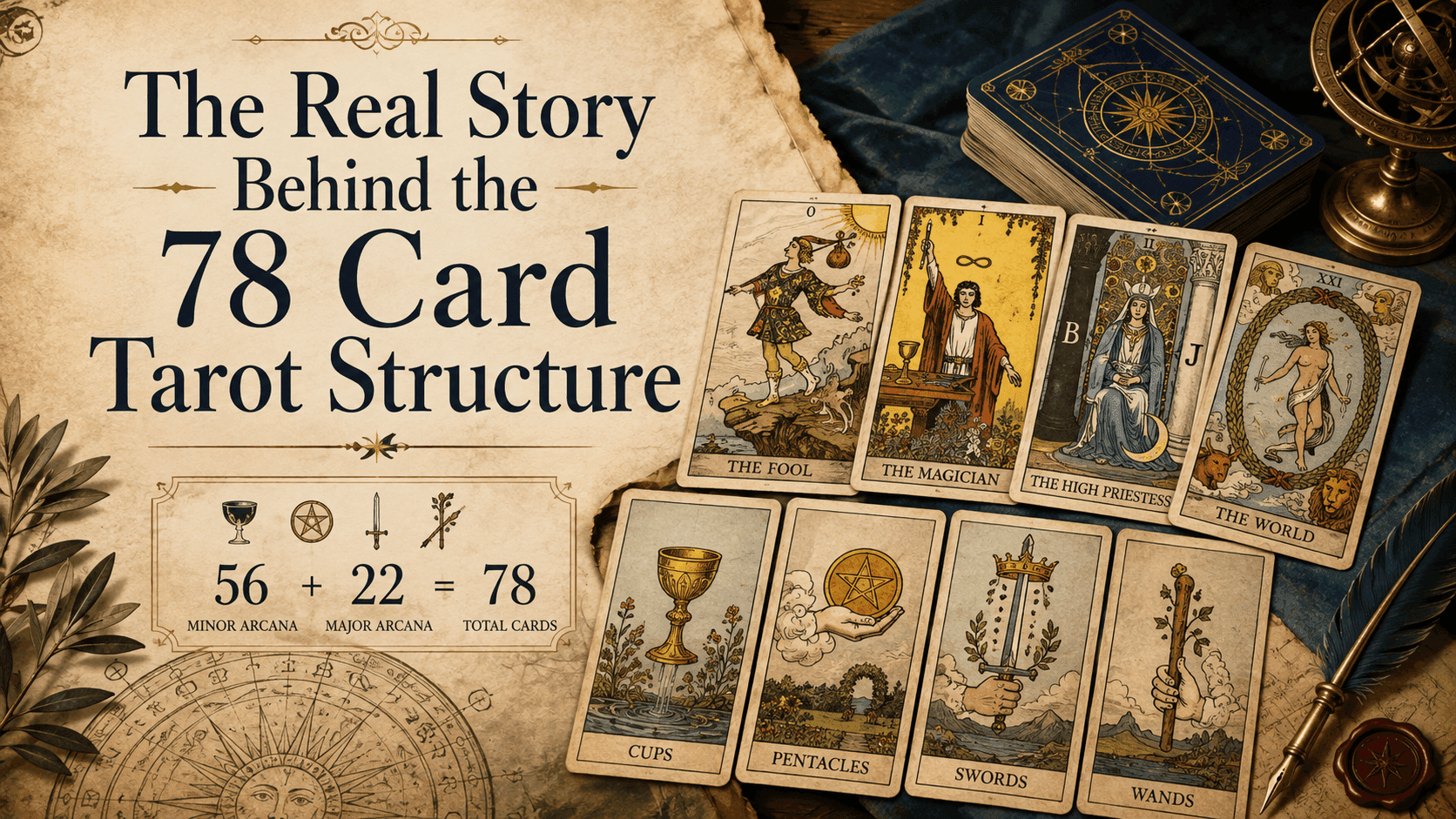
Now add structure to the daily pull. Spend day eight learning the shape of the deck: 22 majors, 56 minors, four suits of fourteen running ace through ten plus four court cards. That is the whole architecture, and it takes about four minutes.
Days 9 through 12 give one day each to a suit. Traditionally, in the correspondences formalized by the Golden Dawn in the late nineteenth century, wands go with drive and action, cups with feeling and relationship, swords with thought and conflict, pentacles with work and material life. Lay out all fourteen cards of one suit and look for what changes as the numbers climb. Days 13 and 14 do the same across suits: put the four fives side by side, then the four tens, and write what they have in common.
The payoff is immediate. After this week, "eight of cups" tells you minor arcana, emotional territory, late in the sequence, before you have looked at the picture at all.
Week three, days 15 to 21: the majors, three or four a day
Nine days of the month go to 22 cards, which sounds thin until you notice you are meeting them in your daily pull all along. Take three or four a day in numerical order, from the Fool through the World.
One warning that saves confusion later. Waite numbered Strength as VIII and Justice as XI, while older Marseille decks have them the other way around. Neither is wrong and sources online rarely say which they are using, so when a card seems to contradict what you read, check the numbering before assuming you misunderstood.
Do resist the urge to write a keyword under each major. Write instead what the figure is doing and what you would ask them. The Hermit holding a lamp on a mountain suggests different questions than the Hermit as "introspection" ever will.
Week four, days 22 to 30: put cards next to each other
The last nine days move from single cards to relationships between them. Days 22 through 25, pull two cards and read the second as a comment on the first. Days 26 through 29, pull three in a row and read them as a sequence: what is set up, what complicates it, where it is heading. Day 30, do a three-card pull on something real and write a full page.
Imagine someone called Ben, on day 23, pulling for a week where he has been quietly dreading a conversation with his flatmate about money owed. Card one is the Four of Pentacles, a figure gripping his coins tightly. Card two is the Six of Cups, traditionally read as memory and old kindness.
Reading the second as a comment on the first, Ben notices the pairing is not telling him to ask or not ask. It is pointing at the tension between holding onto what is his and the history that makes asking feel ungrateful. What he would actually do differently is stop framing the conversation as a demand and name the awkwardness itself when he raises it. Notice that the cards did not decide anything about the money. They described the bind he was already in.
Where a 30 day tarot challenge usually breaks down
Around day 11 or 12, most people miss a day. Then they miss two. Then the challenge becomes a small failure sitting in a notebook, and the deck goes back in the box.
Here is the specific fix: when you miss days, do not double up and do not restart. Pick up on the next calendar day at the phase you were in, and mark the missed days in your notebook as skipped. A challenge you finish on day 38 with five gaps has taught you everything a clean 30 would have. A challenge you restart three times has taught you the first week four times.
The other common mistake is treating the lookup as the point. If you find yourself writing the book's keyword and nothing else, you have quietly turned a practice into a copying exercise. The rule that fixes it: your own sentence has to be longer than the one you copy.
Day 31 and after
The real outcome of a 30 day tarot challenge is not memorized meanings. It is that an unfamiliar card stops being a locked door, because you have a repeatable way to approach one. Meanings arrive on their own once you have met each card in the context of an actual Tuesday.
Do this today: pick your deck, check the four of cups has a scene in it, and pull your first card. Describe it in two sentences with no meanings in them, write one line about your day, and put tomorrow's pull in the same slot on your calendar. That is day one finished.