You finished the reading. Maybe the cards landed hard and you feel a little rattled, or maybe you are looking at three images that mean nothing to you yet. Either way, the question of what to do after a tarot reading gets far less attention than the reading itself, which is odd, because pulling the cards is the easy part.
This post walks through seven concrete moves for once the cards are down: how to record what you pulled, how to compress a spread into one usable sentence, how to test that sentence against things you already know, and how to handle a reading that refuses to make sense. By the end you will have a short routine that takes about fifteen minutes, plus one action small enough to actually finish this week.
1. Write down what you pulled before you tidy it up
Memory rewrites readings. Within an hour you will remember the interpretation you settled on rather than the cards that produced it, which makes the reading useless to you later. Spend two minutes capturing the raw material:
- The question you actually asked, in the words you used
- Each card, its position, and whether it came up reversed
- Your first reaction, before you looked anything up
That last one matters most. A note reading "Five of Pentacles, position: what I am avoiding, first thought: the dentist" will be worth more to you in six weeks than a polished paragraph about scarcity and exclusion. Do not record conclusions. Record observations, and save the meaning-making for the next step.
2. Compress the whole spread into one sentence
A reading you cannot say out loud in one breath is a reading you will not act on. Before anything else, force the spread into a single sentence, even a clumsy one.
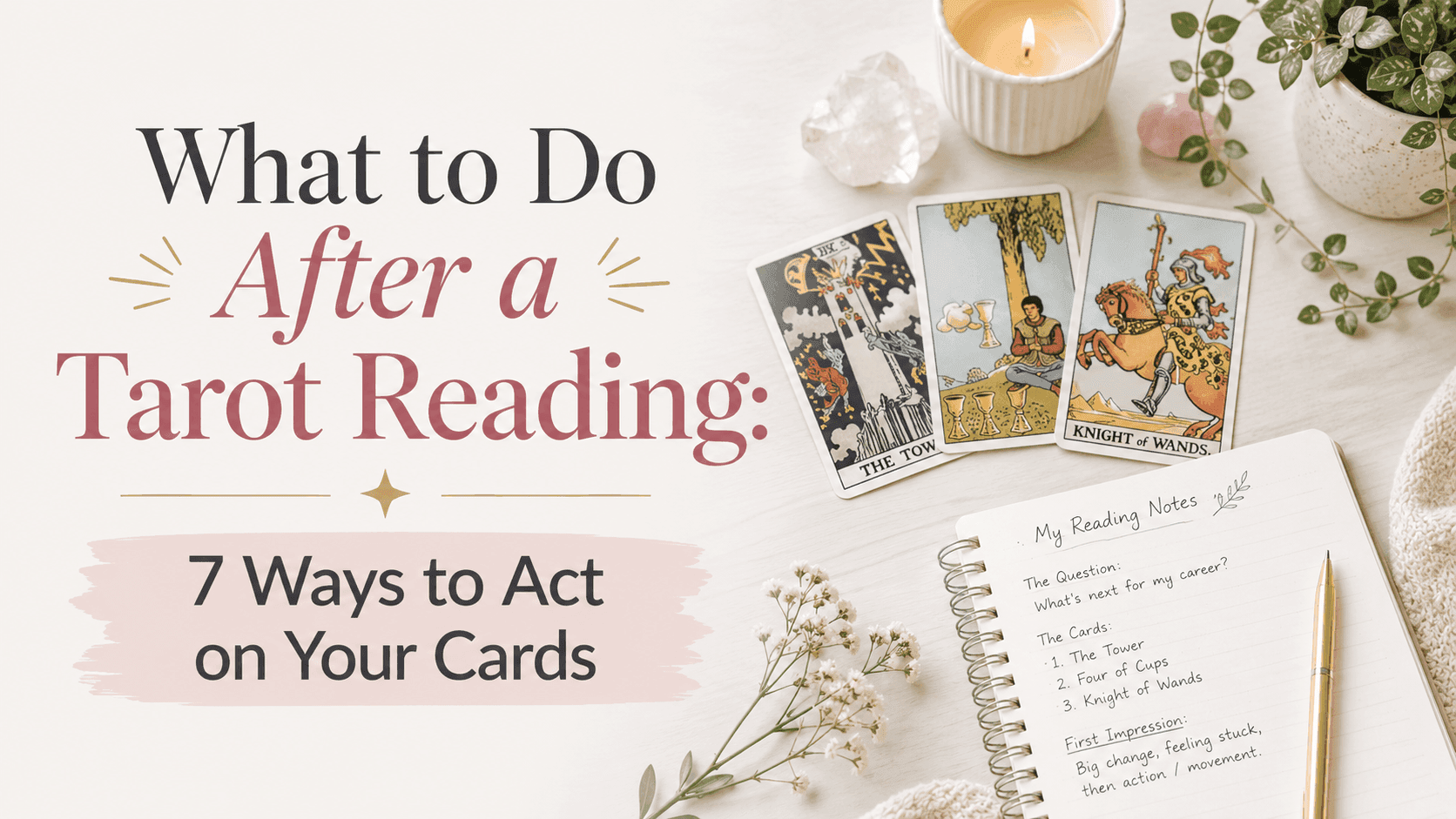
Say you pulled The Tower, the Four of Cups and the Knight of Wands for a loose question about work. The temptation is to write a paragraph on each card. The more useful move is something like: "Something I have been bored by is ending faster than I planned for, and I want to jump straight into whatever is next." That sentence is arguable. You can test it, disagree with it, or notice yourself flinching at it, none of which you can do with three separate card essays.
Do not try to honor every card. A spread is not a checklist, and a reading that only uses two of your five cards is still a reading.
3. Ask the question the cards cannot answer
Tarot works as a mirror for what you already know and have not looked at directly, so the useful follow-up is nearly always about facts rather than symbols. Three questions that work on almost any reading:
- What do I already know that this sentence would explain?
- What would I need to find out to know whether it is true?
- Who could tell me, and have I been avoiding asking them?
Run the work example through those. You already know you have not opened your project tracker in nine days. You could find out whether anyone else has noticed by asking your manager when the next review cycle lands. You have been dodging that conversation since spring. None of that came from The Tower. The reading just made it harder to keep not looking.
4. Pick one action you can finish in 48 hours
Readings fail at the action step far more often than at the interpretation step. Cards tend to suggest enormous things, like leaving, forgiving, or starting over, and enormous suggestions produce nothing. Cut yours down until it fits inside two days and one calendar slot.
Imagine Dan, six weeks into a new job and quietly miserable. He pulls three cards on a Sunday night and gets to a one sentence version: "I am treating a normal adjustment period as proof that I made a mistake." The large action would be to start job hunting again. The 48 hour action he picks instead is smaller: before Wednesday, write down three specific things that have gone badly, and mark each one as either a fixable process problem or a real mismatch. He does it on Tuesday over lunch. Two turn out to be onboarding gaps that one conversation could close. The third is a genuine mismatch about how much client contact the role involves, and it is worth raising with his manager. The reading never told him whether to stay. It got him to break a vague feeling into parts he could do something about, which he had been putting off for a month and a half.
5. Put the deck away and set a date to check back
The most common beginner mistake happens in the ten minutes after an uncomfortable reading: you shuffle and pull again, hoping for something gentler. The second reading almost always feels softer, and it is worth being honest that this is because you are now reading with a preferred answer in mind, not because new information arrived.
So close the deck and put a check-in date somewhere you will see it. Match the date to the timescale of the question. If you asked about a decision you will make at the end of the month, check back at the end of the month, not tomorrow morning. When you do return, read your original note first and your memory second.
6. Keep a log so patterns can surface
One reading tells you about a mood. Thirty readings tell you about a pattern, and patterns are where the practice stops being entertainment. Keep it minimal: date, card or cards, one line of context, one line about what actually happened. A phone note is fine.
This is where a daily one card pull earns its place. It costs a minute, and after a month you have a record dense enough to notice something a single spread could never show you, like the fact that the Eight of Swords turns up almost exclusively on Sunday evenings, or that you read the Devil very differently depending on how much you have slept.
7. What to do after a tarot reading that made no sense
Sometimes a card just sits there. That is normal, and it is not a sign that you are bad at this.
Two things help. First, describe the picture before you reach for a meaning: who is in it, where they are looking, what they are holding. Description often unsticks a card that definitions could not. Second, accept that the sources disagree with each other. Waite's 1911 guide to his deck offers short divinatory meanings that can read oddly against the pictures on the same cards, the Marseille tradition works with number and suit rather than illustrated scenes on the pip cards, and plenty of contemporary readers skip reversals altogether. There is no single correct key you are failing to find.
Do not force a meaning just to make the spread tidy. Do write "no idea" beside that card in your notes, then reread the note in a month. Cards that were opaque on the day are frequently obvious in hindsight.
Conclusion
Knowing what to do after a tarot reading is what keeps the cards from becoming a mood you had on a Tuesday. Record it, compress it to one sentence, test that sentence against facts, act small, then wait. Most of that takes fifteen minutes.
Do this today: take your most recent reading, whether it was an hour ago or last spring, and write the one sentence version of it. Then choose the smallest thing that sentence implies, something you could finish before Thursday, and put it in your calendar with a time attached to it.