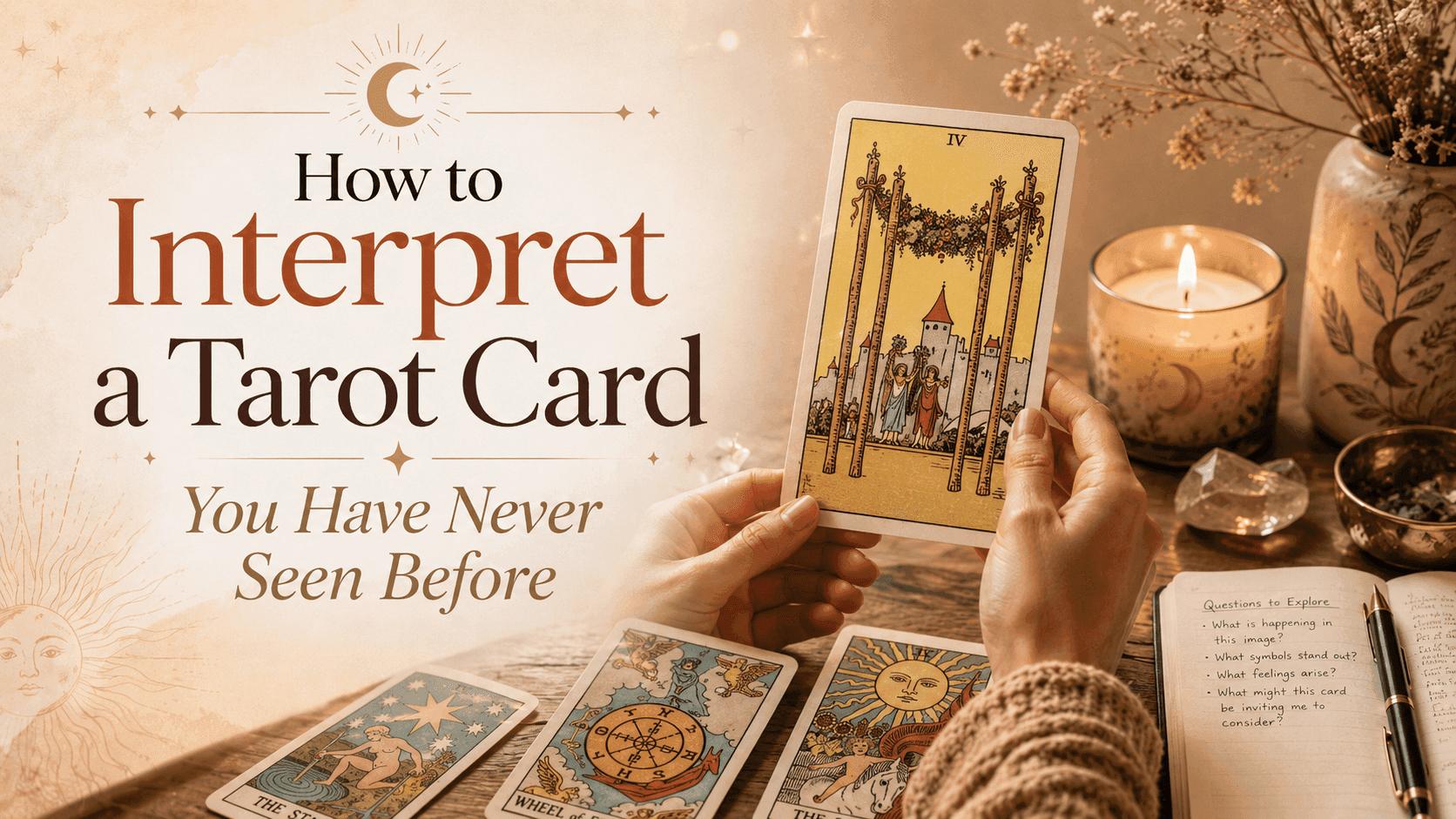
You've got one deck, you're starting to get somewhere with it, and then you see a Marseille deck where the Five of Coins is just five coins on a blank field, or a Thoth deck where Strength is called Lust and sits at a different number entirely. Suddenly it's unclear whether you've been learning tarot or learning one deck.
If you've been trying to sort out rider waite vs thoth vs marseille before spending money on a second deck, this post gives you the structural differences that actually change how you read: what the minor arcana look like, where the numbering diverges, and what each system expects you to bring to the table. By the end you'll know which one suits how you like to think, and whether adding a second deck now would help you or slow you down.
The One Difference That Matters Most
Before any talk of art style or philosophy, there's a single structural fact that determines the daily experience of using a deck: whether the pip cards are illustrated.
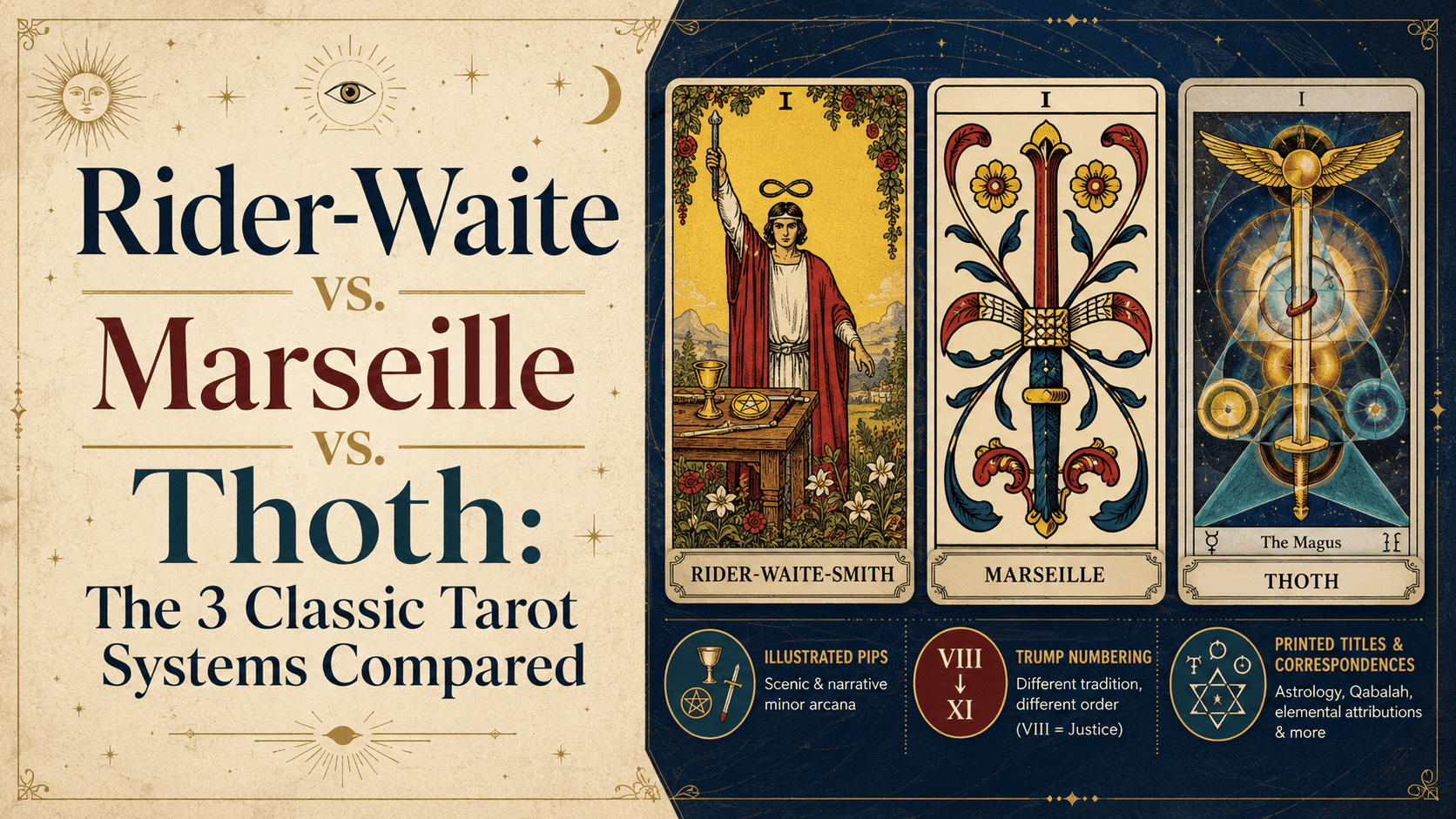
Pips are the numbered minor arcana: ace through ten in each of the four suits, 40 of the 78 cards. In a Marseille deck they're arrangements of suit symbols, closer to a modern playing-card deck than to a picture book. Six coins means six coins in a pattern. In a Rider-Waite-Smith deck, every one of those 40 cards shows a scene with people doing something. Thoth splits the difference: the pips are abstract geometric compositions, but each carries a printed title and astrological attribution.
That one choice cascades into everything else. Illustrated pips let you read a card by asking what's happening in the picture. Non-illustrated pips require you to read number and suit together and to lean on the cards around them. Neither is harder in some absolute sense, but they train different reflexes, and switching between them mid-learning is the fastest way to feel like you've forgotten everything.
Tarot de Marseille: The Oldest Standard Pattern
The Marseille pattern took recognisable form in France and Switzerland during the seventeenth and eighteenth centuries, printed from woodblocks and coloured through stencils. Nicolas Conver's 1760 deck, made in Marseille, is among the most reproduced; the name "Tarot de Marseille" itself was popularised much later, in the twentieth century. These were game decks first (the trick-taking game is still played in France today), and divinatory use grew up alongside that rather than replacing it.
A few concrete features you'll notice immediately. The trumps are titled in French, and Le Mat, the Fool, carries no number. In many Marseille decks, card XIII has no title printed on it at all. Justice sits at VIII and La Force at XI, the reverse of what most modern readers are used to.
The practical do: when you draw a Marseille pip, read the suit for the domain of life it points at, the number for the shape of the situation, and the neighbouring cards for direction. The don't: don't import a Rider-Waite scene onto it. The Marseille Five of Coins isn't a picture of two figures in the snow, and reading it as though it were means you're using one deck's imagery as a decoder ring for another's.
Rider-Waite-Smith: The Deck That Made Pictures Do the Work
Published in 1909 by William Rider & Son, conceived by A. E. Waite and illustrated by Pamela Colman Smith, both members of the Hermetic Order of the Golden Dawn. Waite's companion book, The Pictorial Key to the Tarot, followed in 1911.
Its enduring contribution is the illustrated minor arcana. Smith gave all 40 pips narrative scenes, which made the deck learnable without a memorised system of correspondences. You can look at the Eight of Cups and get something from it on day one. Scenic pips weren't unprecedented; the late-fifteenth-century Sola Busca deck had them, and photographs of it that reached the British Museum in 1907 are widely accepted as an influence on Smith's designs, with a few cards showing clear echoes.
Waite also renumbered two trumps, giving Strength the number VIII and Justice XI, following Golden Dawn astrological reasoning. This trips up beginners constantly: people open a Marseille deck, find Justice at VIII, and assume they've bought a faulty one. Neither numbering is a mistake. They're different conventions, and both are old.
Thoth: A Deck That Shows You Its Own Framework
Aleister Crowley designed the Thoth deck with Lady Frieda Harris painting it, roughly between 1938 and 1943. Crowley's The Book of Thoth appeared in 1944, but the deck itself wasn't published until 1969, after both of them had died.
What distinguishes it structurally isn't the art, striking as Harris's work is. It's how much is printed on the cards. Astrological and kabbalistic attributions appear directly on the faces, and every pip carries a title: the Ten of Swords is labelled Ruin, the Nine of Cups Happiness. That's a starting interpretation handed to you rather than derived from a scene.
Several trumps are renamed: Justice becomes Adjustment, Strength becomes Lust, Temperance becomes Art, Judgement becomes The Aeon, and The World becomes The Universe. The court cards are Knight, Queen, Prince and Princess rather than King, Queen, Knight and Page. Crowley kept the Golden Dawn ordering Waite used, so Lust sits at VIII and Adjustment at XI.
The trade-off is honest: Thoth gives you more information per card and expects more framework in return. Read it without any of the underlying system and you're taking the titles on faith.
Rider Waite vs Thoth vs Marseille: The Same Draw, Three Ways
Say the card is the Five of Coins, or its equivalent in each system.
In Rider-Waite-Smith you get a scene (two figures outside a lit window), and the reading starts from what's depicted and who's in it. In Marseille you get five coins in a pattern, so you build from the suit's territory of tangible, practical concerns and the number five's traditional flavour of instability or disruption, then check what it's sitting next to. In Thoth the equivalent card is titled Worry and carries an astrological attribution, so you begin from the label and work outward.
None of those is a forecast about anyone's finances. Tarot isn't doing that here, in any of the three systems. What differs is where your interpretation starts: with an image, with a structure, or with a stated theme.
The common mistake worth naming: treating Thoth as "advanced Rider-Waite" and Marseille as "Rider-Waite with the pictures missing." They're not tiers of difficulty. They're three complete systems that solved the same problem in different decades with different assumptions.
Which Should You Actually Start With?
Imagine Nadia, four months into a daily one-card practice with a standard Rider-Waite-Smith deck. She's curious about Marseille and buys one, planning to alternate.
What she notices in week one is that her fluency evaporates. She draws the Seven of Batons, reaches for the scene she knows, and finds seven staves crossed on a plain background. Her honest options are to guess or to look it up, and looking it up in a Marseille context means learning a different reading method, not a different keyword list.
What works better for her is committing the daily draw to one deck for a stretch and using the second deck deliberately: once a week, she draws the same card she pulled that morning from the Marseille deck and writes down what she'd say about it from number and suit alone. The comparison teaches her something the alternating approach never would, which is how much of her reading was coming from Smith's illustrations rather than from the card itself.
The general principle: a second system is a study tool, not a rotation. Add it when your first one is steady enough to notice the difference.
The Takeaway
The choice between rider waite vs thoth vs marseille is really a choice about where you want interpretation to begin: in a picture, in a structure, or in a stated theme. All three are legitimate, all three are old enough to have deep traditions behind them, and none of them makes tarot more accurate, because what tarot offers is a prompt for reflection rather than a readout.
Today: pull one card from whatever deck you own and write two sentences about it without opening any book. If those sentences lean entirely on what the picture shows, you've just learned something useful about which system you've actually been studying.