You sit down with the deck, you have a whole situation churning in your head, and then you go blank. Or worse, you ask "will it work out?" and pull a card that tells you nothing you can use. The question does more work than beginners expect, and a vague one produces a vague reading no matter how well you know the cards.
This post gives you 50 good questions to ask tarot cards, grouped by what you are actually dealing with: your day, yourself, your relationships, your work, a decision you keep circling, and the harder stuff. It also covers the four kinds of questions that reliably fall flat, how to rewrite a shapeless worry into something a card can answer, and what to do when the card seems to ignore you.
What separates a question worth pulling for from one that wastes the card
A useful tarot question puts you inside the situation rather than outside it watching. Compare "Will he text me back?" with "What am I hoping his text will settle?" The first has one of two answers, neither of which changes what you do next. The second gives a card something to respond to, and whatever you pull, you learn something about your own position.
The pattern holds across topics. "Should I quit?" becomes "What is the real cost of staying another six months?" "Am I on the right path?" becomes "What am I ignoring about the path I am already on?"
The tradition itself is thin on question craft. Waite's 1911 Pictorial Key to the Tarot gives almost all its length to card meanings and only a short passage to how a reading is conducted, and framing tarot as reflection rather than prediction is largely a twentieth-century development. There is no ancient rule here, just the practical fact that specific, self-directed questions give you more to work with.
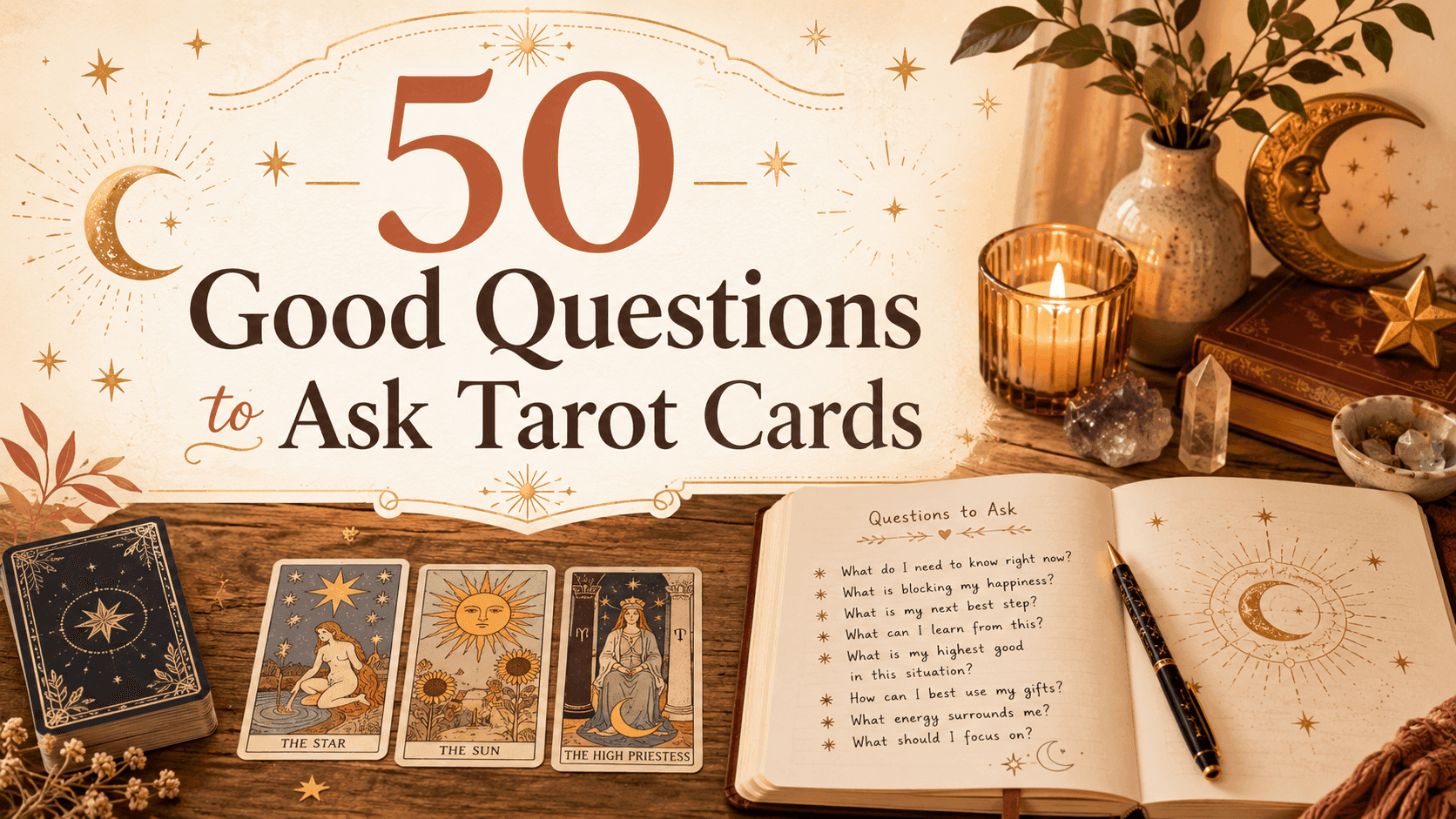
50 good questions to ask tarot cards
Take these as starting points, not scripts. Swap in the names and timeframes of your own situation, because "What does this friendship need from me right now?" works better when you are picturing an actual person. Do not pull for more than a few in one sitting, and do pick the one that made you slightly uncomfortable to read.
Daily check-in questions
- What do I most need to be aware of today?
- Where is my energy best spent this morning?
- What am I avoiding right now?
- What would make today feel like a good day, specifically?
- What mood am I carrying into this week, and where did it come from?
- What is the smallest useful thing I could do today?
- What am I taking more seriously than it deserves?
- What deserves more attention than I am giving it?
Questions about yourself
- What story am I telling myself about this situation?
- Which part of me is driving this decision?
- Which of my habits is quietly costing me the most?
- What do I want that I have not admitted out loud?
- Where am I performing instead of participating?
- What did I learn the last time this happened?
- What am I afraid people would think if I changed my mind?
- What does rest actually look like for me?
- What am I good at that I keep discounting?
Questions about relationships
- What am I bringing to this relationship that I have not noticed?
- What am I hoping this person will do that I could do for myself?
- What is unsaid between us, and what is my part in that?
- How do I want to show up in this conversation?
- What am I tolerating that I would tell a friend not to tolerate?
- What does this friendship need from me right now?
- Where am I confusing intensity with closeness?
- What boundary am I hoping someone else will set for me?
- What would kindness look like here that does not cost me myself?
Questions about work and direction
- What is actually draining me at work: the tasks, the people, or the pace?
- What skill am I ignoring because it comes easily to me?
- What am I hoping a new job would fix?
- Where am I mistaking busyness for progress?
- What would I work on this year if no one were watching?
- What feedback have I received twice and dismissed twice?
- What does ambition mean to me now, not five years ago?
- What is the cost of staying exactly where I am?
Questions when you are stuck on a decision
- What am I not letting myself consider?
- What would change if I stopped waiting to feel certain?
- What is the difference between the fear and the actual risk here?
- What information am I missing, and who has it?
- What would the version of me who already decided say?
- What am I getting out of staying undecided?
- If both options are survivable, what is the real question?
- What would I need to see to feel ready?
Harder questions for when you are ready
- What pattern keeps returning, and what does it keep asking of me?
- Where am I still arguing with something that already happened?
- What would forgiving myself here actually require?
- What am I proud of that I have not let myself count?
- Where do I confuse control with care?
- What am I outgrowing?
- What do I keep asking the cards about, and what does that repetition tell me?
- What is the kindest true thing I can tell myself today?
Four question types to rewrite before you shuffle
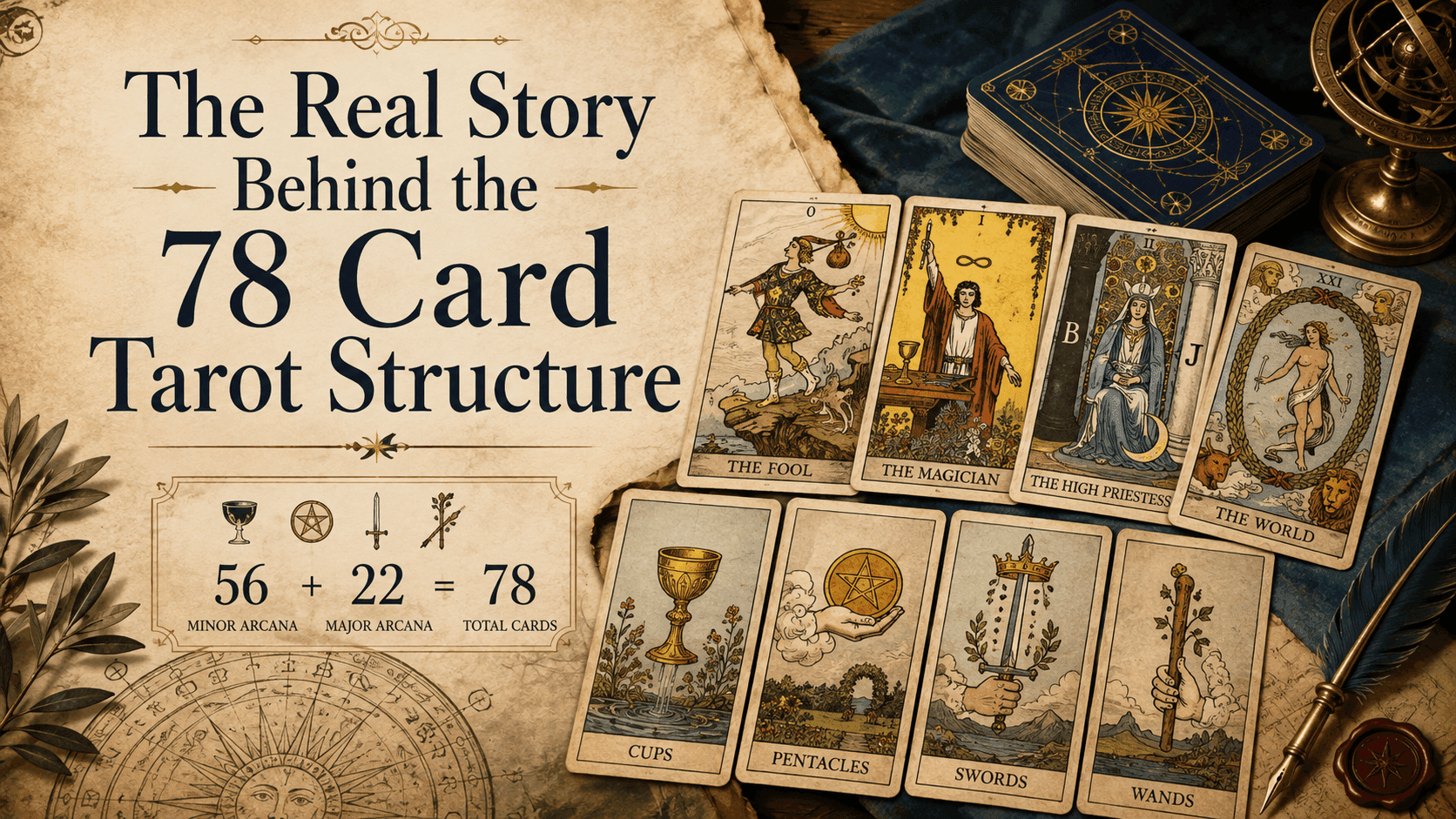
The first is the yes or no question. "Will I get the job?" collapses a 78 card deck into a coin flip, and you end up squinting at the Two of Cups deciding whether it counts as a yes. Ask instead what you want the outcome to give you, or how you will handle either result.
The second is the question about someone else's inner life. "Does she regret it?" is not answerable, and treating a card as evidence about another person's feelings makes you more certain and less curious at once. Turn it toward your side: "What would I do differently if I knew she regretted it?"
The third is the question you have already answered. This is where beginners most often go wrong, and it looks like re-asking: you pull a card, dislike it, reshuffle, and repeat until something agreeable turns up. If you catch yourself doing that, the honest question is "What am I hoping the cards will give me permission to do?"
The fourth is the question tarot has no business answering: a diagnosis, a pregnancy, a court case, a debt, a bet. A card cannot tell you whether the lump is serious, and treating it as though it can may delay a call to someone who genuinely can help. Ask the doctor, the lawyer, the accountant. You can still bring the deck the surrounding feeling: "What am I most afraid of hearing, and what would I need to get through it?"
How to turn a vague worry into a question you can pull for
Say the worry out loud in its messiest form, then find the verb hiding in it. "I feel weird about my job" has a feeling but no action, so keep going until you reach something you could do or decide this week.
Imagine someone called Priya, six months into a role she took for the money. Her first question is "Should I stay?" She notices it is a yes or no question and tries again: "What is actually draining me at work: the tasks, the people, or the pace?" She pulls the Eight of Pentacles, traditionally a card of steady, repetitive craft. It is not a verdict, it is a lens, and sitting with it she realizes the work is fine and the pace is fine, but she has done the same task for six months with no sign of it leading anywhere. That is a much smaller problem than "should I quit," and it has an obvious next move: a conversation with her manager about what comes after this project.
This is the honest case for the daily one card pull: asking one small question every morning teaches you what a card feels like when it lands, and what it feels like when you are forcing it.
When the card does not seem to answer your question
Before you reshuffle, try three passes. Read the card literally: what is happening in the image? Read it as a reframe: what slightly different question might it be answering? Read it as the thing you did not want to hear.
If none of that lands, write the question and the card in a notebook and leave it. That notebook is what people actually mean by "trust your intuition," which is useless as advice on its own. You build a record, notice which readings looked wrong on the day and obvious three weeks later, and start telling a card that is not speaking from one you are not ready to hear.
The one thing to take away
Good questions to ask tarot cards keep you in the driver's seat: specific, about your own choices, open enough that any of the 78 cards could give a real answer. The deck is a mirror with a large vocabulary, not an oracle with a schedule.
Today, pick one question from the list above that you slightly do not want to answer, write it at the top of a page, pull a single card, and write three sentences about what the image is doing before you look up any meaning. That last part is the difference between reading a card and reciting one.