Somebody told you not to, or you read it in a forum thread, or you tried it and got an answer that felt suspiciously like the one you wanted. Meanwhile your deck is sitting right there and the thing you want clarity on is your own life, not a stranger's.
So can you read tarot for yourself? Yes, and the useful part of the answer is that it is harder in specific, nameable ways you can design around. This post covers where the rule against it comes from, the three ways self-readings actually go wrong, how to phrase a question that cannot flatter you, and a set of rules that keep you honest. By the end you will have a method you can run today, plus a clear sense of when to close the deck and talk to a person instead.
Can you read tarot for yourself? Where the rule against it came from
This is folk wisdom, not doctrine. It gets passed reader to reader, and readers disagree about it openly: plenty read for themselves daily and consider it the core of their practice, while others will only read for other people and go to a colleague when they want a reading of their own.
The rule is worth taking seriously anyway, because it is pointing at something real. It is just pointing at it badly. The problem was never that the cards behave differently when you are the subject. It is that you are the only person in the room, and you already have a preferred answer.
Compare the two situations honestly. When someone reads for you, they do not know which answer you are hoping for, they have no stake in your comfort, and they will say the awkward thing about the Four of Cups without softening it. Reading for yourself, you lose all three of those. Nothing mystical has changed. The quality control has just left the building.
The three ways self-readings actually go wrong
The failure modes are specific enough to name, which means they are specific enough to catch.
Motivated interpretation. Every card carries a range of meanings, and you will reach for the one that suits you. The Three of Swords can be grief, or it can be a clean and necessary cut. Which one you pick when you are hurting is not a neutral choice.
The re-pull. You get an answer you dislike, decide you shuffled badly or asked wrong, and pull again. The second answer is always gentler, because you are now reading with a target in mind.
The unanswerable question. You ask "what should I do about my sister" with no sense of what a useful answer would even look like, then feel let down when three cards fail to produce a plan.
The common beginner mistake sits underneath all three: treating the reading as a verdict to receive rather than a prompt to argue with. If a card can only be right, you have built a machine that agrees with you. The whole value of a self-reading is in the friction, so protect the friction.
Ask a question that cannot flatter you
Most bad self-readings are bad before the cards come out. A vague question lets you accept any answer; a yes-or-no question about the future asks tarot to do something it cannot do. What works is a question about your own position, framed so the answer might be unwelcome.
Rewrite yours along these lines:
- "Will he text me back?" becomes "What am I doing while I wait, and what is it costing me?"
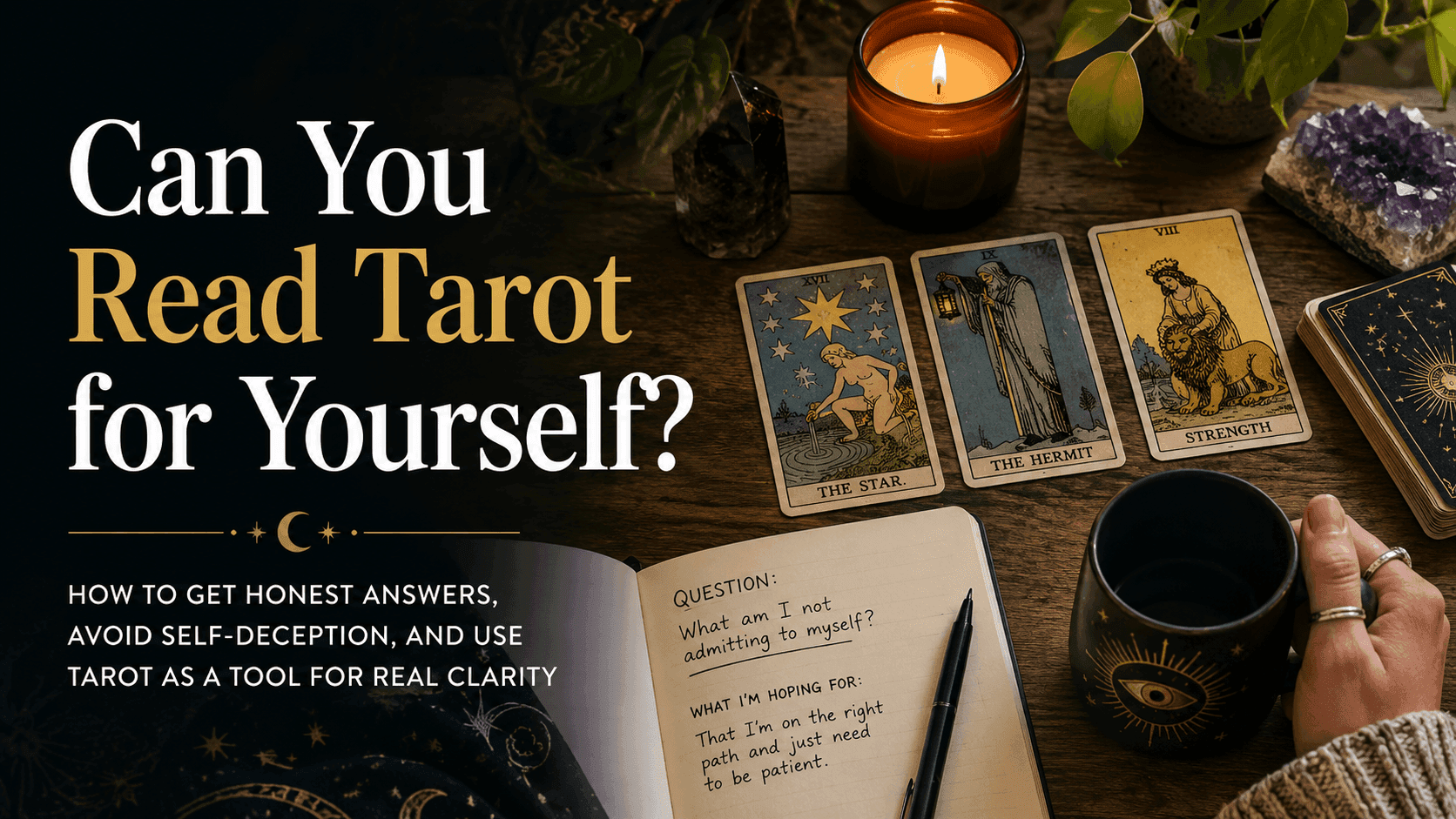
- "Should I take the job?" becomes "What am I not admitting about my current role?"
- "Will this work out?" becomes "What am I assuming here that I have not checked?"
- "What does the future hold for me?" becomes "What have I been avoiding looking at this month?"
Notice the pattern. Each rewrite points the question back at you and leaves room for an answer you would rather not hear. That is the test. If your question has no unwelcome possible answer, rewrite it again.
Build in friction so the cards can disagree with you
Here is a method that puts the guardrails in before your feelings arrive.
Write the question down first, in full, and write one line underneath it: the answer you are secretly hoping for. This takes fifteen seconds and does most of the work, because a bias you have named in writing is much harder to act out.
Then decide the spread size and the rules before you shuffle. One card or three, reversals or no reversals, and one pull only. Set the deck down when you are done.
Read the cards literally before you interpret them. Describe what is in the picture, out loud if you can, and only then reach for meaning. Where a card has two plausible readings, write down both. Do not resolve the ambiguity in the moment, because that is exactly where motivated interpretation lives.
Finish by writing one sentence you would not have written yesterday, then one small thing you will do about it this week. If you cannot produce that sentence, the honest note is "nothing landed," and that is a legitimate outcome.
Imagine Priya, hypothetically, three months into a flatshare that has started to grate. Her first instinct is to ask whether she should move out. She rewrites it as "What am I not saying to Nadia?" and writes underneath it: "I am hoping the cards tell me she is the problem." She pulls one card, the Seven of Swords, and describes it literally: a figure carrying off an armful of swords, glancing back, leaving some behind. Her first read is the obvious one, that Nadia is being sly about something. But she has committed to writing both readings, so she also writes the version where she is the figure in the picture: taking what she wants quietly, avoiding the confrontation, telling other people instead of Nadia. The second reading is the one she has been dodging for weeks. Her action for the week is a specific one, raising the kitchen thing directly, before the end of Sunday.
Practising on low-stakes days is what makes this possible on high-stakes ones. A daily one-card pull about something ordinary teaches you your own tells, so that when a real question comes along you already know what it feels like when you are steering.
What self-readings are genuinely good for, and what they are not
Self-readings work well as a structured way to notice what you already half-know. The cards give you an image you did not choose, which interrupts the loop of thinking you have been running all week. That interruption is the actual mechanism, and it is a real one.
They do not work as a source of information you do not have. Tarot cannot tell you what someone else is thinking, how a diagnosis will go, whether a case will settle, or what a market will do. It has no access to any of that, and treating it as though it does turns a reflection tool into a way of outsourcing decisions you need to make with real evidence.
So do use a self-reading to surface the question you have been avoiding. Do not use one to settle a decision that hinges on facts you could go and find out. And when the topic is your health, your money, your legal situation or your safety, the reading is not a substitute for the appropriate professional. It can, at most, clarify what you want to ask them.
Conclusion
You can read tarot for yourself, provided you accept that the difficulty is not spiritual but ordinary: you know what you want the answer to be. Everything above is a way of building that admission into the process rather than pretending it away.
Do this today. Take whatever is nagging at you, rewrite it as a question about your own position, and write one line underneath naming the answer you are hoping for. Then pull a single card, describe what is literally in the picture before you interpret anything, and write down both readings if two are plausible. Ten minutes, one card, no re-pull.