You pull a card, look at it, and recognize nothing. Some stranger is walking away from a row of cups, or sitting up in bed with their head in their hands, and you have no idea what it is supposed to mean. So you reach for the little white booklet, read a line like "disappointment, moving on," and the reading goes flat before it starts.
This post is about how to interpret tarot cards when you do not know them yet, using the picture in front of you instead of a memorized definition. You will get a five-step method you can run on any unfamiliar card in about three minutes, a full worked walkthrough of one card, and a clear idea of when to open the guidebook and what to do with what it says.
Start by describing, not interpreting
The single most useful habit here is separating what you see from what you think it means. Beginners collapse those two steps instantly, which is why an unfamiliar card feels like a locked door: you are trying to produce a meaning before you have actually looked at the thing.
So describe it out loud or on paper, in the plainest language you can manage, as if to someone on the phone who cannot see it. Not "this card is about loss." Instead: "A person in a red cloak is walking away from me, uphill, toward mountains. Eight cups are stacked behind him with a gap in the row. There is water. The sky is dim."
Do keep the description free of judgment words. Do not write "abandoned" or "sad" yet, because those are conclusions wearing the costume of observation. The description takes maybe forty seconds and it is what everything else is built on.
Locate the card in the deck's structure
Now use what the deck tells you before any book does. Every card carries three pieces of information on its face: whether it belongs to the major or minor arcana, which suit it is in, and its number or court rank.
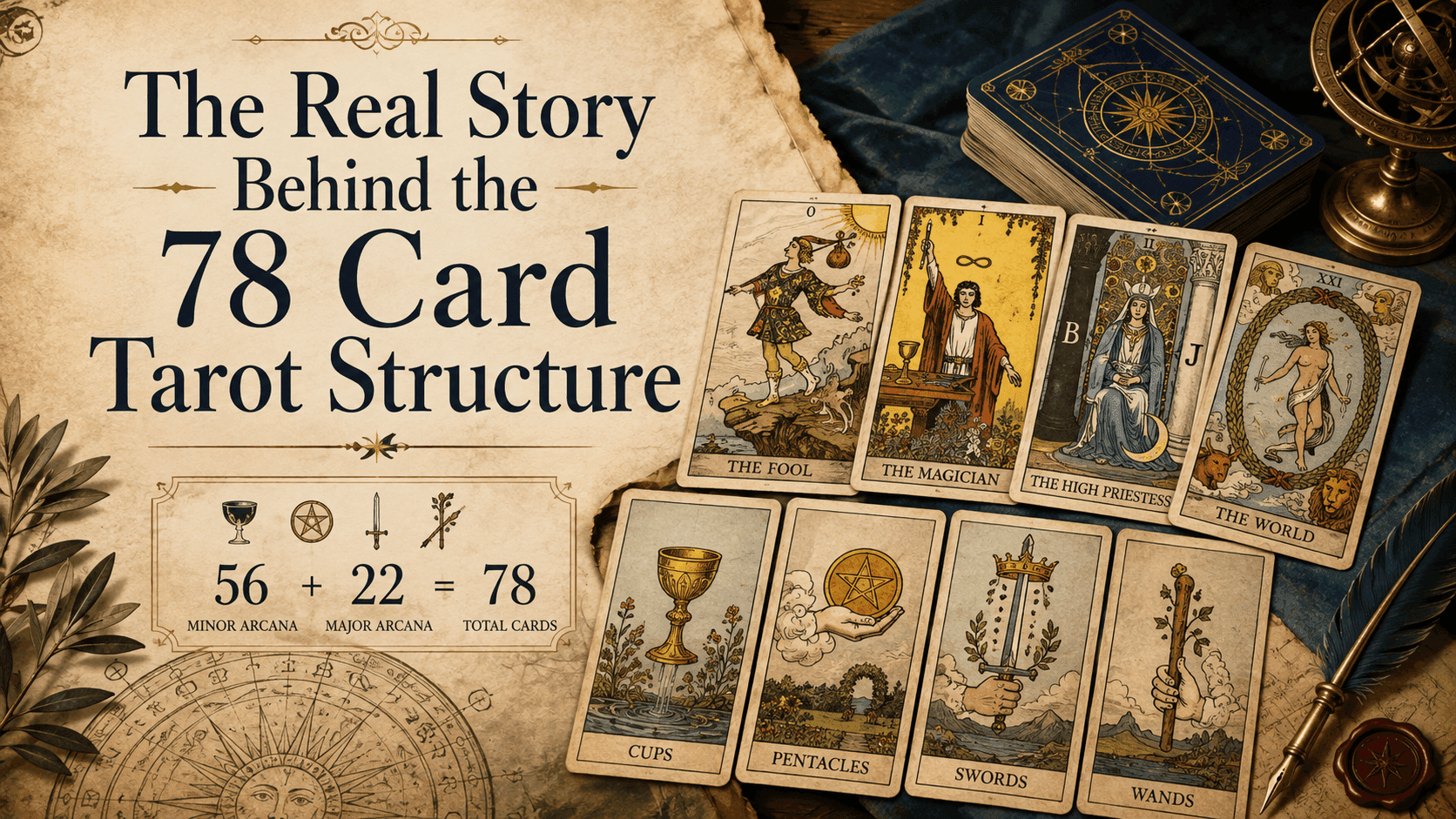
Majors are the 22 named and Roman-numbered cards, and traditionally they point at larger themes and turning points. Minors, the other 56, sit closer to daily texture. If you pull an unfamiliar major, you are probably looking at the weather of your situation. An unfamiliar minor is more likely describing the specific room you are standing in.
Suit gives you the arena. Traditionally, and this pairing was formalized in the late nineteenth century by the Golden Dawn, wands go with drive and action, cups with feeling and relationship, swords with thought and conflict, pentacles with body, work, and material life. Numbers give you the stage: aces as openings, fives as friction, tens as the extreme end of whatever the suit does. Court cards are usually read as a way of behaving rather than an event.
Here is the useful part. Before you know a single card meaning, "eight of cups" already tells you: minor, emotional territory, well past the middle of the sequence. Pair that with your description and you have a real hypothesis.
How to interpret tarot cards from the picture alone
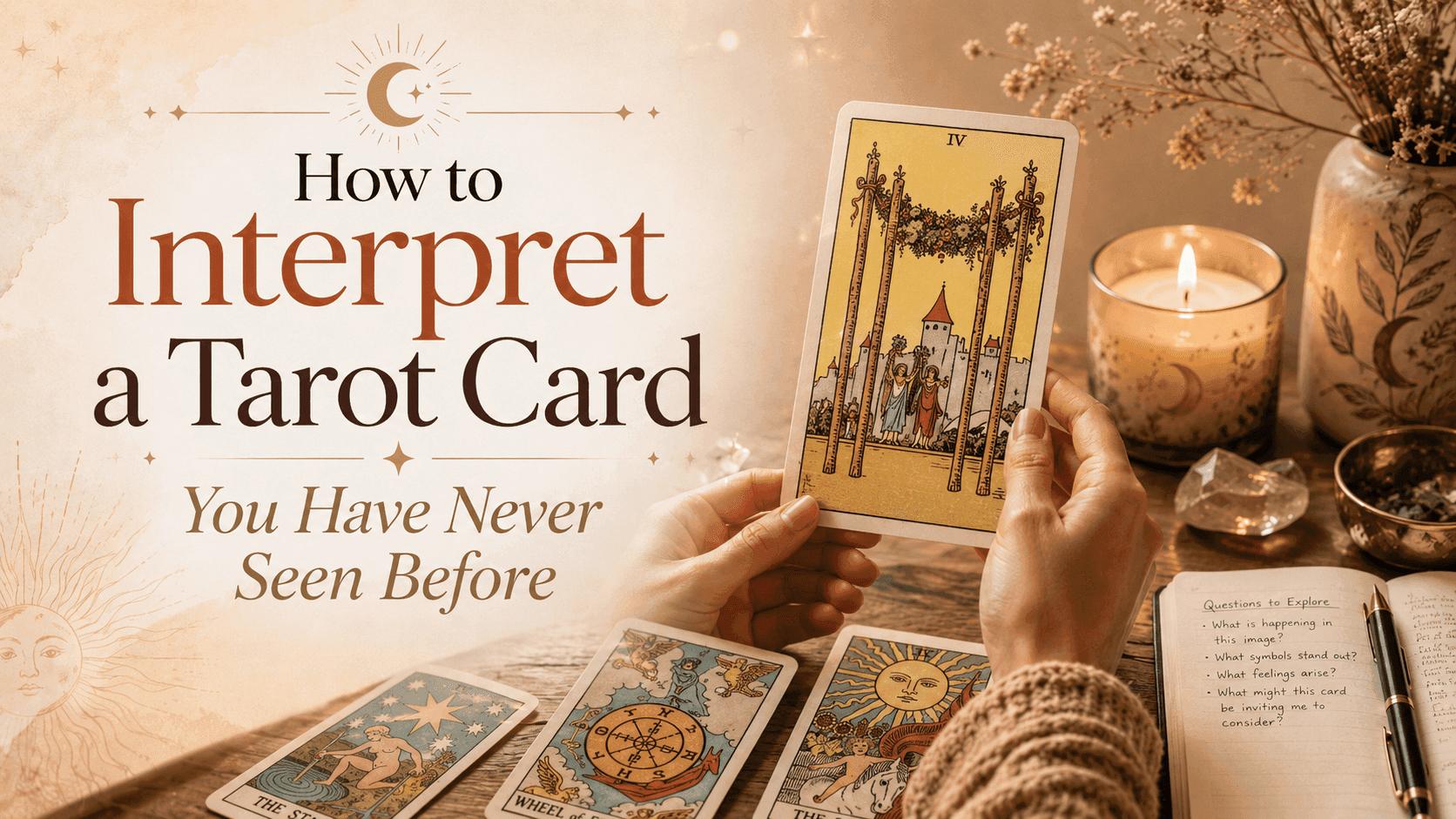
With the description and the structure in hand, work through five questions in order. This is the whole method.
- Who is in the card, and what are they doing with their body? Standing, turning, hiding, holding, walking away. Posture is the fastest read in tarot imagery.
- Where are they looking, and what are they not looking at? Gaze direction is doing a lot of work in most illustrated decks.
- What is the relationship between the figure and the suit objects? Are the cups being held, ignored, spilled, stacked, offered?
- What is the setting doing? Weather, time of day, water, walls, distance. Setting usually tells you the emotional temperature.
- What is happening just outside this moment? Every card is a freeze frame. Ask what happened a minute before and what happens a minute after.
Run that on the card described above. A man walks uphill and away, so the body says departure, deliberately and under his own power rather than fleeing. He is not looking back at the cups. His relationship to the suit objects is that he has arranged them carefully and left them anyway, and the gap in the stack suggests something is missing from an otherwise decent arrangement. The setting is dim and the terrain is hard. A minute before, he decided. A minute after, he is further up the hill.
That reading arrives at something close to what tradition says about the Eight of Cups, which is roughly walking away from something that is fine but not enough. You got there without memorizing anything.
Then open the book, and pay attention to the gap
Once you have your own reading, look the card up. Reading tradition after your own attempt rather than before is the difference between studying and being told.
The interesting information is where your reading and the book disagree. Sometimes the book has context you could not see, since a lot of standard meanings come from systems layered onto the images rather than from the pictures themselves. Sometimes your reading caught something specific to your situation that no general meaning could contain, and that is worth keeping.
Also worth knowing: not every deck is built to be read this way. The Rider-Waite-Smith deck of 1909, illustrated by Pamela Colman Smith, gave the minor arcana full narrative scenes, which is exactly why the picture-first approach works so well on it and on the many decks that followed its structure. In the older Marseille tradition the minors are not scenic at all, just arranged suit symbols, so readers there work primarily from number and suit. Even the numbering differs. Waite placed Strength at VIII and Justice at XI, while Marseille decks have them the other way around. If a card seems to contradict what you read online, check which tradition the source was working from before assuming you were wrong.
The mistake almost everyone makes with an unfamiliar card
The common error is not misreading the picture. It is skipping the picture entirely, looking up a keyword, and then trying to bend the keyword to fit the question. You end up saying "so, disappointment, and my question was about my sister, so I guess my sister is disappointed in me," which is a sentence assembled from nothing.
Imagine someone called Nadia pulling a card about a tense project at work and getting the Seven of Swords, which she has never seen. The booklet says deception, and she immediately starts wondering who is lying to her, which does not fit anything and leaves her uneasy.
Running the method instead, she describes it first: a figure creeping away from a camp of tents, carrying five swords awkwardly, two still stuck in the ground behind him, and he is looking back over his shoulder while he goes. Body says sneaking. Gaze says checking whether he got away with it. He is carrying more than he can hold and has left part of it behind.
What Nadia would actually notice is that this is not about someone deceiving her. It is a picture of how she has been handling the project: quietly taking on pieces that were not hers, avoiding the conversation, and leaving two things undone that she keeps not mentioning. The card described her own strategy back to her, which the keyword alone never would have.
Building the skill without cramming
Meeting unfamiliar cards one at a time beats trying to learn all 78 at once, and this is the honest argument for a daily one-card pull. One card a day gives you a real situation to test it against, and a card you met on a specific Tuesday when you were dreading a phone call is a card you will actually remember.
Keep a running page for each new card with two lines: what you saw and what you decided it meant that day. Over a few months that page becomes your own reference, and it will be more useful to you than any published list, because the entries are attached to memories rather than adjectives.
What to do with the next strange card
Learning how to interpret tarot cards is mostly learning to trust a plain description before a definition. The image is the primary source. The keyword is a summary someone else wrote of that same image, and summaries lose things.
Next time you pull a card you do not recognize, set a timer for three minutes and do not look it up until it goes off. Describe the picture in judgment-free language, run the five questions, write one sentence about what it seems to be saying about your situation, and only then check a book. Do that ten times and unfamiliar cards will stop feeling like locked doors.