You're getting the hang of tarot. The Major Arcana are starting to click, the numbered cards make sense, and then you turn over the Knight of Pentacles or the Queen of Swords and your mind goes blank. The court cards are the part almost every beginner quietly dreads. This is tarot court cards explained without the overwhelm: a simple two-part method that turns all sixteen of them from a wall of near-identical faces into something you can actually read. By the end you'll be able to break down any court card on sight, work out whether it's pointing at another person or at you, and stop skipping them when they turn up in a spread. No memorizing sixteen separate personalities required.
Why the Court Cards Feel Impossible at First
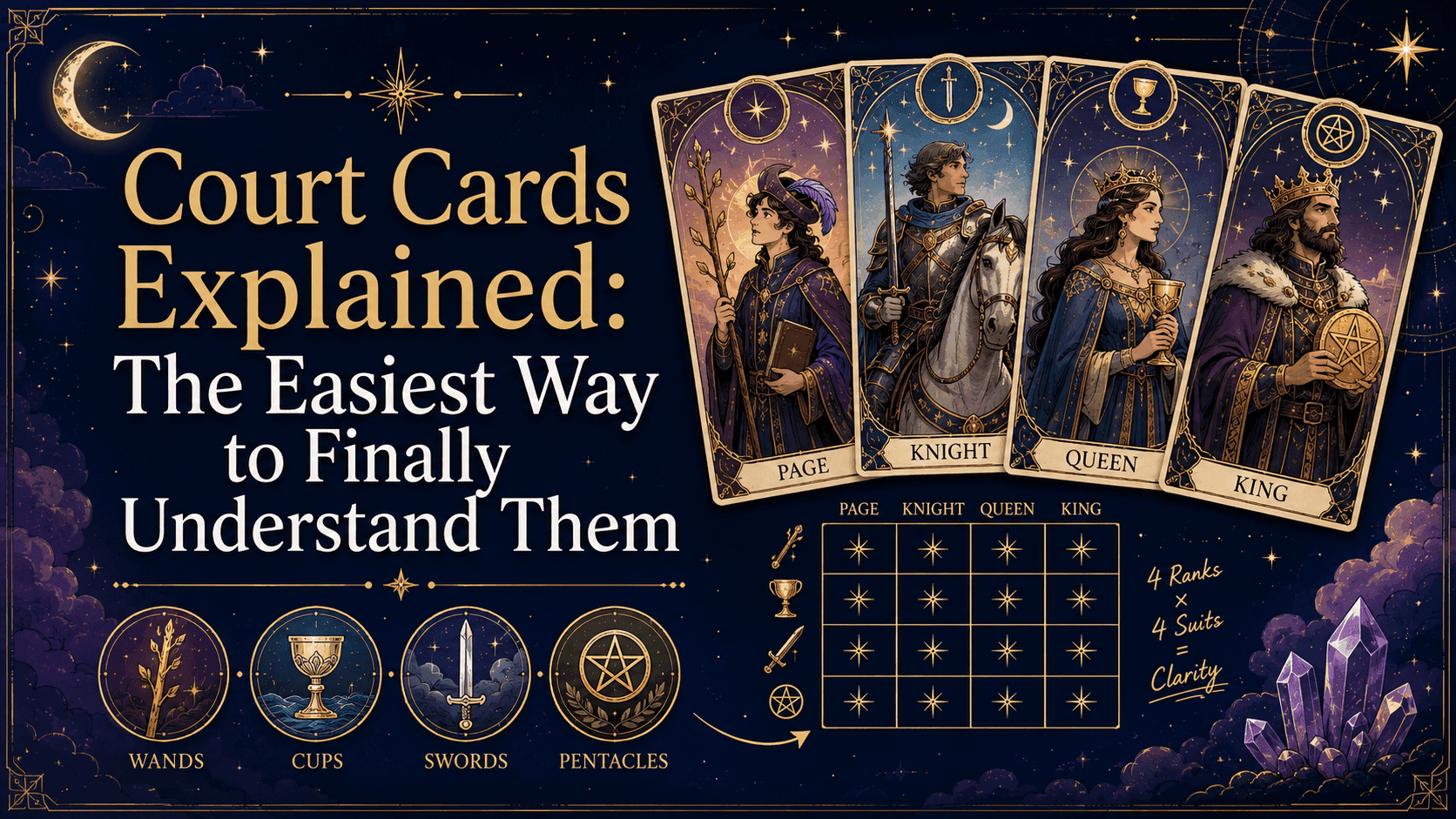
There are sixteen court cards: a Page, Knight, Queen, and King in each of the four suits. Most beginners hit them and instinctively try to memorize sixteen distinct characters, the way you'd cram sixteen strangers' names at a party. That's the slow, miserable route, and it's the most common mistake people make with these cards.
Here's the reframe. The courts aren't sixteen unrelated people. They're a tidy four-by-four grid: four suits crossed with four ranks. Once you can read the grid, you stop memorizing and start calculating, working each card out from its two coordinates, the same way a chess player never memorizes every square individually.
There's a second reason they feel hard, and it's worth naming out loud. A number card usually points at a situation, but a court card often looks like it's pointing at a who. Beginners freeze trying to name the person before they've even read the card. We'll fix that part too, but the grid comes first.
Tarot Court Cards Explained in Two Questions
Every court card answers to exactly two questions, and you already have most of what you need to answer them.
Question one: what suit is it, and what flavor does that suit carry? Question two: what rank is it, Page, Knight, Queen, or King, and what mode does that rank represent? The suit tells you the arena. The rank tells you how the figure operates inside it. Stack the two together and the meaning falls out on its own.
Take the King of Swords. Swords is the suit of thought and communication, so we're in the arena of ideas and clear speech. King is the rank of outward authority. Put the two together and you get someone, or a stance, that leads with logic, cuts to the point, and sets the terms of a discussion. You didn't memorize that anywhere. You built it from two parts.
Question One: Reading the Suit
The suit is the easy half, because you already use it everywhere else in the deck. Each suit carries a flavor, traditionally tied to one of the four classical elements.
Wands (fire) is the arena of energy, drive, creativity, and getting things moving. Cups (water) is emotion, relationships, and the inner life. Swords (air) is thought, communication, truth-telling, and sometimes conflict. Pentacles (earth), sometimes called Coins, is the practical world of work, resources, and the body.
So before you even glance at the rank, the suit hands you the subject. A Cups court is going to be about feeling and connection, whoever the figure turns out to be. A Pentacles court will be grounded and practical. Don't overthink this half. The suit is just the room the figure is standing in; the rank tells you what they're doing in it.
Question Two: Reading the Rank
The rank is where the real personality lives. A useful way to hold the four ranks is as rising degrees of maturity and mastery in the suit, from newcomer to authority. This is a common teaching model rather than an ancient law, but it makes the cards readable fast.
Page: The Beginner and the Message
The Page is new to the suit: curious, learning, a little green. Read a Page as the beginner's energy of its suit, someone (or a part of you) just starting to explore that arena. Traditionally, Pages were also read as bringers of news or messages in their suit, so a Page of Cups might mean staying open to an emotional or creative spark rather than acting on a finished plan.
Knight: The One in Motion
The Knight is the suit in action, riding hard in one direction. Knights bring drive and momentum, but they tend to overdo their suit: the Knight of Swords can be brilliant and blunt to a fault, the Knight of Cups romantic to the point of unrealistic. When a Knight shows up, a good question is where you're currently going all in, for better or worse.
Queen: Mastery Held Within
The Queen embodies her suit from the inside. She has full command of its energy but holds it inwardly, self-possessed rather than showy. The Queen of Pentacles is quiet, practical competence that just takes care of things; the Queen of Swords is clear-eyed honesty that has learned discernment. Queens are less about visible action and more about a deep, settled understanding of the suit.
King: Mastery Turned Outward
The King directs his suit outward into the world. Where the Queen holds the energy, the King applies it, leads with it, and sets direction. The King of Wands channels creative fire into leadership; the King of Cups keeps emotional steadiness while steering other people. Kings carry authority and responsibility in the arena of their suit.
One thing worth knowing: not every deck uses these four names. The Marseille tradition calls them Valet, Cavalier, Reine, and Roi. The Thoth deck renames the ranks Knight, Queen, Prince, and Princess, which shifts the correspondences and can trip you up when you switch decks. You don't need any of that to start; the four-step maturity model above is plenty.
Person, Part of You, or Energy?
Now the question that stalls everyone: is the court card a real person, or is it me? The honest answer is that it can be any of three things, and reading it well means choosing which one fits.
A court card can point to another person in the situation, showing their qualities or how they're acting. It can point to you, naming a role you're playing or could step into. Or it can be a pure energy or approach, an invitation to act a bit more like that figure regardless of who's involved. The Knight of Pentacles might describe a steady coworker, or your own need to grind out something unglamorous, or simply the patient approach the situation is calling for.
How do you pick? Let the question you asked decide. Ask about a relationship and a court card more likely describes a person or a dynamic. Ask something like "what do I need right now" and it usually points back at you or at an approach to take. If a court card turns up as your daily one-card draw, that's the cleanest place to practice this: pull it, then ask which of the three it is for you today, and why.
One tradition worth setting aside: older fortune-telling guides used court cards to describe people by hair color or age. It's part of the history, but it's reductive and easy to get wrong, and most readers now treat the courts as qualities rather than physical descriptions.
Putting It All Together
Run any court card through the two questions and then the three lenses, and you have a full reading in about ten seconds.
Imagine someone named Tomas pulling the Queen of Wands while thinking about a creative project he keeps stalling on. Question one, the suit: Wands, so we're in the arena of creativity, drive, and self-expression. Question two, the rank: Queen, meaning mastery held inwardly, warm and self-assured. Together, the Queen of Wands reads as confident, magnetic creative energy that knows its own worth. Now the three lenses. A person? Maybe a bold friend he could ask for input. Himself? More likely, since it names the self-assured maker he goes quiet about being. An energy? Yes, the exact approach the project is asking for. Tomas doesn't get a prediction out of this. He walks away with one clear nudge: stop waiting to feel ready and work with the confidence the card is describing.
Conclusion
The whole trick to tarot court cards explained simply is this: stop memorizing sixteen personalities and start reading two coordinates, suit plus rank, then decide whether the card means a person, you, or an energy. Do that and the scariest corner of the deck becomes one of the most useful.
Your move today: pull one court card out of your deck on purpose and run it through the two questions and the three lenses out loud. Name the suit's flavor, the rank's mode, and which of the three readings fits your life right now. One card, two minutes, and the grid starts to feel like second nature.