SwordsAir
Tarot Card Meaning

King of Swords

The King of Swords means intellectual authority, clear judgment, and fairness. Explore its upright and reversed meanings, symbolism, and daily-pull guidance.

King of Swords tarot card
At a glance

Quick Keywords

Upright
  • intellectual authority
  • clear judgment
  • fairness
  • decisive leadership
  • truth
  • logical clarity
  • discipline of thought
Reversed
  • cold authority
  • manipulation through logic
  • rigid thinking
  • harsh judgment
  • abuse of intellectual power
Symbolism

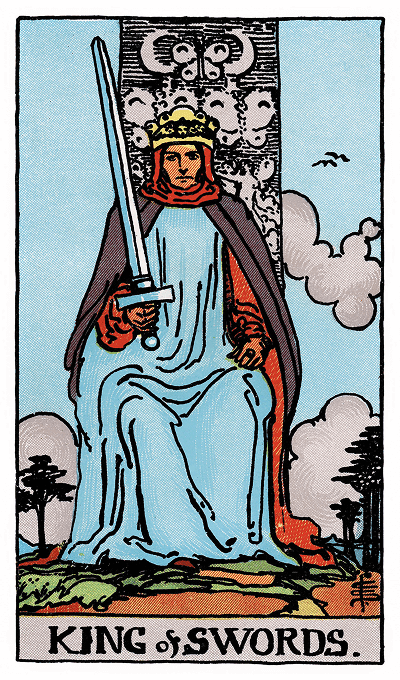
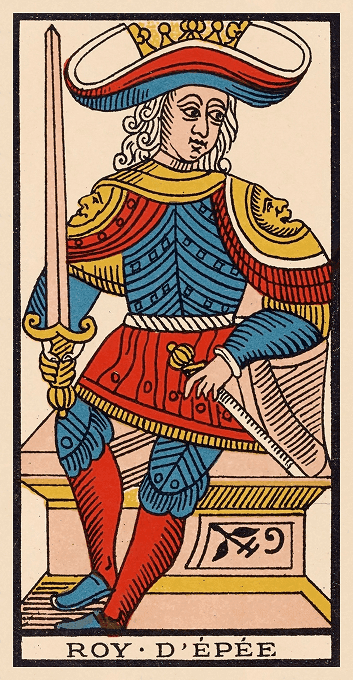
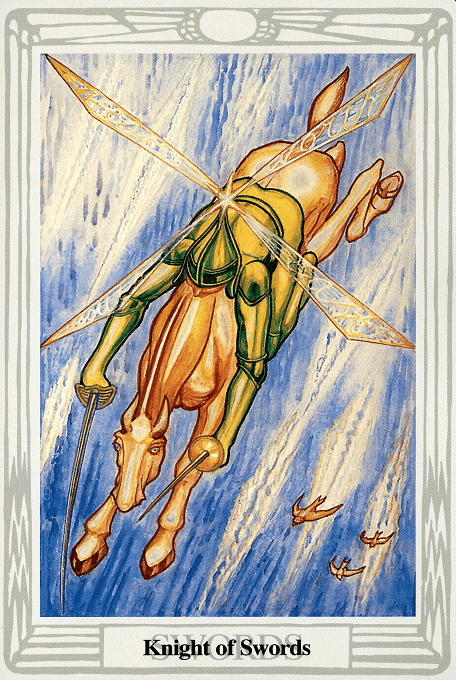
What's in the Image

The King of Swords — Rider-Waite-Smith version
Rider-Waite-Smith
The King of Swords — Marseille version
Marseille
The King of Swords — Thoth version
Thoth

In the Rider-Waite-Smith deck, a king sits upright on a throne carved with butterflies and crescent moons, holding a sword upright in one hand, his gaze direct and unwavering. Clouds pass through the sky behind him, echoing the same restless, mental atmosphere seen throughout the swords suit. The core message concentrates in three details: his perfectly upright sword, held with the same straightforward clarity as the Ace and Queen of Swords, suggesting judgment exercised with precision and authority, his direct, forward gaze, indicating decisiveness and unflinching honesty, and the butterflies on his throne, echoing the Queen of Swords's own throne and tying him to the same transformation through experience, though channeled here into structured, authoritative judgment rather than personal directness alone. Together these describe intellectual authority exercised clearly and decisively, judgment that's both sharp and fair.

Waite's 1911 notes describe this king as representing "power in all its forms," specifically tied to authority exercised through the mind and through command over others, someone whose judgment carries real weight and consequence, a description that ties him closely to formal authority and decisive leadership rather than purely personal clarity. Court cards in the Tarot de Marseille include a King of Swords as well, but generally without this detailed throne imagery, since Marseille court cards typically omit elaborate background scenes altogether, making the butterfly and crescent moon symbolism a distinctly Rider-Waite-Smith contribution to this king's character.

Upright Meaning

The King of Swords represents intellectual authority exercised with clarity, fairness, and decisive judgment. Its essential energy is disciplined, truthful leadership: making decisions based on logic and evidence rather than emotion or bias, and communicating those decisions directly and with real authority.

In everyday situations, this often shows up as making a difficult decision based on clear, rational assessment, offering fair, well-reasoned judgment in a dispute, or leading a team or project with intellectual clarity and firm, decisive direction. As with other court cards, some readers interpret the King of Swords as representing an actual person, often someone authoritative, fair-minded, and intellectually sharp, entering the situation, rather than describing a general quality available to anyone.

A nuance beginners often miss is that this king's authority is meant to be fair as well as sharp. The connection to the Queen of Swords's own butterfly imagery suggests his judgment, like hers, is meant to be informed by real understanding rather than pure detached logic alone, even though his role channels that understanding into more formal, structured authority. Reading this card only as "cold, calculating power" misses its equally important connection to genuine fairness and truth-seeking, not just decisive control.

Readers disagree somewhat on how much this card should emphasize formal, institutional authority specifically versus personal intellectual clarity more broadly. Some traditions read the King of Swords closely through leadership roles, law, or structured authority, echoing Waite's own language about power and command. Other, more general readings apply the card to anyone exercising clear, fair judgment in their own life, whether or not they hold any formal position of authority. Both readings share the underlying theme of disciplined, truthful judgment; they differ mainly in how formally that authority needs to be recognized.

Reversed Meaning

Reversed, the King of Swords doesn't simply mean total confusion or an inability to make decisions. That would just negate the upright meaning too flatly. The more useful distinction is between cold, detached authority and judgment that's become manipulative or unfair. Cold authority suggests logic and decisiveness without enough humanity or compassion, technically fair perhaps, but delivered in a way that feels harsh or dismissive of genuine feeling.

A different shadow expression involves manipulation through logic: using intellectual skill and persuasive reasoning not to arrive at truth, but to control or mislead others, a distortion of the upright card's genuine fairness into something calculating and self-serving. This differs from simple coldness, since here the issue involves dishonest intent rather than merely detached delivery.

The reversed card can also point to rigid thinking: judgment that's become inflexible, unwilling to consider new information or perspectives that might complicate an already-formed conclusion. This differs from both coldness and manipulation; here the issue is closed-mindedness rather than either harsh delivery or dishonest intent.

It's worth noting that some readers don't use reversals at all, reading every card only upright and relying on surrounding cards for shading instead. If that's your approach, the cold-authority, manipulation, and rigid-thinking readings above still apply, held as tensions that can appear within an upright King of Swords, particularly in a reading involving a decision or authority figure that already feels harsh or inflexible.

In a daily reading

King of Swords in a Daily Reading

As a single morning card, the King of Swords is worth reading as encouragement to approach a decision today with clear, disciplined thinking, while making sure that clarity doesn't come at the expense of fairness or compassion. It's a good day to lead with logic, tempered by genuine consideration for the people involved.

Say you pull this card before a day that includes making a difficult, high-stakes decision at work or in your personal life. The King of Swords doesn't guarantee the decision will be easy; it suggests approaching it with clear, honest assessment of the facts, and communicating your reasoning directly and fairly to anyone affected by it.

A daily-pull scenario

A Daily-Pull Scenario

Imagine pulling the King of Swords on a morning before mediating a dispute between two people who both feel strongly about their position. A beginner's first instinct might be to read this as permission to simply declare a winner based on cold logic alone. A more useful reading treats the card as encouragement to weigh the facts fairly and communicate your judgment clearly, while remembering that this king's authority, like the Queen of Swords's own clarity, is meant to be informed by genuine understanding, not just detached, impersonal reasoning.

Read with care

Common Misreadings

  • This card means cold, unfeeling authority.

    Waite's own notes tie this king to power exercised through the mind, but the shared butterfly symbolism with the Queen of Swords suggests his judgment is meant to be fair and informed, not simply detached or harsh.

  • This card always means a specific powerful man is entering my life.

    Some traditions read court cards as literal people, but many contemporary readers treat the King of Swords as describing a clear, authoritative quality available to anyone, regardless of gender.

  • Reversed always means someone is being deliberately manipulative.

    Reversed can describe manipulation, but it can just as easily describe simple coldness in delivery or rigid thinking that hasn't considered new information, different problems than deliberate deception.

Combinations

Cards That Change Its Meaning

  • King of SwordsJustice

    Amplifies fair, balanced judgment, suggesting the authority described here is being exercised with genuine impartiality and careful attention to fairness.

  • King of SwordsThe Emperor

    Tempers intellectual authority with structured, practical discipline, suggesting clear thinking paired with firm, well-organized leadership suited to significant responsibility.

  • King of SwordsThe Moon

    Redirects confident, clear judgment toward uncertainty, suggesting the facts of the situation may be less settled than this king's usual clarity would suggest.

Sit with it

Questions for Reflection

  1. 1

    Where in my life could I benefit from clearer, more disciplined thinking about a decision I'm facing?

  2. 2

    Am I being fair as well as decisive in how I'm judging a current situation?

  3. 3

    Is there a place where my logic or reasoning has become too detached from genuine compassion?

  4. 4

    What would it look like to communicate a difficult decision today with both clarity and fairness?