You lay out three cards and one of them is The Tower. The other two are the Four of Cups and the Knight of Swords. Instinctively you stare at The Tower and half-ignore the rest, because it feels louder. That instinct is the major arcana vs minor arcana question in disguise, and getting it straight changes how you read every spread from here on.
This post covers what actually separates the two groups, what each one is good at telling you, why the court cards confuse almost everyone at first, and how to read a mixed spread without letting one dramatic card drown out the others. By the end you'll be able to look at any three-card pull and say what job each card is doing.
The basic split: two decks living in one box
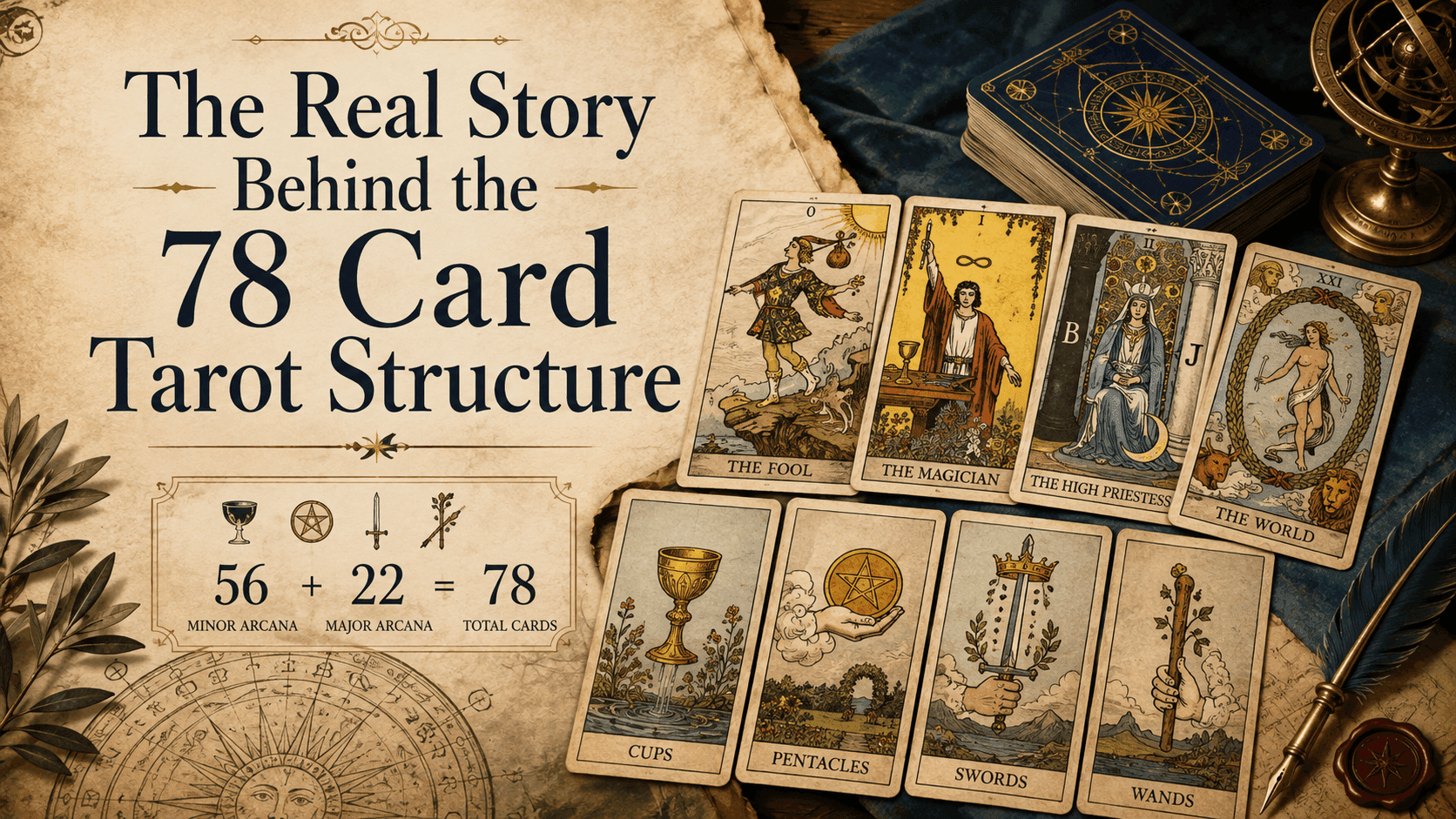
A standard tarot deck holds 78 cards. Twenty-two of them are the Major Arcana, numbered 0 through 21, running from The Fool to The World. The other 56 are the Minor Arcana, divided into four suits of 14 cards each.
The word "arcana" comes from the Latin arcanum, meaning a secret or mystery, and the Major and Minor labels came from later occult writers rather than from the cards' origins. Tarot began as a card game in fifteenth-century Italy, where those 22 cards were simply the trionfi, the trumps: the cards that beat the ordinary suits. That gaming logic is still a surprisingly good mental model. Majors outrank Minors in scope, not in importance.
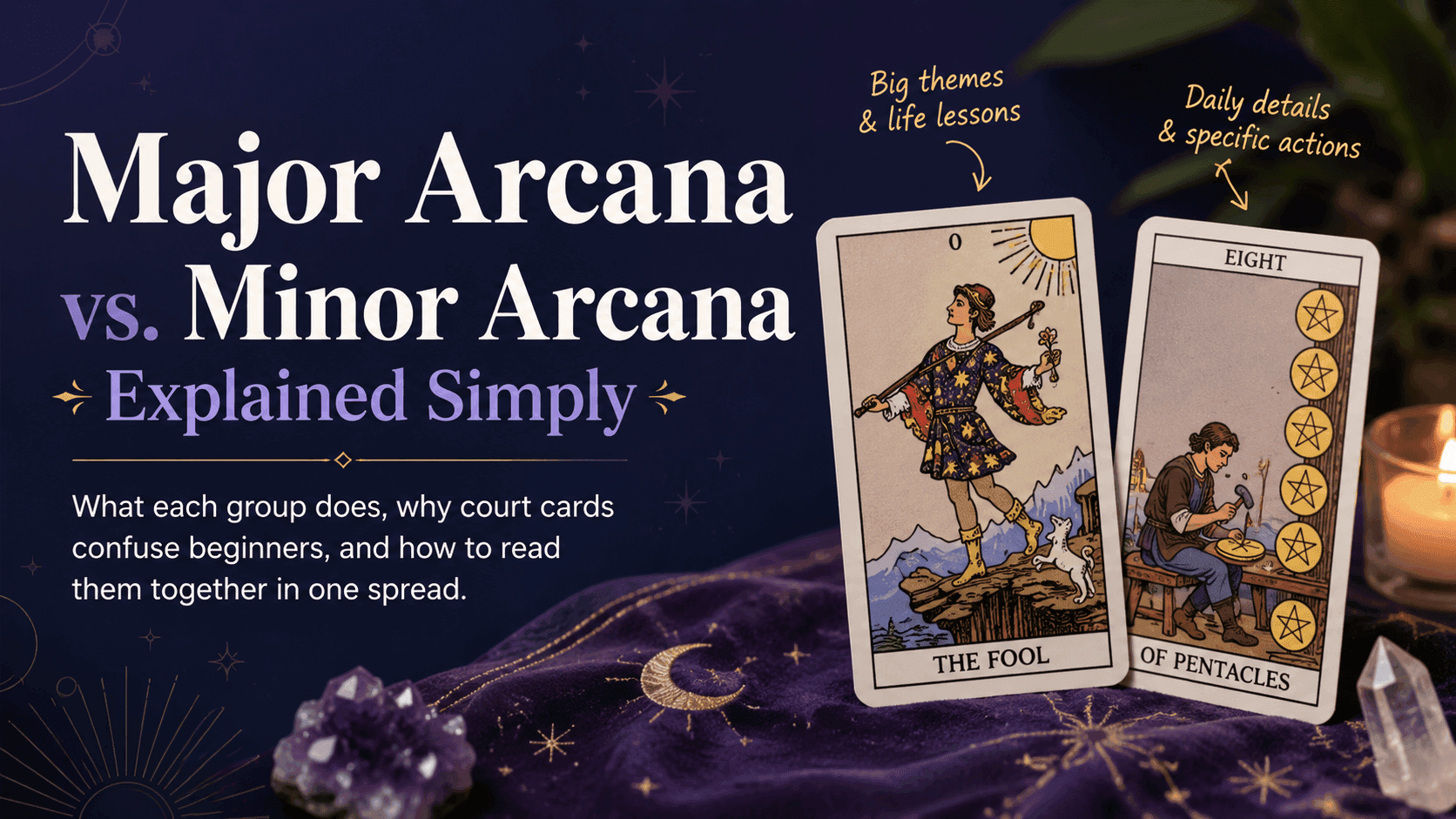
Here's the practical difference. A Major Arcana card tends to name a theme: the shape of the situation, the lesson, the chapter you're in. A Minor Arcana card tends to name a detail: a mood, an action, a specific pressure, a person's behavior. Judgement (20) might point to a reckoning with how you've been handling something. The Eight of Pentacles points at the thing you're actually doing on Tuesday afternoon.
What the Major Arcana are good at
The 22 Majors carry the big archetypes: The Magician, The High Priestess, The Hermit, Death, The Star. They're the cards that show up on posters and in movies, which is exactly why beginners over-read them.
Because they cover broad territory, Majors are most useful for orientation. Say you pull The Hermit while thinking about a friendship that's gone quiet. Read as a theme, it isn't a prediction that you'll be alone. It's a frame: this is a stretch that calls for stepping back and getting clear on your own before doing anything about the friendship.
That breadth is also their limitation. A Major will tell you what kind of story you're in and almost nothing about what to do at 9am tomorrow. If you draw The Wheel of Fortune and stop there, you've learned that things are in motion and that some of it is outside your control. Useful, but not actionable on its own. That's what the other 56 cards are for.
What the Minor Arcana are good at
The Minor Arcana split into four suits, and each one covers a different slice of ordinary life:
- Wands (also called Batons or Staves): energy, drive, creative momentum, ambition. Traditionally associated with fire.
- Cups: emotions, relationships, intuition, what you feel rather than what you think. Associated with water.
- Swords: thought, conflict, communication, decisions, anxiety. Associated with air.
- Pentacles (also called Coins or Disks): work, resources, the body, the material and practical. Associated with earth.
Each suit runs Ace through Ten, then four court cards. The numbered cards, often called pips, describe stages and situations. The Ace is a beginning, the Ten is a completion or an overload, and the middle numbers chart the messy stretch in between.
One historical wrinkle worth knowing, because it explains why decks look so different from each other. In the Tarot de Marseille tradition, the pip cards aren't scenic. The Five of Cups is literally five cups arranged in a pattern, closer to a modern playing card. The Waite-Smith deck, published in 1909 and illustrated by Pamela Colman Smith, gave every pip a full illustrated scene instead. That single choice is a big reason most beginner-friendly decks today are scene-based: you can read a picture before you've memorized a system. If you've ever picked up a Marseille deck and felt lost, that's why, and it isn't a sign you're doing anything wrong.
The court cards, where most beginners stall
The last four cards of each suit are the courts: Page, Knight, Queen, and King in Waite-Smith decks. Names vary by tradition, so a Marseille deck gives you a Valet and a Cavalier, and some later decks use Princess and Prince. The ranks are doing the same structural job under different labels.
Courts trip people up because there are three common ways to read them and no consensus about which is right. A court card can represent another person, a part of yourself, or an approach you could take. Beginners often lock onto "this is a person" and then get stuck trying to identify who, which stalls the reading.
A workable habit while you're learning: read the court card as an approach first. The Knight of Swords as an approach means charging in fast with a sharp argument. That reading is available immediately, and you can always widen it to a person later if the rest of the spread supports it.
Reading major arcana vs minor arcana together in one spread
In a mixed pull, the Majors set the theme and the Minors tell you where it's showing up. Do that in order: read the Majors first for the frame, then let the Minors fill in the specifics. Don't read every card in isolation and then try to average them into a verdict.
The proportion is worth noticing too. Since 22 of 78 cards are Majors, roughly a quarter of any random draw will be one, so a spread that's mostly Minors is completely ordinary rather than a sign your reading is weak.
Imagine someone, call her Nadia, pulling three cards about a side project she keeps abandoning. She gets The Chariot, the Eight of Pentacles, and the Four of Cups. Reading Majors first, The Chariot gives her the theme: focus and forward motion, the question of whether she's actually steering. Then the Minors get specific. The Eight of Pentacles is patient, repetitive skill-building, the unglamorous practice phase. The Four of Cups is that flat, unimpressed feeling where nothing on offer looks appealing. Put together, the reading she'd take away isn't "you'll succeed." It's a more useful observation: she's in the boring middle stretch of the work, her boredom is the actual obstacle, and the frame she's being handed is about steering deliberately rather than waiting to feel inspired. What she'd do today is pick the smallest next task and do it while still bored.
The common mistake: treating Majors as good or bad news and Minors as filler. A Minor Arcana card in a spread about your week is often the most actionable card there, because it describes something concrete enough to change. Dramatic-looking Majors like The Tower or Death get read as verdicts when they're better read as descriptions of a process. And drawing only Minors doesn't mean nothing important is happening. It usually means the important thing is happening in the daily details.
If you want this distinction to become automatic, a daily one-card pull is the cheapest way to get there. Draw one card each morning and, before looking anything up, say out loud whether it's a Major or a Minor and what job that suggests it's doing: naming the theme, or naming the detail. Two or three weeks of that will teach you more than reading another twenty articles.
Conclusion
The one takeaway: the major arcana vs minor arcana difference is about scope, not importance. Majors describe the chapter you're in, Minors describe what's happening on the page, and a reading that uses both is more useful than one that only listens to the loud cards.
Do this today. Pull two cards on purpose, one from the Majors and one from the Minors, and write a single sentence connecting them in the form "the theme is X, and it's showing up as Y." That one sentence is the whole skill in miniature, and it works on every spread you'll ever lay out.