Major ArcanaCard 9Virgo
Tarot Card Meaning

The Hermit

The Hermit tarot card means introspection, solitude, and inner guidance. Explore its upright and reversed meanings, symbolism, and daily-pull guidance.

The Hermit tarot card
At a glance

Quick Keywords

Upright
  • introspection
  • solitude
  • inner guidance
  • withdrawal
  • wisdom through experience
  • patience
  • self-reflection
  • quiet searching
Reversed
  • isolation
  • loneliness
  • avoidance
  • withdrawal taken too far
  • refusing guidance
  • restlessness
  • rushing back to others too soon
Symbolism

What's in the Image

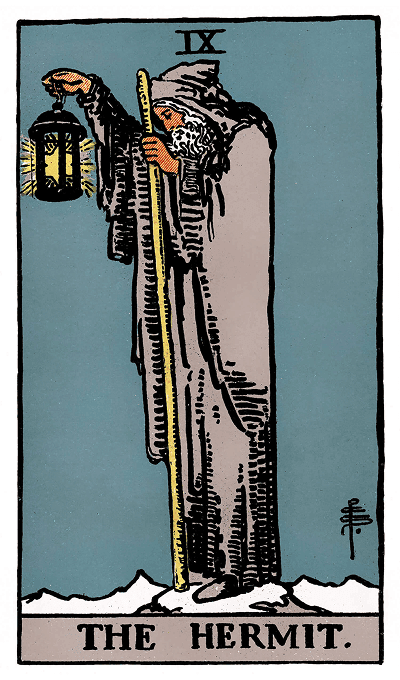
The The Hermit — Rider-Waite-Smith version
Rider-Waite-Smith
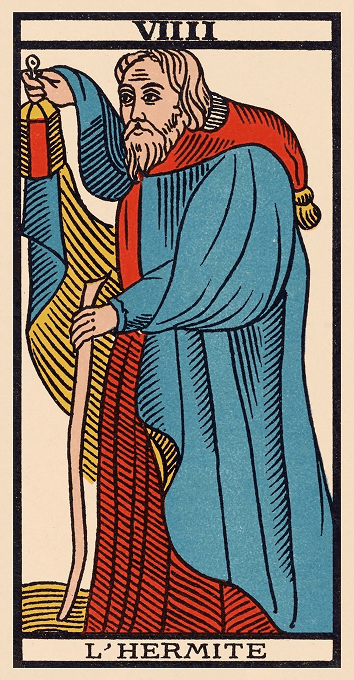
The The Hermit — Marseille version
Marseille
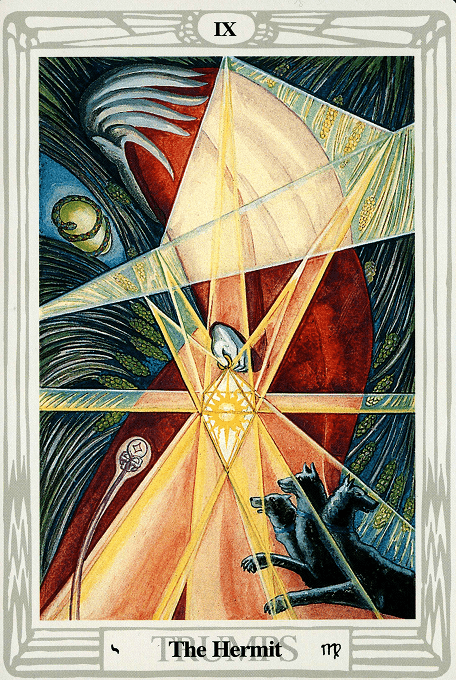
The The Hermit — Thoth version
Thoth

In the Rider-Waite-Smith deck, an old man stands alone on a snowy mountain peak, wrapped in a gray cloak, holding a staff in one hand and a lantern in the other. Inside the lantern glows a six-pointed star. The core message concentrates in three details: the isolation of the mountaintop setting, the staff supporting a figure who has clearly walked a long way already, and the lantern's light, which illuminates only a small area immediately around him rather than the whole landscape. Together these describe wisdom gained through solitary experience, offered as a small, steady light rather than a complete map for someone else's path.

Waite's 1911 notes describe the lantern's star as the "Seal of Solomon," a detail modern readers sometimes reduce to simple decoration, though Waite specifically ties it to wisdom drawn from within rather than borrowed from any outside source. This card's Marseille equivalent (often called simply L'Hermite, the Hermit) shows a similarly robed, staff-carrying old man holding a lantern, but earlier versions of this card were sometimes labeled Time and depicted with an hourglass rather than a lantern, emphasizing aging and the passage of time over spiritual introspection. That older "Time" framing is a useful reminder that this card's association with quiet wisdom developed over the deck's history rather than being fixed from the start.

Upright Meaning

The Hermit represents wisdom that comes from deliberately stepping back from noise and company to think clearly. Its essential energy is introspection: choosing solitude not as avoidance, but as a way of finding clarity that's harder to access in the middle of everyday busyness or other people's opinions.

In everyday situations, this often shows up as needing time alone to process a decision, stepping back from a group or social plan to recharge, or simply preferring quiet reflection over immediate action when something important is unresolved. It can also describe seeking guidance from someone with more experience, since the lantern's light suggests wisdom passed along in a small, focused way rather than delivered all at once.

A nuance beginners often miss is that the Hermit's solitude is usually temporary and purposeful, not a permanent retreat from life. The staff in the image suggests a figure still walking, still moving forward, rather than someone who has settled permanently on the mountain. Reading this card only as "be alone" misses the equally important idea that the solitude has a direction and, eventually, an end point.

Readers disagree somewhat on how much this card points toward mentorship versus pure self-guidance. Some traditions emphasize the Hermit as a figure who has wisdom to offer others, tying the card to receiving or being a mentor. Other readings focus almost entirely on internal searching, treating any outside guidance as secondary to the deeper work of sitting with your own thoughts. Both readings share a core theme of hard-won clarity; they differ mainly in whether that clarity is meant to be shared or is primarily a private process.

Reversed Meaning

Reversed, the Hermit doesn't simply mean loneliness in a general sense. That would just negate the upright meaning. The more useful distinction is between necessary solitude that's tipped into isolation, and a restless avoidance of the reflection this card usually calls for. Isolation suggests withdrawal that's gone on too long or become disconnected from any real purpose, where being alone no longer feels clarifying but simply lonely or stagnant.

A different shadow expression involves resisting the Hermit's invitation altogether: staying constantly busy or surrounded by others specifically to avoid the quiet self-examination the upright card describes. This can look like restlessness, distraction, or an inability to sit still with a difficult question. This is nearly the opposite of isolation, yet both meanings appear under a reversed Hermit depending on the specifics of the reading.

The reversed card can also point to refusing guidance, whether that's dismissing advice from someone more experienced or ignoring your own inner sense of what's needed, insisting instead on figuring everything out through sheer activity rather than reflection. This differs from healthy independence; the issue here is a rejection of insight itself, not simply a preference for self-reliance.

It's worth noting that some readers don't use reversals at all, reading every card only upright and relying on surrounding cards for shading instead. If that's your approach, the isolation, restlessness, and refused-guidance readings above still apply, held as tensions that can appear within an upright Hermit, particularly in a reading that already suggests avoidance or disconnection.

In a daily reading

The Hermit in a Daily Reading

As a single morning card, the Hermit is worth reading as a nudge to build in some quiet time today rather than filling every hour with company or obligation. It's a good day to notice a question you've been avoiding sitting with, simply because solitude feels less comfortable than distraction.

Say you pull this card before a day that includes an invitation to a social event you're not sure you have the energy for. The Hermit doesn't tell you to decline automatically; it suggests checking in honestly with whether you need quiet reflection right now, or whether the pull toward solitude is more about avoidance than genuine need.

A daily-pull scenario

A Daily-Pull Scenario

Imagine pulling the Hermit on a morning before a weekend with no set plans. A beginner's first instinct might be to read this as a directive to cancel everything and spend the day in isolation, treating the card as a blanket instruction to withdraw. A more useful reading treats the card as an invitation to notice what unstructured quiet time actually does for you today: does an hour alone leave you clearer and calmer, or does it start to feel like avoidance of something you actually need to address with other people? The card points toward purposeful reflection, not isolation for its own sake.

Read with care

Common Misreadings

  • This card means I should isolate myself completely.

    The Hermit describes purposeful, temporary solitude, not permanent withdrawal from other people. The staff in the image suggests a figure still moving forward, not someone settled into isolation indefinitely.

  • Reversed always means I'm too withdrawn.

    Reversed can describe isolation, but it can just as easily describe restlessness or an active avoidance of the quiet reflection the card calls for, a nearly opposite problem depending on the situation.

  • This card is only about being alone, not about learning from others.

    Some traditions read the Hermit as connected to mentorship and guidance received from someone more experienced, not solely private, unaided reflection. The lantern's light is often read as wisdom meant to help light someone else's way too.

Combinations

Cards That Change Its Meaning

  • The HermitThe High Priestess

    Amplifies the theme of inward attention, suggesting reflection paired with intuitive insight, often pointing to a period where quiet, receptive thinking matters more than any outward action or conversation.

  • The HermitThe Chariot

    Tempers solitary reflection with a pull toward forward motion and external goals, suggesting a tension between needing more time alone and the pressure to keep moving on a plan or deadline.

  • The HermitThe Tower

    Redirects chosen, purposeful solitude toward isolation brought on by sudden disruption, suggesting withdrawal that wasn't fully chosen but instead followed an unexpected upheaval or loss.

Sit with it

Questions for Reflection

  1. 1

    What question have I been avoiding simply because sitting with it alone feels uncomfortable?

  2. 2

    Where might some quiet, unstructured time actually help me think more clearly right now?

  3. 3

    Am I staying busy to avoid something, or because the busyness genuinely serves me?

  4. 4

    Is there guidance, from myself or from someone more experienced, that I've been resisting?