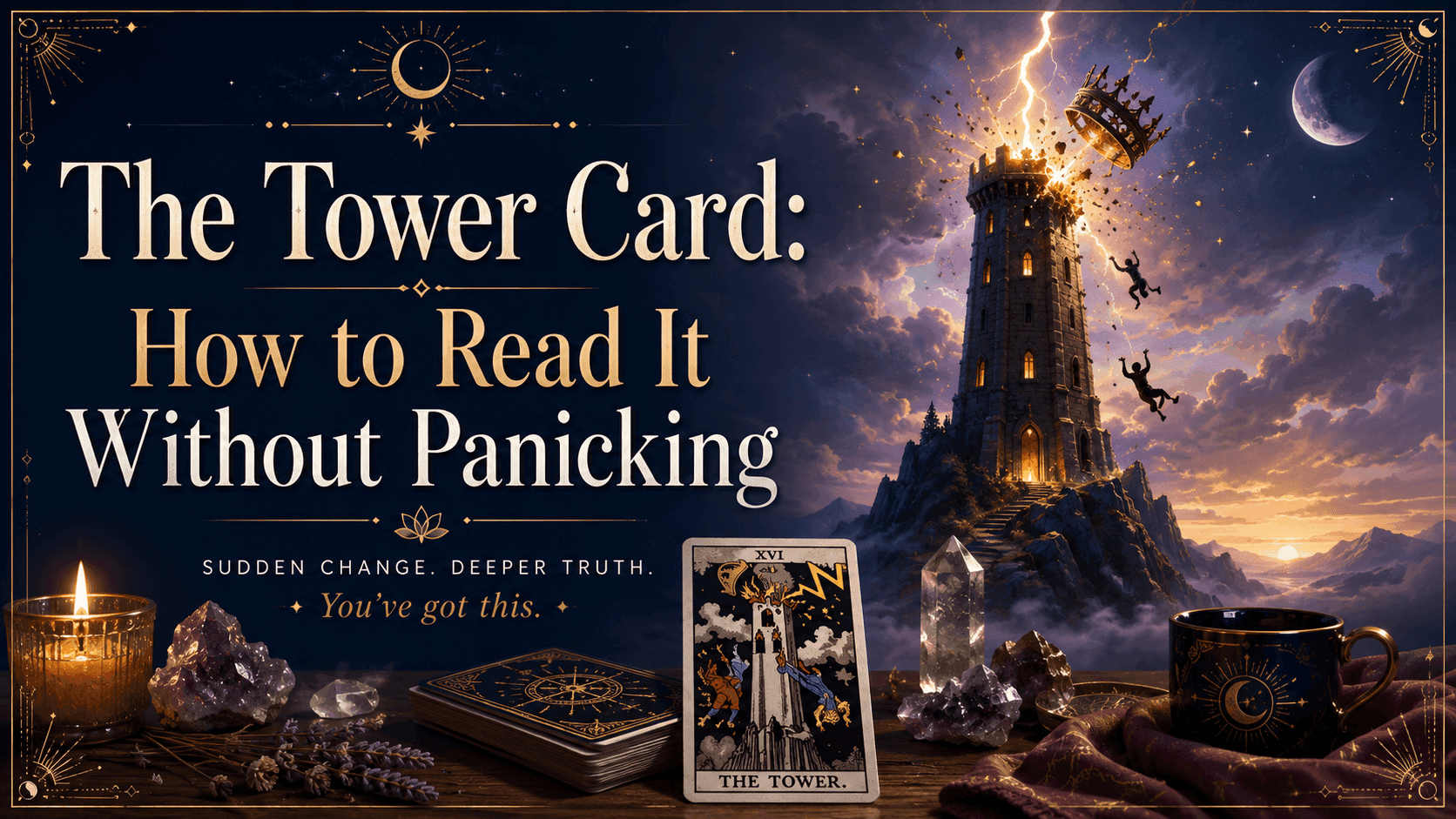
You pulled the Tower: a tall tower hit by lightning, flames in the windows, two figures falling headfirst toward the rocks below. It is, visually, the most alarming card in the deck, and plenty of beginners quietly reshuffle and pretend it never came up. Before you do that, it's worth knowing that the tower tarot card meaning is far less doom-laden than the picture makes it look. This post covers what the card actually shows, what it tends to point to, why it isn't the catastrophe it resembles, and how to read it calmly inside a real spread. By the end, you'll be able to draw the Tower and stay curious instead of spooked.
What the Tower card actually shows
In the Rider-Waite-Smith deck, the Tower is card sixteen of the Major Arcana, and its image is built to unsettle you: a stone tower on a rocky peak, a bolt of lightning knocking the golden crown off its top, flames bursting from the windows, and two people falling through the air. Waite's 1911 guide, The Pictorial Key to the Tarot, presents it in that dramatic register, and the older keyword lists that travel with the card are genuinely grim.
The imagery isn't universal, though. In the older Tarot de Marseille tradition, the same card is usually named La Maison Dieu, often translated as the House of God, and it shows the top of a building being struck off while two figures tumble from it. Different decks dramatize the same core idea in their own way. The lightning and the fall are the constant, so treat them as symbols of a sudden jolt, not a literal forecast about buildings or bodies.
The tower tarot card meaning, in plain terms
Strip away the theatrics and the Tower points to a few closely related things: sudden change, a structure collapsing because it was built on a weak foundation, and a shock that reveals something you'd been avoiding. Many readers also read it as an awakening, the uncomfortable but clarifying moment when an illusion breaks.
Picture the everyday versions. A role you'd quietly outgrown ends before you were ready to admit you'd outgrown it. A belief you'd organized your life around, something like "I have to keep everyone happy," suddenly cracks under pressure. An arrangement that looked fine on the surface turns out to have been held together with tape. None of that is pleasant in the moment, but notice what these share: the thing that gives way was already unsound.
It's fair to say the tradition is split in tone here. Waite's own keywords for the card lean bleak, while most modern teaching frames it as disruptive but freeing change. You don't have to choose a camp. Read it as a strong signal that something unstable is being exposed, and let the rest of the spread tell you what.
Why the Tower isn't a catastrophe
Here's the reframe that takes the panic out of it. The Tower doesn't describe random destruction landing on an innocent life. It describes a structure that couldn't hold coming down. Think of the difference between an arsonist and a building inspector condemning a place that was already unsafe: both leave you with a building you can't use, but only one of them is a disaster, and the other is closer to a rescue.
That distinction matters because the fear around this card almost always comes from reading it as a prophecy rather than a prompt. Tarot works as a reflection tool, so the honest question the Tower raises isn't "what terrible thing is coming?" It's "what am I propping up that isn't holding?" If the Tower shows up in a daily one-card pull, that single question is the whole assignment: notice the shaky thing before it decides to fall on its own schedule.
So here's a clear do and don't. Do use the Tower to look honestly at what feels forced or unstable in your life right now. Don't read it as a prediction about your health, your finances, or any other fixed outcome, because that isn't something the card can tell you, and reading it that way just manufactures dread.
How to read the Tower in a spread
A single card rarely means much in isolation, and the Tower means even less on its own than most. Three things shape how you read it: where it lands, what sits next to it, and the question you asked.
Position tells you what's being shaken. A Tower in a "recent past" spot reads very differently from one in a "the way forward" spot. The neighboring cards color it too: a gentle card beside it can soften the jolt into a needed clearing, while a heavy one can underline that something genuinely needs your attention. And the question frames all of it, which is why a vague question makes this card especially hard to read well.
Then there's orientation. Readers genuinely disagree about the reversed Tower. Some read it as a collapse that's being delayed or resisted, some as a smaller or more internal upheaval, and some as a disaster narrowly avoided. There's no single official answer, so pick the reading that fits the surrounding cards and stay consistent about it.
The common mistake here is reading the Tower in isolation and spiraling: you see the lightning, assume the worst, and stop looking at the four other cards that would have told you what's actually shaking. Slow down and read the whole picture.
Imagine someone, call her Dana, who draws the Tower in the center of a three-card spread after asking why a side project keeps stressing her out. Her first instinct is dread. Instead, she looks at the neighbors: the card before it hints at overcommitment, and the card after it looks calmer and more open. Reading across the row, Dana notices the Tower isn't warning of some outside catastrophe. It's pointing at the over-scaled plan she keeps forcing to work, the one held together by late nights. The "collapse" the card describes is simply that plan being allowed to fall apart. What she'd actually do next is stop propping it up, and cut the project back to something sustainable before it topples on its own.
Conclusion
The takeaway is small and steadying: the tower tarot card meaning is about the fall of something unstable, not a curse landing on your life. It's a prompt to look at what's shaky, not a prophecy of doom.
So do this today. Whether you just drew the Tower or you pull one now on purpose, write down one thing in your life that feels propped-up, forced, or held together with tape, and one honest question about it. That single question is the card doing its real job, turning an alarming picture into something you can actually use.