Major ArcanaCard 16Mars
Tarot Card Meaning

The Tower

The Tower tarot card means sudden upheaval, revelation, and forced change. Explore its upright and reversed meanings, symbolism, and daily-pull guidance.

The Tower tarot card
At a glance

Quick Keywords

Upright
  • sudden upheaval
  • revelation
  • collapse
  • disruption
  • awakening
  • breaking point
  • forced change
Reversed
  • avoiding disaster
  • delayed collapse
  • internal upheaval
  • resisting necessary change
  • fear of disruption
  • aftermath
  • gradual realization
Symbolism

What's in the Image

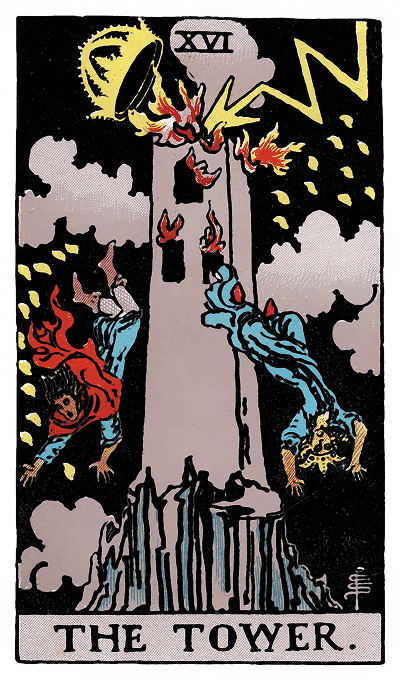
The The Tower — Rider-Waite-Smith version
Rider-Waite-Smith
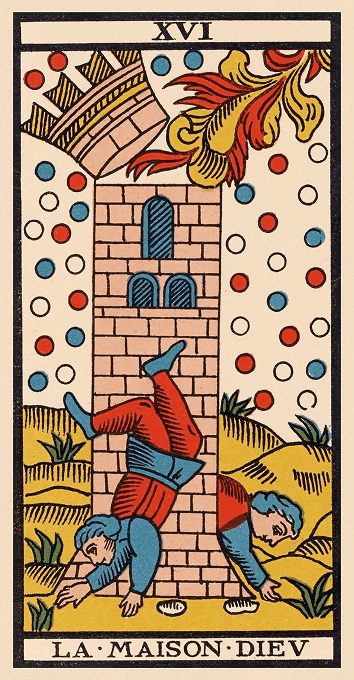
The The Tower — Marseille version
Marseille
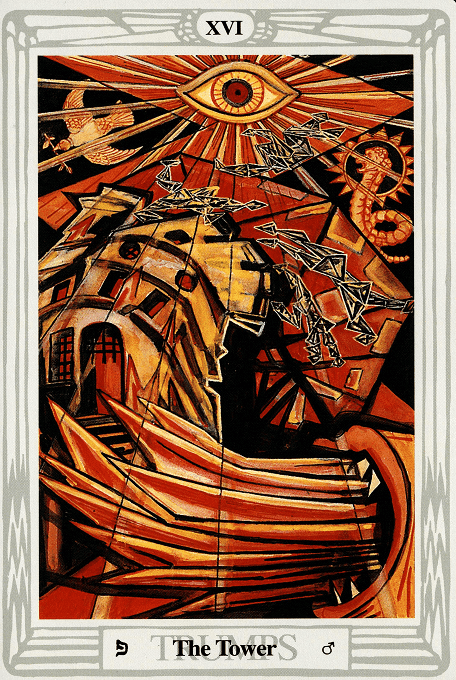
The The Tower — Thoth version
Thoth

In the Rider-Waite-Smith deck, lightning strikes a tall stone tower, knocking its crown loose and sending two figures falling headfirst from its windows. Flames burst from the tower's upper section, and twenty-two flame-like shapes, sometimes read as yods, a Hebrew letter associated with divine presence, fall from the sky around the lightning bolt. The core message concentrates in three details: the crown being struck loose, suggesting an authority or structure built on a flawed foundation, the two falling figures, caught mid-collapse rather than shown safely afterward, and the lightning itself, arriving suddenly rather than as a gradual erosion. Together these describe change that arrives abruptly and without warning, forcing an immediate and visible break from what came before.

Waite's 1911 notes describe this card as representing the ruin of a house built on false premises, specifically calling out material ambitions unsupported by anything more solid underneath them, language modern readers sometimes miss when focusing only on the card's dramatic imagery. The Tower's imagery has stayed relatively consistent across tarot history; the Tarot de Marseille's version, sometimes titled La Maison Dieu (the House of God), shows a similar lightning-struck tower with falling figures, and some scholars believe the card was inspired partly by the biblical Tower of Babel, reinforcing the idea of a structure that collapses specifically because it was built on a flawed or overreaching premise.

Upright Meaning

The Tower represents sudden collapse that reveals a flaw which was already present, even if it wasn't visible until the moment of breakdown. Its essential energy is forced revelation: something built on an unstable foundation gives way abruptly, and the disruption that follows, however unwelcome, exposes the truth of the situation more clearly than gradual change might have.

In everyday situations, this often shows up as an unexpected event that upends a plan, a relationship, or an assumption you'd been relying on, like a sudden piece of news, an abrupt ending, or a realization that shatters a belief you'd built other decisions around. It can also describe an internal shock: a moment of clarity that arrives suddenly and forces you to see a situation differently than you had been.

A nuance beginners often miss is that the Tower's disruption, while often distressing, isn't usually described as pointless destruction. The falling crown suggests the structure being destroyed was already flawed or built on a shaky premise, meaning the collapse tends to clear away something that wasn't going to hold up regardless. Reading this card only as "disaster" skips over its equally important, if less comforting, connection to necessary and ultimately clarifying change.

Readers disagree somewhat on how much comfort to offer alongside this card's difficult imagery. Some traditions present the Tower fairly starkly, emphasizing the shock and disruption without softening it much, treating the card as one of the more genuinely difficult ones to receive. Other, more encouraging modern approaches lean harder into the idea of necessary demolition, framing the collapse primarily as clearing space for something more honest and stable to be built afterward. Both readings agree on the card's core event, sudden, forced change, but differ in how much weight to give the difficulty of living through it.

Reversed Meaning

Reversed, the Tower doesn't simply mean the disruption has been avoided entirely. That would be a comforting but often misleading negation of the upright meaning. The more useful distinction is between disruption that's been delayed and disruption that's happening internally rather than visibly. A delayed collapse suggests a situation built on an unstable foundation that hasn't yet given way, even though the underlying flaw described by the upright card is still present and unresolved.

A different shadow expression involves internal upheaval: a shock or realization happening privately rather than through an obvious external event. This can look like a quiet but significant shift in perspective, or a slow-dawning recognition of a problem that an upright Tower might reveal all at once. This is a distinct process from a delayed collapse, since it may not require any external event catching up at all.

The reversed card can also point to resistance: actively avoiding a necessary confrontation with an unstable situation, holding a flawed structure together through sheer effort rather than addressing what's actually unsound about it. This differs from simple delay; here the person is aware, at some level, of the instability and is working specifically to prevent the break from happening.

It's worth noting that some readers don't use reversals at all, reading every card only upright and relying on surrounding cards for shading instead. If that's your approach, the delayed-collapse, internal-upheaval, and resistance readings above still apply, held as tensions that can appear within an upright Tower, particularly in a reading involving a situation that already feels unstable or unsustainable.

In a daily reading

The Tower in a Daily Reading

As a single morning card, the Tower is worth reading as a nudge to stay flexible today, since something unexpected may require you to adjust plans on short notice. It's a good day to notice where you might be relying on an assumption that hasn't actually been tested.

Say you pull this card before a day that includes a meeting where a plan you'd been counting on might change abruptly. The Tower doesn't guarantee something dramatic will happen; it suggests staying open to sudden shifts, and treating any disruption that does occur as useful information rather than only as a setback.

A daily-pull scenario

A Daily-Pull Scenario

Imagine pulling the Tower on a morning before a conversation you suspect might not go the way you're hoping, like discussing a change in plans with a roommate or partner. A beginner's first instinct might be to read this as a warning to avoid the conversation altogether, assuming the card predicts disaster. A more useful reading treats the card as a prompt to notice what assumption the conversation might overturn, and to see any resulting discomfort as clarifying rather than purely negative, since an honest exchange, even a difficult one, can reveal something more accurate than the comfortable assumption it replaces.

Read with care

Common Misreadings

  • This card predicts a literal disaster or catastrophe.

    The Tower is often read as sudden, disruptive change, but its scope varies widely depending on the situation and surrounding cards. It doesn't specify the scale or nature of the disruption on its own.

  • This card means I did something wrong.

    The collapse described here points to a structure or assumption that was already unstable, not necessarily a personal failure. The flaw being revealed was present beforehand, whether or not anyone could have seen it coming.

  • Reversed always means I've avoided the problem.

    Reversed can describe a delayed or internalized version of the Tower's disruption, but the underlying instability the upright card describes is often still present and unresolved, just not yet visible.

Combinations

Cards That Change Its Meaning

  • The TowerThe Star

    Amplifies the sense that renewal follows the disruption, suggesting the collapse, however difficult, is clearing the way for genuine healing or a more honest foundation afterward.

  • The TowerFour of Pentacles

    Tempers sudden upheaval with rigid holding-on, suggesting a person may be trying hard to prevent an unstable structure from collapsing, delaying the break rather than avoiding it.

  • The TowerThe Hierophant

    Redirects individual disruption toward institutional or traditional collapse, suggesting the flawed structure being revealed is more about an established system or long-held convention than a personal situation alone.

Sit with it

Questions for Reflection

  1. 1

    What assumption have I been building other decisions on top of without really examining it?

  2. 2

    Is there a situation in my life that feels unstable, even if nothing has visibly broken yet?

  3. 3

    What would honest clarity, even if uncomfortable, actually reveal about a current situation?

  4. 4

    Where might I be resisting a necessary change out of fear of the disruption it would cause?