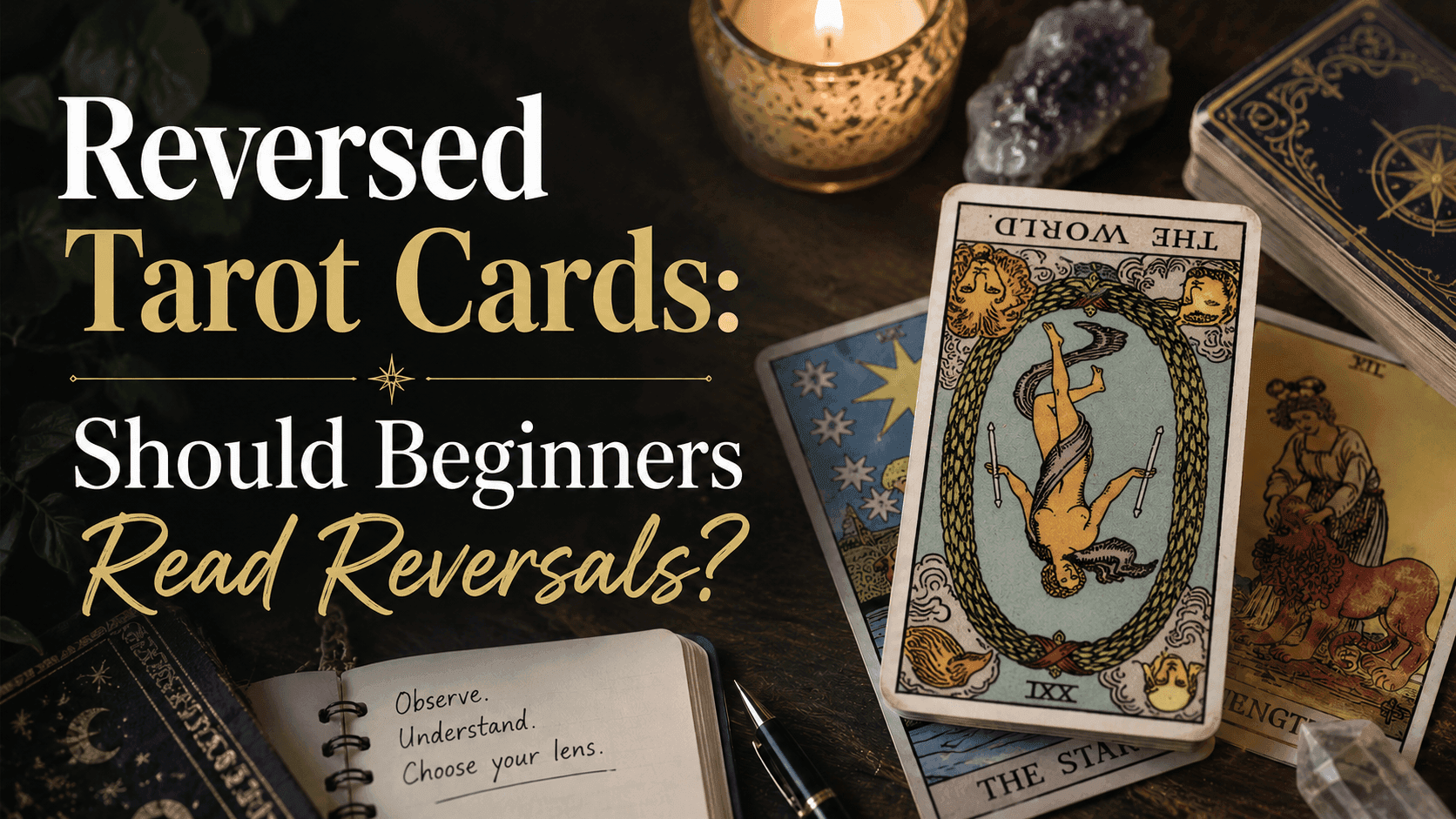
You shuffle, cut the deck, turn over your card, and it's upside down. So you go looking for the reversed tarot cards meaning in the little booklet that came with your deck, and find two vague sentences that don't obviously connect to the two sentences above them. Meanwhile, half the readers you follow online say they ignore reversals completely.
That's a genuinely confusing place to start, and it's a fork in the road you have to take a side on before your next reading.
This post covers what a reversal physically is, where the practice came from, the handful of ways readers actually interpret an upside-down card, and the honest case for and against using reversals while you're still learning the 78. By the end you'll have made a deliberate choice, reversals in or out, and you'll know how to make that choice hold up in an actual reading today.
A Reversal Is Something You Cause, Not Something That Happens to You
Here's the mechanical fact that almost nobody mentions first: a card can only land upside down if your shuffling puts it there.
If you riffle shuffle, splitting the deck in two and interleaving the halves, every card keeps the orientation it started with. You could shuffle that way every day for a year and never see a single reversal. Reversals appear when you introduce rotation: spreading the cards face-down on a table and swirling them around, cutting the deck and flipping one half before recombining, or turning a portion of the deck end-for-end mid-shuffle.
So the frequency of reversals in your readings is a dial you set, not a message the deck is choosing to send. Someone who swirls the whole deck on the table before every reading will land somewhere near half reversed. Someone who riffles three times and then flips one packet might see one reversal in a spread of five.
The practical don't: don't let your reversal rate be accidental. If you've been getting reversals without knowing why, you've been interpreting a side effect of your hands.
Where the Reversed Tarot Cards Meaning Tradition Comes From
Tarot began as a card game in fifteenth-century northern Italy. Divinatory use came much later, and reversals came in with it rather than being original equipment.
One of the earliest systematic treatments belongs to the eighteenth-century French cartomancer who published under the name Etteilla, whose materials assigned each card a separate set of meanings depending on which way up it fell. That two-column format (upright keywords, then reversed keywords) is the ancestor of the layout in your guidebook.
A. E. Waite's The Pictorial Key to the Tarot (1911), the companion text to the deck most beginners now own, does the same thing: each card gets a divinatory paragraph and then a short "Reversed" line. What's worth noticing is how often that reversed line isn't an opposite. Some read as intensifications, some as a completely different topic, some as a scatter of keywords with no visible relationship to the upright meaning at all. If you've ever felt like the reversed entries were arbitrary, that's a fair reading of the source, not a failure on your part.
And plenty of tradition pushes back. Readers working in the Marseille lineage often argue that the image is designed as a whole and that turning it upside down doesn't produce a second card. Some prominent teachers in that school reject reversals outright. Others prefer to modify a card's meaning through its neighbours in the spread rather than its orientation, so a difficult card sitting between two supportive ones reads differently than the same card among difficult company.
The takeaway: reversals are a widely used convention with real history behind them. They are not a rule built into tarot, and skipping them doesn't make you a lazy reader.
Five Ways Readers Actually Interpret an Upside-Down Card
"Reversed means the opposite" is only one option, and usually the weakest. The common interpretive lenses are:
- The opposite. Straightforward inversion. Works reasonably for cards with a clean single meaning, badly for cards that are already complicated.
- Blocked, delayed, or resisted. The card's energy is present but not moving. Reversed Eight of Pentacles as practice that's stalled, or effort being poured into something you don't actually care about.
- Internal rather than external. The same content, happening privately. Reversed Three of Cups as a celebration you're keeping to yourself rather than a party.
- Too much or too little. The card dialled past useful, or not turned up enough. Reversed Strength as either forcing something or having quietly given up on it.
- Not yet. The card as an early stage, a possibility that hasn't taken shape.
The mistake is treating all five as available at once. If a reversal can mean the opposite, or a delay, or an excess, or a private version, then it can mean anything, and a reading that can mean anything tells you nothing. Pick one lens and hold it for the whole reading.
Should Beginners Use Reversals? An Honest Comparison
The case against is a workload argument. Seventy-eight cards is already a substantial vocabulary, and reversals nominally double it. Worse, they tempt you toward the guidebook exactly when you should be looking at the picture. Reversed cards are the entries beginners are least able to reason out from the image, so they're the ones most likely to get looked up and recited. That habit is hard to unlearn.
The case for is that reversals interrupt the pleasant-reading problem. Upright-only readers, especially early on, have a tendency to find something encouraging in every card. A reversal is friction; it forces you to ask what the harder version of this card would look like in your situation.
The common mistake sits between those two: reading reversed as a synonym for bad. It isn't. A reversed Tower or a reversed Ten of Swords is not a doubled disaster. Many readers take those as the difficulty passing, losing force, or being less total than it feels. And the strict-opposite lens turns genuinely useful cards into gibberish when applied to cards whose upright meaning is already uncomfortable. Ask yourself what the opposite of the Moon is and you'll see the problem.
A reasonable path: read upright-only for your first couple of months, until you can look at a card and say something about it before you open a book. Then add reversals with one chosen lens.
What This Looks Like in Practice
Imagine someone, call her Priya, who has been drawing one card each morning for about six weeks, upright only, and has decided she's ready to add reversals. She picks a single lens: blocked or resisted. She writes that at the top of a fresh journal page so she can't quietly redefine it later. She changes her shuffle to include one deliberate flip of a cut packet, which gives her reversals sometimes but not constantly.
Thursday she pulls the Page of Pentacles reversed. Upright, she'd read it as the beginning of a slow, practical learning process. Under her chosen lens, she asks what she's started and stopped: the certification course she opened twice in March. She notes it, then writes one line about why she stopped. Not a prediction, just a description she wouldn't have written otherwise.
That's the whole win. The card didn't tell her anything about the future. It aimed her attention at a thing she'd been steering around.
If You Use Reversals, Use Them Consistently
Decide before you shuffle, not after you see the card. The temptation to reach for reversals only when the upright meaning is inconvenient, or to physically rotate a card to "fix" a reading, is the fastest way to turn a reflection tool into a mirror that agrees with you.
Write your rule down somewhere you'll see it: which lens you're using, and how you shuffle. Keep both stable for a month at minimum. If you switch lenses whenever the first one doesn't produce an insight, you're not reading; you're searching for a version of the card you already wanted.
This is where the daily one-card practice earns its keep. A single card a day is a low-stakes laboratory for exactly this question: over thirty days you'll accumulate a real sample of reversals, and you can go back and see which ones actually landed and which ones you talked yourself into. That's a far better test than any argument about whether reversals "work."
One more do: note the orientation in your journal even when it doesn't change your interpretation. The pattern only shows up in review.
The One Thing to Take Away
The reversed tarot cards meaning that will serve you is the one you chose on purpose and can still explain a month from now. Reversals aren't more advanced or more accurate than upright-only reading. They're a second axis of interpretation that's useful if you handle it consistently and confusing if you don't.
Today: decide. If you're going upright-only, keep riffle shuffling and turn any stray reversal upright before you read it. If you're going in, write one lens at the top of your journal page, change your shuffle to match, and pull your card for tomorrow morning knowing exactly what you'll do if it lands upside down.