Major ArcanaCard 8Leo
Tarot Card Meaning

Strength

The Strength tarot card means inner strength, courage, and gentle self-control. Explore its upright and reversed meanings, symbolism, and daily-pull guidance.

Strength tarot card
At a glance

Quick Keywords

Upright
  • inner strength
  • courage
  • patience
  • compassion
  • self-control
  • gentle influence
  • resilience
  • confidence
Reversed
  • self-doubt
  • insecurity
  • raw aggression
  • weakness
  • lack of self-control
  • forced control
  • inner conflict
Symbolism

What's in the Image

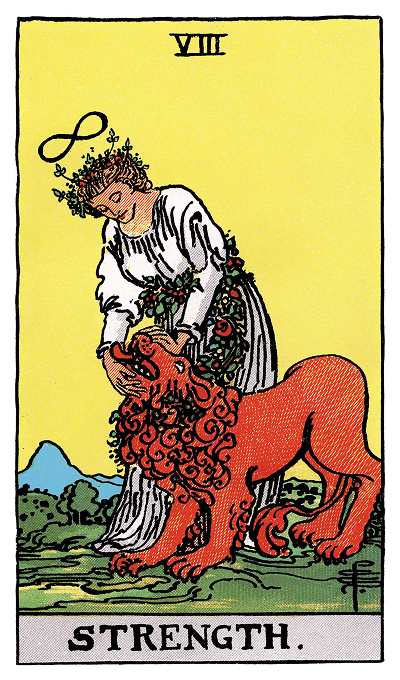
The Strength — Rider-Waite-Smith version
Rider-Waite-Smith
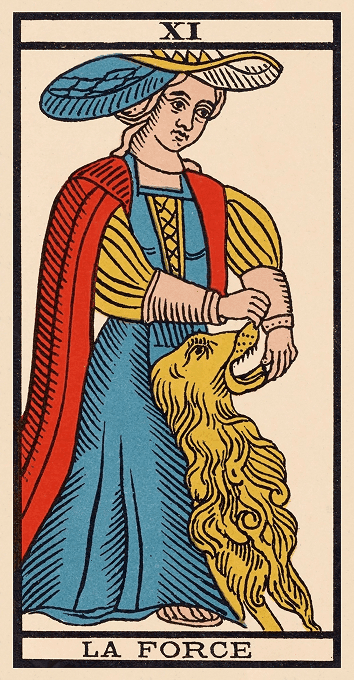
The Strength — Marseille version
Marseille
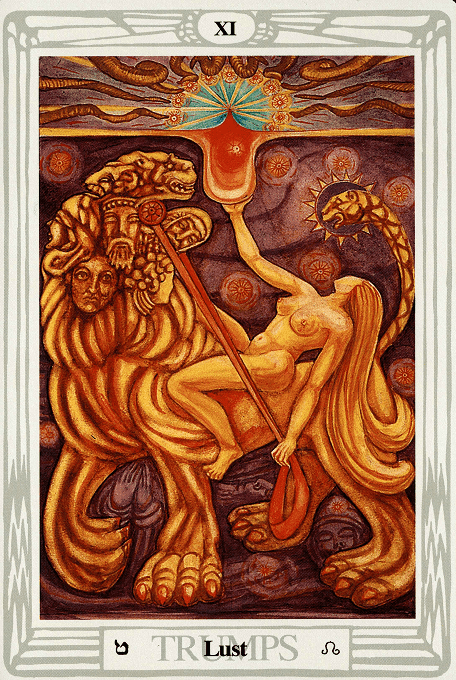
The Strength — Thoth version
Thoth

In the Rider-Waite-Smith deck, a woman in a white robe gently closes a lion's mouth with her bare hands, a lemniscate floating above her head, echoing the same infinity symbol seen above the Magician. Flowers are woven into her hair and draped around her waist, and the setting is an open, sunlit landscape rather than an enclosed or dramatic one. The core message concentrates in three details: the calm, almost tender way she handles the lion, the lemniscate connecting this card to the Magician's own symbol of focused will, and the absence of any struggle or violence in the image despite the lion's power. Together these describe strength expressed through gentleness and command rather than through force.

Waite's 1911 description explicitly favors this quieter reading, noting that the card represents strength that comes from "the higher self" mastering the "lower nature," and describing the woman's power as coming through moral force rather than physical dominance. This is a meaningful departure from the Tarot de Marseille, where the equivalent card, often titled La Force, similarly shows a woman controlling a lion's jaw but is traditionally read with less emphasis on inner psychological mastery and more on raw physical fortitude and the sheer image of overpowering something dangerous. It's also worth noting that in the Thoth deck, Crowley renamed this card Lust and depicted a woman riding a seven-headed beast, pushing the symbolism further toward the integration and transformation of primal energy rather than gentle restraint.

Upright Meaning

Strength represents the ability to influence a powerful force, whether an external situation or an internal impulse, through patience and steadiness rather than through force or domination. Its essential energy is quiet courage: the confidence to face something difficult without needing to overpower it aggressively.

In everyday situations, this often shows up as staying calm and measured during a stressful conversation instead of reacting sharply, or persisting gently with a difficult task rather than forcing a quick resolution. It can also describe managing a strong emotion, like anger or fear, not by suppressing it but by working with it patiently until it settles.

A nuance beginners often miss is that this card isn't about suppressing or denying whatever the "lion" represents. The woman in the image doesn't fight or cage the lion; she calms it while it remains present and powerful. Reading this card only as "control your emotions" misses the more accurate idea of working alongside a difficult feeling or force with patience, rather than eliminating or ignoring it.

Readers disagree somewhat on how much this card should emphasize gentle, moral strength versus raw personal power and vitality. Traditions closely following Waite's language keep the focus on quiet, internal mastery, closely paired with virtues like patience and compassion. The Thoth deck's reframing as Lust pushes toward a very different emphasis: integrating and channeling primal, even sexual, energy rather than calming it into stillness. Both readings share an underlying theme of working with power rather than suppressing it; they differ mainly in how much emphasis to place on restraint versus expression.

Reversed Meaning

Reversed, Strength doesn't simply mean weakness in a general sense. That would just negate the upright meaning. The more useful distinction is between genuine self-doubt and strength that's being expressed as force rather than as patience. Self-doubt suggests a lack of confidence in your ability to face a difficult situation, perhaps avoiding a challenge altogether or feeling overwhelmed by an emotion you'd normally be able to sit with more calmly.

A different shadow expression involves the opposite problem: forcing control rather than earning it through patience, described sometimes as raw aggression standing in for the upright card's gentler influence. This can look like trying to dominate a situation or suppress a feeling through sheer willpower rather than the calmer, steadier approach the upright card describes. This is nearly the opposite of self-doubt, yet both meanings appear under a reversed Strength card depending on the reading's context.

The reversed card can also point to internal conflict: a struggle between impulse and self-control that hasn't yet resolved into either calm mastery or open aggression, sitting somewhere in the tension between the two. This differs from simple weakness; here the issue is an unresolved pull between two responses rather than a clear lack of capacity.

It's worth noting that some readers don't use reversals at all, reading every card only upright and relying on surrounding cards for nuance instead. If that's your approach, the self-doubt, forced control, and internal conflict readings above still apply, held as tensions that can appear within an upright Strength card, particularly in a reading involving something emotionally difficult.

In a daily reading

Strength in a Daily Reading

As a single morning card, Strength is worth reading as a reminder to meet whatever's difficult today with patience rather than force. It's a good day to notice a moment where you'd normally react sharply, and to try holding steady instead.

Say you pull this card before a day that includes a tense conversation with someone who tends to push your buttons. Strength doesn't promise the conversation will be easy; it suggests approaching it calmly and without needing to win or overpower the other person, trusting that steadiness will do more than a forceful reaction.

A daily-pull scenario

A Daily-Pull Scenario

Imagine pulling Strength on a morning before a demanding workout, a difficult conversation, or any situation requiring endurance. A beginner's first instinct might be to read this as a sign to push through by sheer willpower, gritting your teeth until it's over. A more useful reading treats the card as a prompt to pace yourself with patience rather than force, staying present with the difficulty rather than fighting against it. The card describes steady, sustained composure, not a burst of aggressive effort.

Read with care

Common Misreadings

  • This card means physical toughness or power.

    Strength is more often read as inner steadiness and patience than physical force. The gentle handling of the lion in the image points toward calm influence, not raw physical dominance.

  • Reversed always means I'm being weak.

    Reversed can describe self-doubt, but it can just as easily describe forced control or unresolved internal conflict, different problems than simple weakness. The specific shape of the imbalance matters.

  • This card means suppressing my emotions.

    The woman in the image doesn't cage or eliminate the lion; she calms it while it stays present. The card describes working patiently with a strong feeling, not denying or hiding it.

Combinations

Cards That Change Its Meaning

  • StrengthThe Sun

    Amplifies the card's confidence and calm, suggesting inner steadiness paired with genuine optimism, often pointing to a situation where patience is not only working but bringing real relief or clarity along with it.

  • StrengthFive of Swords

    Tempers gentle influence with the presence of real conflict or tension, suggesting that patience alone may not be enough here; some direct address of an ongoing disagreement is also needed.

  • StrengthThe Devil

    Redirects the card's calm mastery toward a harder internal struggle, suggesting the "lion" being faced may be closer to a genuine compulsion or dependency than a manageable emotion, complicating the idea that patience alone will resolve it.

Sit with it

Questions for Reflection

  1. 1

    Where in my life am I trying to force a resolution instead of approaching it with patience?

  2. 2

    What strong feeling have I been trying to suppress rather than sit with calmly?

  3. 3

    Is there a situation where quiet steadiness would serve me better than an aggressive response?

  4. 4

    What would it look like to face something difficult today without needing to immediately control or eliminate it?