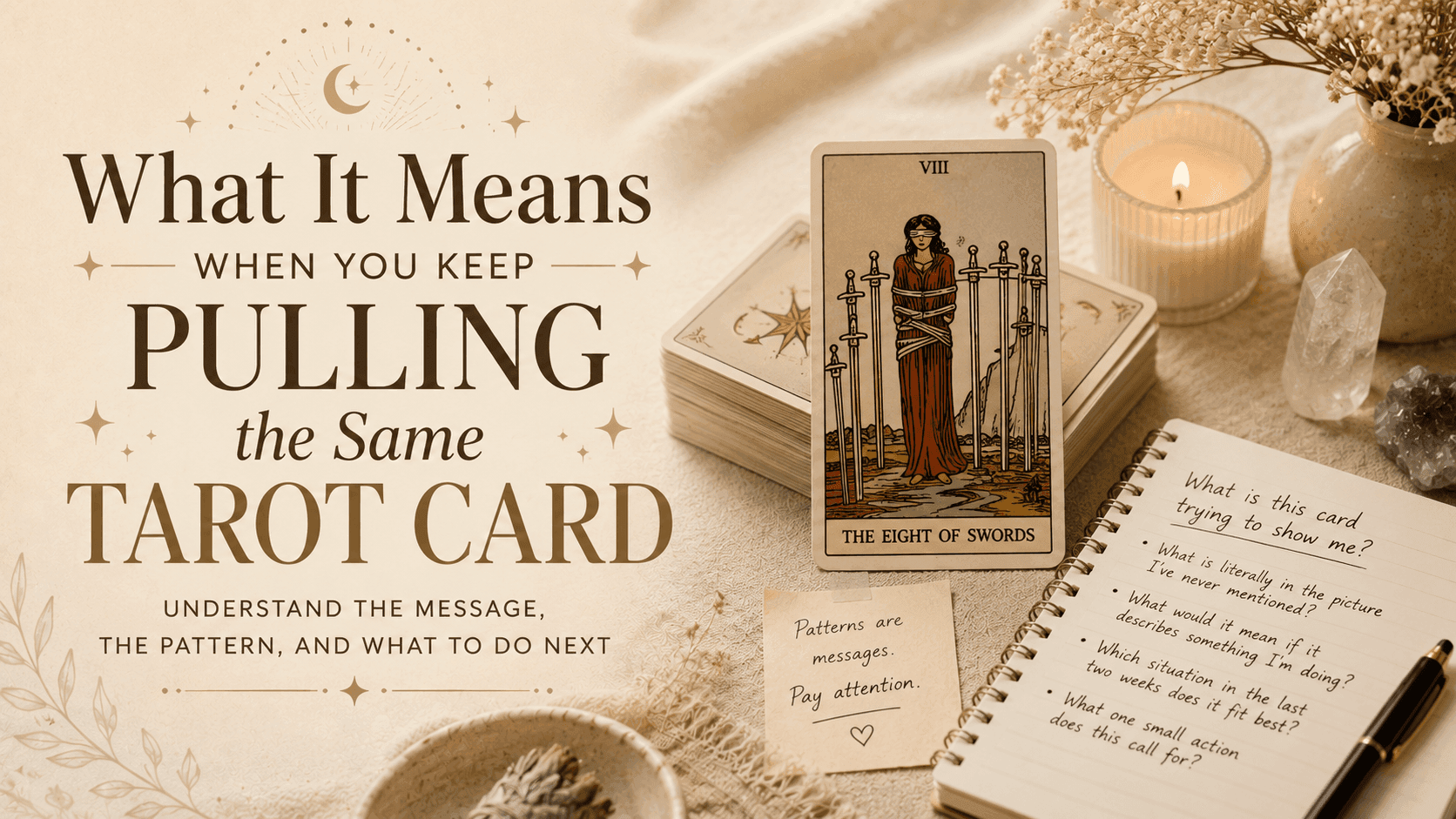
The Eight of Swords again. Fourth time this month, and now you are starting to feel like the deck is nagging at you, or like something is being demanded of you that you have not worked out yet. It is a genuinely unsettling experience, and it is also one of the most common things beginners write in about.
When you keep pulling the same tarot card, there are three separate explanations worth checking, and they are not equally likely. Most of the time it is ordinary probability doing exactly what probability does. Sometimes it is your deck or your hands. Occasionally it is worth reading as something about you. This post covers how to tell which one you are looking at, and gives you a specific method for working a repeating card until it goes quiet.
Why you keep pulling the same tarot card: start with the maths
The number that surprises people: if you pull one card a day and reshuffle the whole deck each time, you only need eleven days before it is more likely than not that some card has already come up twice. By day thirty, a repeat somewhere is close to certain, around 99.8 percent. Over a year of daily pulls, any given card will show up between four and five times on average.
So "the Eight of Swords three times this month" is not an anomaly. It is what a 78-card deck does. The repeat feels significant because you noticed it, and you noticed it because it was the Eight of Swords rather than because it was unusual. You do not remember the forty-one cards that came up once.
This is the common mistake, and it is worth naming plainly: treating a repeat as automatically meaningful, then reasoning backwards to find the meaning. If you look for significance in a coincidence you will always find some, because tarot cards carry broad enough meanings to fit any week.
That does not make the repeat useless. It just means the card is not the evidence. What you do with it is.
Then check your deck and your hands
Physical causes are more common than anyone admits, and they are easy to rule out.
- A new deck is stiff and clumpy. Cards printed together tend to travel together for the first few weeks, so a fresh deck will keep producing the same neighbours until it wears in.
- Bent, dinged or slightly warped cards get found by your fingers. Check the repeating card against the others: hold the deck side-on and look for a card sitting proud, or a corner that is softer than the rest.
- Overhand shuffling barely randomises anything. Shuffling by pulling chunks from the back to the front moves blocks around without breaking them up, so cards stay clustered for a long time.
- Cutting to the same depth every time. A lot of people cut at roughly the same point out of habit, which reintroduces the same section of the deck repeatedly.
The fix takes two minutes. Riffle shuffle seven or so times, or spread the whole deck face down on the table and swirl it around properly before gathering it up. If the card stops appearing after that, you had a mechanical problem, and that is a perfectly good answer.
Then check what you have been asking
If you have ruled out the deck, look at your questions rather than your cards.
Asking a version of the same question every day will produce a narrower range of cards, partly because you are shuffling in a similar state of mind and partly because you are only really registering the cards that speak to that question. Someone worrying about the same unresolved thing for three weeks tends to notice the Two of Swords every time it appears and forget the Six of Wands entirely.
So do this: look back through your notes and write down the actual question you asked each day. If they are all rewordings of one question, the repetition you are seeing is yours, not the deck's.
What a genuine repeat might be pointing at
Once the boring explanations are cleared, a card that keeps returning is worth reading, not as a message but as a marker of something unfinished.
The most useful framing is that the repeating card is usually one you have not actually dealt with. You interpreted it, wrote a tidy sentence about it, and moved on without doing anything, so nothing about your situation has changed and the card still fits. That is why the Eight of Swords keeps landing during a stretch when you feel stuck: not because the deck is insisting, but because the description keeps being accurate.
There is a second pattern worth knowing. Sometimes the card that repeats is the one you read the same way every time, which usually means you are reaching for the first keyword you ever learned and not looking at the picture. A card you have flattened into a single meaning will keep feeling generic, and generic cards keep seeming to apply.
Here is a method for working a repeating card. Take it out of the deck and set it in front of you, then answer four things in writing: what is literally in the picture that you have never mentioned in your notes; what the card would mean if it were describing something you are doing rather than something happening to you; which specific situation in the last two weeks it fits best; and what one small action that situation actually calls for. Then put the card back and carry on.
Imagine Tomas, hypothetically, who has pulled the Four of Cups five times in six weeks of daily practice. He has written "boredom, discontent" every time. He does the exercise. Looking at the picture properly, he notices for the first time that a cup is being offered from a cloud and the seated figure is not refusing it so much as failing to see it, arms folded, eyes down. Reframed as something he is doing rather than something happening to him, it reads as declining things without noticing he is declining them. The situation it fits best is obvious once he asks: he has turned down three invitations from a colleague and told himself each time that he was too tired. The small action is a text arranging coffee for Thursday. Whether or not the Four of Cups shows up again next week, he now has something to do that he did not have before.
When to stop paying attention to it
A repeating card stops being useful the moment it becomes a source of dread. If you are opening the deck already braced for a particular card, or feeling followed by it, the practice has flipped from reflection into anxiety, and the right move is to put the deck away for a week rather than to interpret harder.
This matters most with cards that look ominous. Repeated appearances of Death, the Tower or the Ten of Swords do not accumulate into a warning, and tarot cannot forecast events regardless of how many times a card turns up. A card appearing four times is not four times as urgent as a card appearing once, because the deck has no way of knowing what has happened in between.
If the worry underneath is about your health, your money or a legal situation, no number of repeats is information about it. The reading can at most tell you what you have been carrying around, which is worth knowing before you go and talk to someone who can actually help.
Conclusion
The takeaway: when you keep pulling the same tarot card, probability explains most of it, your shuffling explains a good chunk of the rest, and only what is left is worth reading. The card is not insisting on anything, but a card that keeps fitting is telling you that your situation has not moved.
Do this today. Riffle your deck properly, seven times or more, and then take the repeating card out and write one sentence about something in the picture you have never noticed before. If it comes back after a real shuffle, you have something worth working with rather than a clumpy deck.