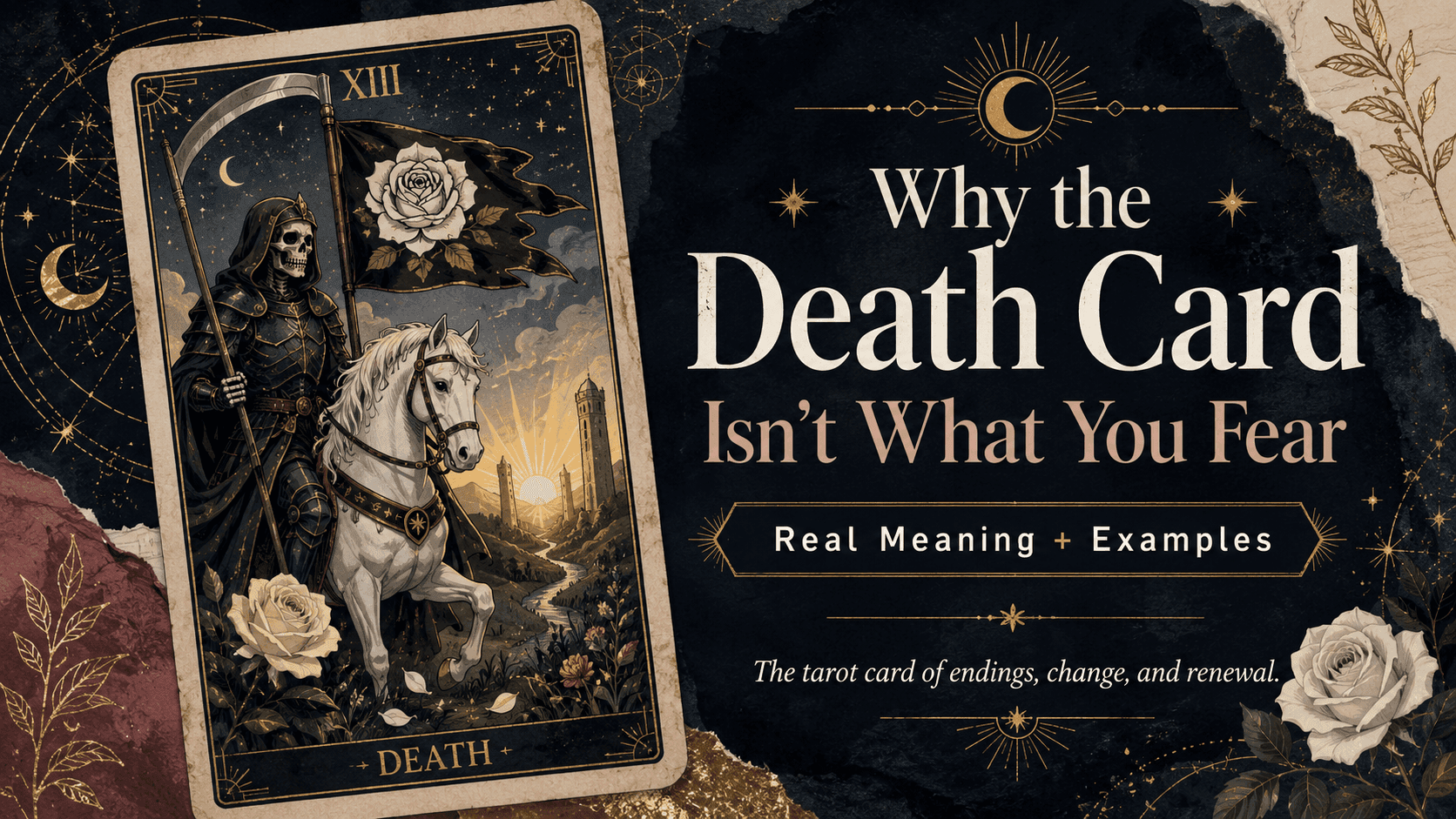
You drew a skeleton on a horse, your stomach dropped, and now you're here typing it into a search bar. Take a breath: pulling this card is one of the most common reasons beginners go looking for reassurance, and the reassurance is real.
The death tarot card meaning has almost nothing to do with literal death, and this post shows you what it actually points to, why the imagery got such a fearsome reputation, and how to read it when it turns up in a real pull. By the end you'll be able to see the card land face-up and know what to do with it instead of bracing for bad news.
We're treating tarot here as a tool for reflection, a way to look at your own situation from a fixed angle. Not a prediction of events, and never a forecast about anyone's health or lifespan.
Where the Fear Actually Comes From
Almost none of the dread attached to this card comes from tarot itself. It comes from movies. A character pulls Death, ominous music swells, and someone dies by the end of the film. That's a screenwriter's shortcut, not a reading, and it has trained a couple of generations to flinch at a card that traditional readers have long treated as one of the most hopeful in the deck.
The imagery doesn't help the card's public relations. In the Rider-Waite-Smith deck, Death is a skeleton in black armor on a white horse, carrying a black banner with a white flower on it, while figures in its path react differently: one has fallen, a child offers flowers, a bishop stands to meet it. It looks grim if you stop at the surface. But notice the detail beginners skip: behind the rider, a sun is rising between two towers. The card is pointing at a sunrise, not just a fall. Whoever designed it wanted an ending and a beginning in the same frame.
What the Card Traditionally Depicts
It helps to know the card wasn't invented to scare you. In the older Marseille tradition, Death is usually shown as a skeleton with a scythe, and in some of those decks the thirteenth trump is left without its name printed at all, which is why you'll sometimes hear it called the unnamed card. The scythe is the giveaway: it's a harvest tool. You cut down the wheat because the wheat is ready, and because next season needs the ground.
Waite's 1911 guide, the Pictorial Key to the Tarot, frames the card around transformation and change rather than physical death, and cautions against reading it the obvious way. That framing is worth holding onto, because it's the source most modern meanings descend from. The consistent thread across traditions isn't dying. It's the hard, ordinary business of one chapter closing so another has room to open.
The Real Meaning: Endings That Make Room
Strip away the costume and the card is about a specific kind of change: the ending you don't fully choose but can't avoid, the one that clears space whether you're ready or not. A job that's over. A version of yourself you've outgrown. A relationship dynamic that can't keep running the way it has.
Compare it to the Tower, which tarot tradition treats as sudden collapse, the shock you never saw coming. Death is slower and more deliberate. The Tower is the roof caving in; Death is the long, quiet knowing that you're moving out. That distinction matters when you read, because it tells you the card is usually less about catastrophe and more about a transition already underway that you might be resisting.
Here's the part beginners get wrong, and it's the opposite of what you'd expect. Once someone learns Death "just means change," they often over-correct, waving it off with a cheerful "it's about new beginnings!" and skipping straight past the loss. But the card holds both. Something genuinely ends, and endings ask to be grieved a little before the sunrise counts for anything. Reading only the hopeful half is as incomplete as reading only the skull.
How to Read It in an Actual Pull
When Death shows up, resist the urge to interpret it in a vacuum. The most useful move is to ask what, in the situation you were actually asking about, might already be ending or asking to end. Then check your own reaction, because your resistance is usually the real message.
A do and a don't make this concrete. Do ask: "What am I holding onto that's already over?" That question turns the card into something you can work with. Don't ask: "Is someone going to die?" That's not a question tarot can answer, and treating a card as if it can is how people talk themselves into fear over a piece of cardboard.
If Death turns up in a daily one-card pull, it's an especially good prompt for exactly this reflection: sit with what in your day or your week feels like it's winding down, and whether you've been pretending otherwise. A single card, read this way, tends to be gentler and more honest than a big anxious spread built to interrogate the scary card.
A Worked Example
Imagine Priya, who pulls Death after asking, "Why do I feel so stuck at work?" Her first instinct is dread. Then she slows down and reads the card the useful way.
She looks at the rising sun behind the skeleton and asks herself what's already ending. The honest answer surfaces fast: the role she's clinging to stopped fitting a year ago, and she's been treating "stuck" as something happening to her rather than a departure she keeps postponing. The card didn't announce a new job or predict she'll quit. It named the thing she'd been avoiding, that a chapter is over and she's the one keeping it artificially open.
Her takeaway, hypothetically, is a single note: the ending already happened; I just haven't acted on it. That's a reading she can do something with tomorrow, and none of it required the card to foretell a single event.
Conclusion
The one thing to carry away: the death tarot card meaning is about the ending that makes room, not the ending you fear, and your own resistance to that ending is usually the reading. The skeleton is holding a harvest tool, and there's a sunrise behind it for a reason.
So do this today. Take the card out of your deck, look at it for a full minute, and write down one thing in your life that's genuinely over but that you're still holding open. You don't have to act on it yet. Naming it is the whole first step.