Major ArcanaCard 13Scorpio
Tarot Card Meaning

Death

The Death tarot card means transformation, endings, and necessary change, not literal death. Explore its upright and reversed meanings, symbolism, and daily-pull guidance.

Death tarot card
At a glance

Quick Keywords

Upright
  • transformation
  • endings
  • transition
  • letting go
  • change
  • release
  • renewal
  • closure
Reversed
  • resistance to change
  • stagnation
  • fear of endings
  • prolonged transition
  • avoidance
  • incomplete letting go
  • delayed transformation
Symbolism

What's in the Image

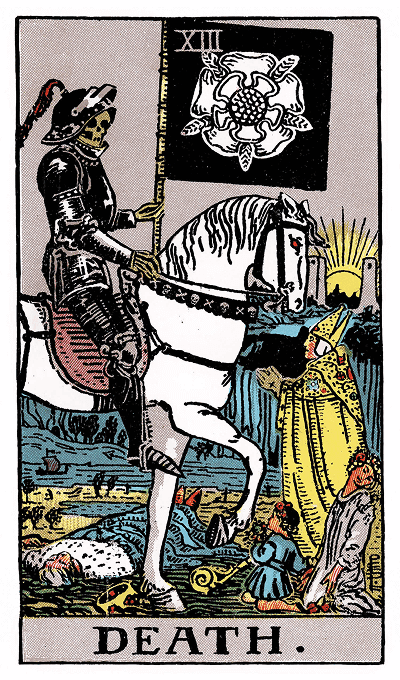
The Death — Rider-Waite-Smith version
Rider-Waite-Smith
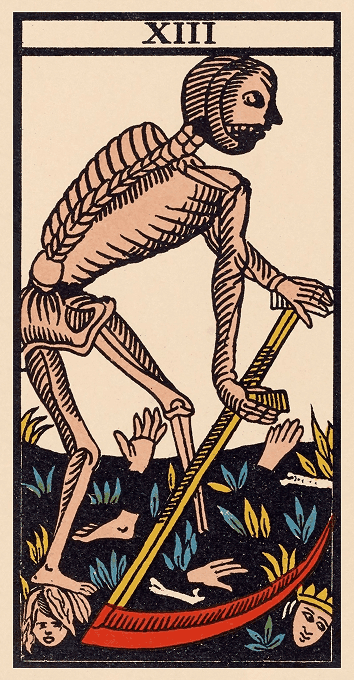
The Death — Marseille version
Marseille
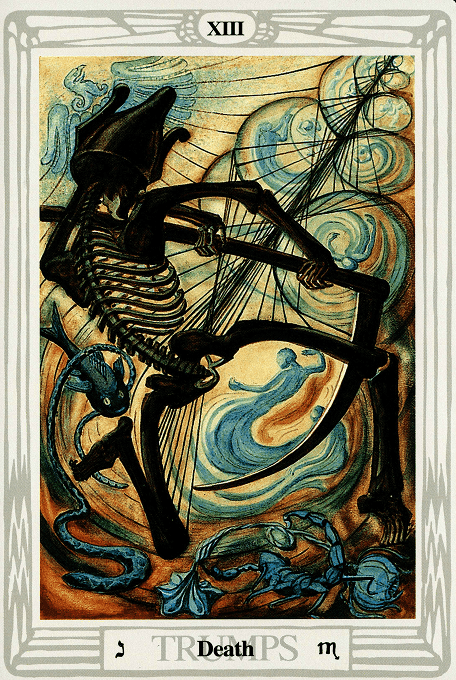
The Death — Thoth version
Thoth

In the Rider-Waite-Smith deck, a skeletal figure in black armor rides a white horse, carrying a black flag marked with a white rose. Around him lie figures from different walks of life, a fallen king, a young child, a maiden, and a bishop who approaches with hands folded, while a rising sun appears between two distant towers in the background. The core message concentrates in three details: the white rose on the flag, a traditional symbol of purity and new life rather than horror, the varied figures on the ground representing that this transition touches everyone regardless of status, and the rising sun in the distance, suggesting renewal following whatever ends. Together these describe Death as impartial, natural transition rather than a targeted or final catastrophe.

Waite's 1911 notes are direct about this, stating plainly that this card does not signify literal death and describing it instead as pointing to change, transformation, and the natural close of one stage before another begins. This framing is largely consistent across historical versions of the card. The Tarot de Marseille's equivalent, often left unnamed on the card itself (sometimes called simply "Arcanum XIII" or "L'Arcane sans Nom," the nameless arcana), shows a similar skeletal figure with a scythe cutting through a field containing various human forms, an image that predates Waite and reinforces the same idea of transformation as an old, well-established reading rather than one Waite invented to soften the card.

Upright Meaning

Death represents the end of one phase and the necessary clearing that makes room for the next one. Its essential energy is transformation: something has run its course and needs to be released, even if the ending itself feels uncomfortable or unwelcome at first.

In everyday situations, this often shows up as a significant transition, like the end of a job, a relationship, a living situation, or a long-held habit or identity that no longer fits. It can also describe a quieter, internal shift: letting go of an old way of thinking about yourself or a situation, even when nothing external has visibly changed yet.

A nuance beginners often miss is that this card describes a process, not a single instant. The rising sun in the background suggests renewal is coming, but it hasn't fully arrived yet within the scene itself, meaning the card often points to being in the middle of a transition rather than at its resolved end. Reading this card only as "something is over" skips over the equally important sense that the new phase is still forming and hasn't fully taken shape.

Readers disagree somewhat on how much this card should be read symbolically versus how directly it should be tied to a specific real-world ending. Nearly all tarot traditions agree the card is not a literal prediction of physical death, a point worth stating clearly given how often newcomers worry about this. Beyond that agreement, some readers connect the card closely to identity and psychological transformation, while others read it more concretely, pointing to the actual end of a specific situation, relationship, or chapter. Both readings share the core theme of necessary ending; they differ in how literally or symbolically that ending should be understood.

Reversed Meaning

Reversed, Death doesn't simply mean the ending is avoided or canceled. That would just negate the upright meaning without engaging with what actually gets stuck. The more useful distinction is between an ending that's being actively resisted and one that's simply taking longer than expected. Resistance suggests holding onto something past the point where it still serves you, refusing to acknowledge that a phase has genuinely ended even as evidence mounts that it has.

A different shadow expression involves a transition that's stalled rather than resisted outright: the old phase has ended, but the new one hasn't clearly begun, leaving an uncomfortable, undefined middle stretch. This can look like a project that's wrapped up without a clear next step, or a relationship that's effectively over without anyone naming it yet. This is a distinct problem from active resistance, since the person here may be willing to move on but lacks clarity about what comes next.

The reversed card can also point to fear driving the avoidance: staying in a familiar situation specifically because the unknown feels more threatening than the discomfort of what's not working. This differs from simple stubbornness; the underlying driver here is anxiety about the transition itself rather than attachment to the old phase.

It's worth noting that some readers don't use reversals at all, reading every card only upright and relying on surrounding cards for shading instead. If that's your approach, the resistance, stalled-transition, and fear-driven readings above still apply, held as tensions that can appear within an upright Death card, particularly in a reading involving a change that already feels overdue or incomplete.

In a daily reading

Death in a Daily Reading

As a single morning card, Death is worth reading as a nudge to notice what in your life has already run its course, even if you haven't fully acknowledged it yet. It's a good day to consider what letting go, even in a small way, might actually free up.

Say you pull this card before a day that includes cleaning out a closet, ending a subscription, or wrapping up a project that's dragged on longer than it should have. Death doesn't describe anything alarming here; it simply points to the value of clearing something out deliberately, making space for whatever comes next rather than letting the old thing linger indefinitely.

A daily-pull scenario

A Daily-Pull Scenario

Imagine pulling Death on a morning before a conversation about ending a routine you've outgrown, like a weekly commitment that no longer feels meaningful. A beginner's first instinct might be to panic, assuming the card predicts something frightening happening that day. A more useful reading treats the card as a straightforward invitation to name what's already over and stop investing energy in maintaining it, whether or not you make any external change today. The card points toward honest acknowledgment of an ending, not a warning about anything sudden or harmful.

Read with care

Common Misreadings

  • This card predicts literal death.

    Nearly every tarot tradition, going back well before Waite's own explicit denial of this reading, treats this card as symbolic transformation rather than a literal prediction. Reading it that way causes unnecessary alarm the card doesn't actually support.

  • This card means the ending has already fully resolved.

    The rising sun in the image is still distant, suggesting the new phase hasn't fully arrived yet. The card often describes being in the middle of a transition rather than at its finished, settled outcome.

  • Reversed always means I'm refusing to change.

    Reversed can describe active resistance, but it can just as easily describe a transition that's simply stalled in an undefined middle stage, or avoidance driven by fear rather than stubbornness.

Combinations

Cards That Change Its Meaning

  • DeathThe Tower

    Amplifies the sense of abrupt, forceful ending, suggesting a transformation that arrives suddenly and disruptively rather than as a gradual, expected close to something.

  • DeathThe Star

    Tempers the difficulty of an ending with a sense of hope, suggesting that whatever renewal follows this transition is likely to feel gentler and more encouraging than the ending itself might suggest.

  • DeathEight of Swords

    Redirects natural transformation toward a sense of being trapped, suggesting the person may recognize a phase has ended but feel unable to actually release it or move forward yet.

Sit with it

Questions for Reflection

  1. 1

    What in my life has already run its course, even if I haven't fully acknowledged it?

  2. 2

    Where am I holding onto something out of habit rather than because it still serves me?

  3. 3

    What would it feel like to let a specific chapter close, even without knowing exactly what comes next?

  4. 4

    Is fear of the unknown keeping me in a situation longer than it needs to last?