SwordsAir
Tarot Card Meaning

Three of Swords

The Three of Swords means heartbreak, grief, and painful truth. Explore its upright and reversed meanings, symbolism, and daily-pull guidance.

Three of Swords tarot card
At a glance

Quick Keywords

Upright
  • heartbreak
  • grief
  • painful truth
  • emotional hurt
  • sorrow
  • betrayal
  • necessary pain
Reversed
  • healing
  • releasing pain
  • recovery
  • forgiveness
  • processing grief
  • moving past heartbreak
Symbolism

What's in the Image

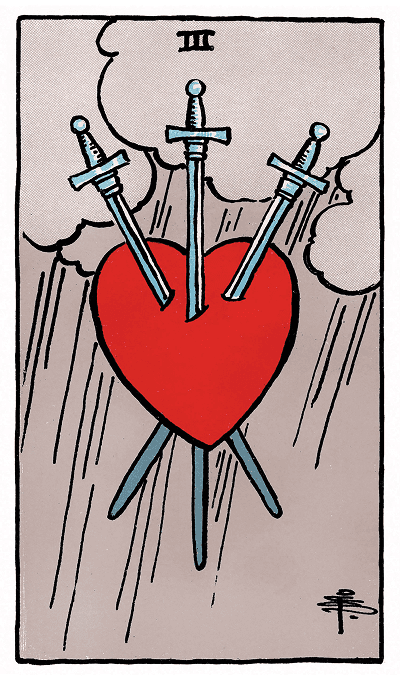
The Three of Swords — Rider-Waite-Smith version
Rider-Waite-Smith
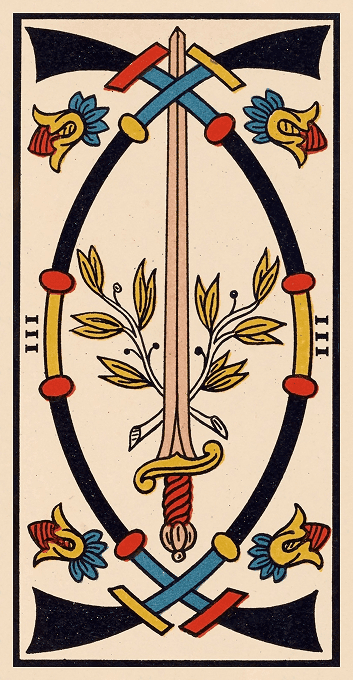
The Three of Swords — Marseille version
Marseille
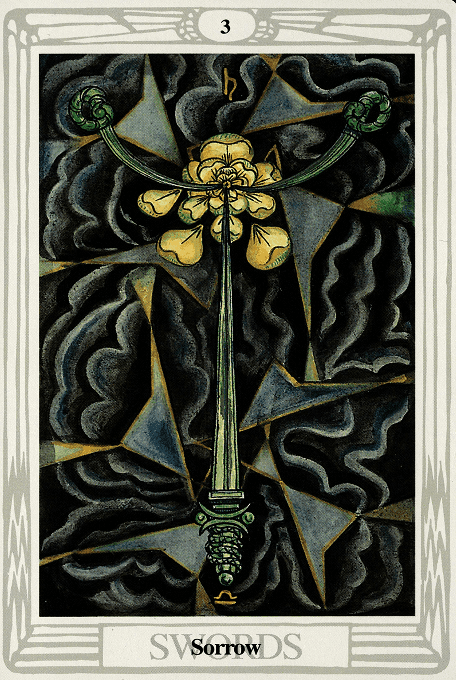
The Three of Swords — Thoth version
Thoth

In the Rider-Waite-Smith deck, three swords pierce a single red heart floating against a gray sky, with rain falling steadily around it. The core message concentrates in three details: the three swords piercing the heart from different angles, suggesting pain that comes from more than one direction or source at once, the rain falling in the background, echoing tears and ongoing sorrow rather than a single sharp moment already past, and the heart's isolation against a plain, stormy sky, without any other figures or landscape present, indicating that this hurt is felt intensely and personally, without distraction. Together these describe genuine emotional pain, direct and unambiguous rather than softened or metaphorical.

Waite's 1911 notes describe this card plainly in terms of heartbreak, sorrow, and grief, without much additional symbolic layering, one of the more direct and unambiguous cards in the deck in terms of matching its image to its meaning, a straightforwardness modern readers sometimes still resist by searching for a more comforting interpretation. Earlier decks, including the Tarot de Marseille, depict the threes of each suit without any illustrated scene, typically showing simply three swords arranged decoratively, meaning the specific, emotionally direct image of a pierced heart in the rain is Waite and Smith's addition, and one of their more starkly emotional Minor Arcana scenes.

Upright Meaning

The Three of Swords represents genuine emotional pain, often connected to heartbreak, loss, or a painful truth that's become impossible to avoid. Its essential energy is direct sorrow: hurt that's real and significant, not something to minimize or explain away.

In everyday situations, this often shows up as the end of a relationship, a painful realization about someone you trusted, or simply a period of grief following a significant disappointment or loss. It can also describe the pain of hearing or facing a difficult truth, one that hurts specifically because it's honest and can't be avoided any longer.

A nuance beginners often miss is that this card doesn't suggest the pain is meaningless or purely destructive. Sorrow that arrives this directly is often connected to something that mattered genuinely, and facing it honestly, rather than deflecting or minimizing it, is frequently part of how healing eventually becomes possible. Reading this card only as "something terrible is happening" without acknowledging the deeper honesty involved misses the more complete picture: pain that's real, but not without eventual purpose or resolution.

Readers disagree somewhat on how much comfort to offer alongside this card's direct difficulty. Some traditions present the Three of Swords starkly, without much added reassurance, respecting the genuine weight of grief or heartbreak without rushing to soften it. Other, more gentle approaches pair the card's honesty with a reminder that acknowledging pain honestly is itself a meaningful, even necessary step toward eventually moving through it. Both readings agree on the card's core meaning, genuine emotional hurt; they differ mainly in how much they emphasize the path forward alongside the pain itself.

Reversed Meaning

Reversed, the Three of Swords doesn't simply mean the pain has vanished instantly. That would just negate the upright meaning without describing the actual process involved. The more useful distinction is between genuine healing that's underway and pain that's being suppressed rather than processed. Genuine healing suggests real movement through grief, releasing some of the acute hurt described by the upright card as time and reflection do their work.

A different shadow expression involves suppression: pushing painful feelings aside rather than actually working through them, which can look like healing on the surface but often leaves the underlying hurt unaddressed and liable to resurface later. This differs from genuine healing, since here the pain hasn't actually been processed, just avoided or delayed.

The reversed card can also point to forgiveness, either of yourself or someone else, actively releasing resentment tied to the original hurt in a way that allows real movement forward. This differs from both healing and suppression; here the emphasis is specifically on letting go of blame rather than simply feeling better over time.

It's worth noting that some readers don't use reversals at all, reading every card only upright and relying on surrounding cards for shading instead. If that's your approach, the genuine-healing, suppression, and forgiveness readings above still apply, held as tensions that can appear within an upright Three of Swords, particularly in a reading involving grief or heartbreak that's had some time to settle.

In a daily reading

Three of Swords in a Daily Reading

As a single morning card, the Three of Swords is worth reading as permission to acknowledge a genuine hurt today rather than pushing it aside. It's also a gentle nudge to be honest with yourself about pain you may have been minimizing.

Say you pull this card before a day that includes processing news that's genuinely painful, like the end of an important relationship or a disappointing truth about a situation you'd hoped would go differently. The Three of Swords doesn't ask you to feel better quickly; it suggests allowing the sorrow its space, rather than rushing to explain it away or pretend it doesn't hurt.

A daily-pull scenario

A Daily-Pull Scenario

Imagine pulling the Three of Swords on a morning after receiving disappointing or hurtful news, like learning something painful about a friendship or relationship. A beginner's first instinct might be to read this as confirmation that something is fundamentally wrong with you or your life. A more useful reading treats the card as an honest acknowledgment that this specific hurt is real and significant, worth taking seriously rather than minimizing, while trusting that direct, honest grief tends to move through more fully than pain that's pushed aside or ignored.

Read with care

Common Misreadings

  • This card means something catastrophic is about to happen.

    The Three of Swords describes genuine emotional pain, often connected to heartbreak or a difficult truth, but its scope depends on the specific situation and surrounding cards, not a guaranteed disaster.

  • This card means I should hide how much this hurts.

    The image doesn't soften or hide the pain; it shows it directly and honestly. This card supports acknowledging genuine hurt rather than minimizing or disguising it.

  • Reversed always means I've fully healed.

    Reversed can describe genuine healing, but it can just as easily describe suppression, pain pushed aside rather than actually processed, which isn't the same as real recovery.

Combinations

Cards That Change Its Meaning

  • Three of SwordsTen of Swords

    Amplifies the sense of a difficult ending, suggesting the pain described here connects to a situation that's reached its most painful, exhausted point rather than an isolated hurt.

  • Three of SwordsThe Star

    Tempers acute pain with a sense of hope, suggesting that even amid real heartbreak, some genuine healing or comfort is also becoming available.

  • Three of SwordsTwo of Cups

    Redirects painful hurt toward the possibility of repair, suggesting the relationship or connection involved may still have room for reconciliation despite the current difficulty.

Sit with it

Questions for Reflection

  1. 1

    What genuine hurt have I been minimizing or pushing aside rather than acknowledging honestly?

  2. 2

    Is there grief I've been avoiding sitting with because it feels too painful to face directly?

  3. 3

    What would it look like to let myself feel a difficult emotion fully, without rushing past it?

  4. 4

    Is there resentment connected to this pain that I might need to work on releasing over time?