You bought a deck, flipped through all 78 cards, and realized the keywords from the little booklet vanish the second you close it. If you're trying to work out how to memorize tarot card meanings without drowning in flashcards, this post gives you a system built on how memory actually works: structure first, associations second, and small daily reps instead of one exhausting cram session. By the end you'll be able to break the deck into learnable chunks, use a few memory tricks that genuinely stick, and test yourself so you know what you've actually retained versus what just felt familiar. No mysticism, no shortcuts that fall apart in a week, just study technique applied to a 78-card system.
Start With the Map, Not the 78 Cards
The most common beginner mistake is treating the deck as 78 unrelated facts to memorize one at a time. That's the slow, painful road. A standard tarot deck has a structure, and learning the structure first turns 78 items into a handful of small, related groups.
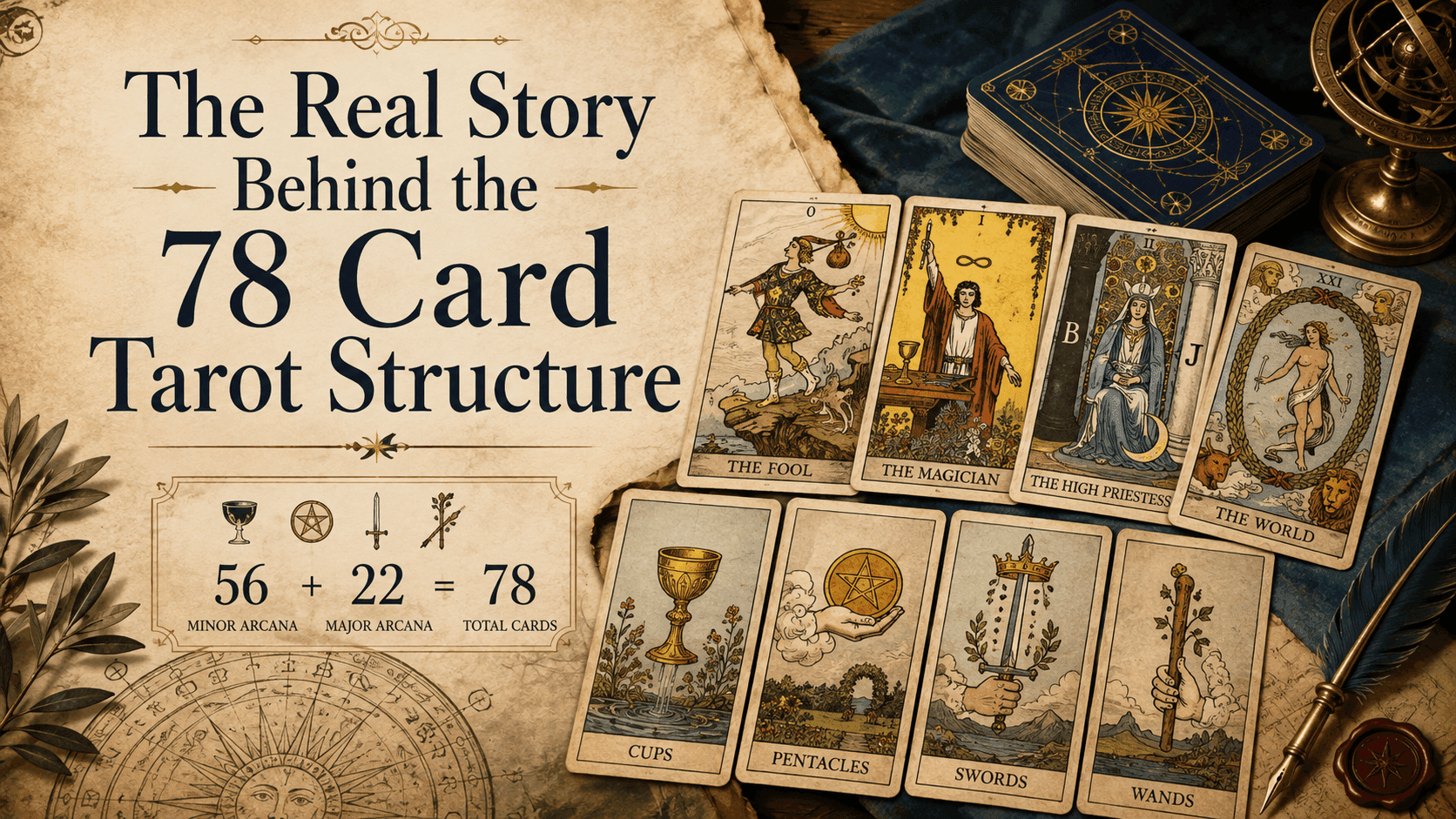
Here's the map. There are 22 Major Arcana cards (The Fool through The World) that deal with big life themes. The remaining 56 are the Minor Arcana, split into four suits of 14 cards each. Every suit runs Ace through Ten, plus four court cards: Page, Knight, Queen, and King in most decks.
Think of it like learning a new card game: you don't memorize every possible hand on day one, you learn the suits and the ranking first, and the specific combinations start making sense on their own. Do this and a card like the Five of Cups already tells you two things before you've studied it individually: it belongs to the Cups suit, and it sits at the number five.
Learn the Four Suits as Four Moods
Once you have the map, learn the four suits as four themes rather than 56 separate cards. Each suit traditionally maps to an element and a slice of everyday life, and that theme colors every card in it.
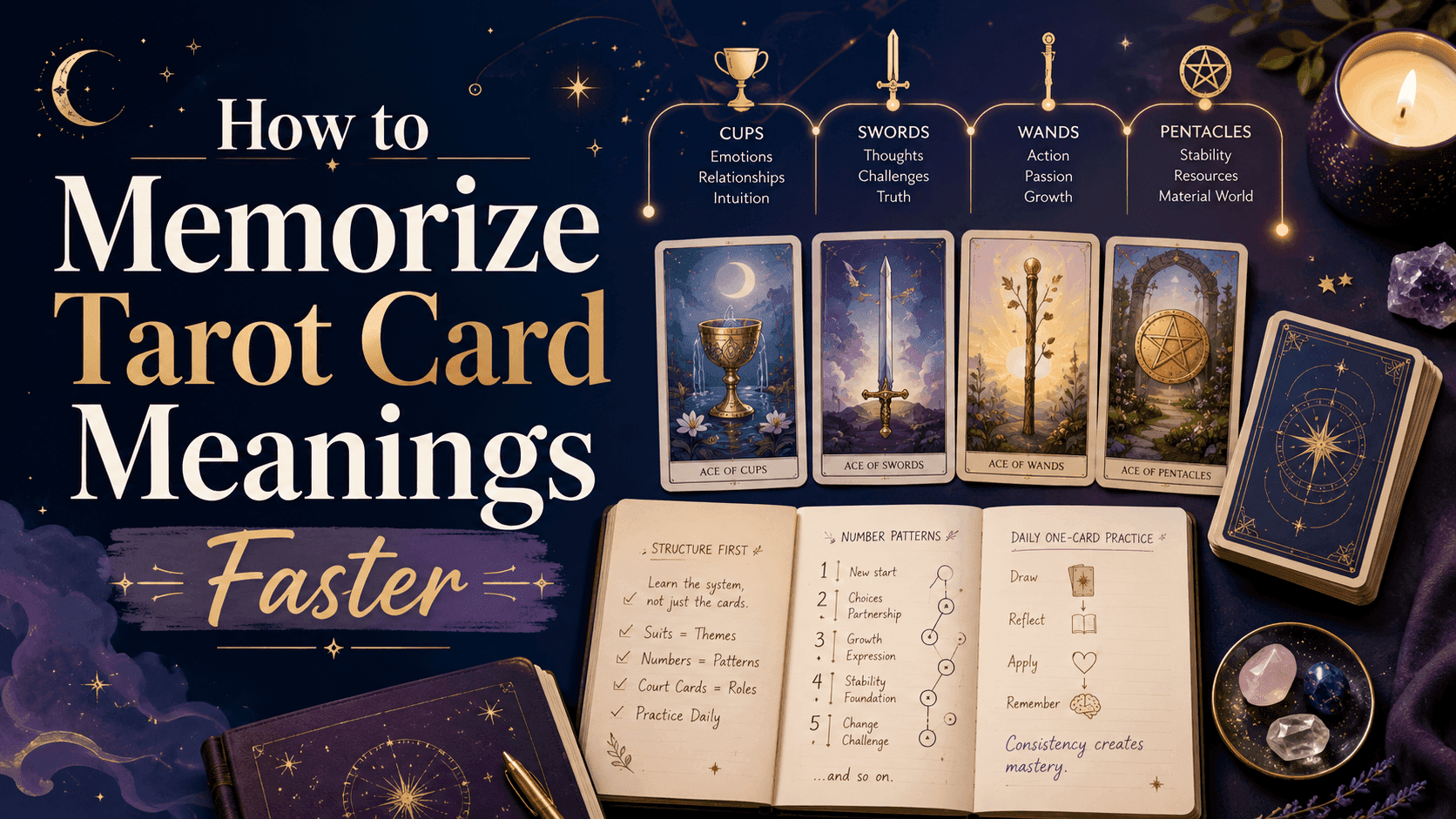
In the widely used Rider-Waite-Smith system, Wands connect to fire and to energy, drive, and creative action. Cups connect to water and to emotions and relationships. Swords connect to air and to thought, conflict, and communication. Pentacles (sometimes called Coins) connect to earth and to work, resources, and the physical world.
A useful exercise: pull all 14 cards of a single suit out and lay them in a row. You'll notice they share a visual palette and a mood, with the Cups tending to feel softer and the Swords sharper. Don't try to learn all four suits in one sitting, though. Spend a day or two living with one suit before moving to the next, so the themes don't blur together in your head.
Read the Numbers as a Story Arc
Within each suit, the numbers Ace through Ten aren't random. They trace a rough progression, and learning that arc lets you anticipate a card's flavor before you look it up. This is one of the biggest speed boosts available to a beginner.
Traditionally, an Ace represents a seed or beginning, the middle numbers show development and complication, and the Ten marks the completion or overflow of that suit's theme. So the same number tends to rhyme across suits. Once you know that Tens sit at the "full completion" end of the scale, the Ten of Pentacles (worldly matters coming to fruition) and the Ten of Swords (a thought-cycle reaching its bitter end) both slot into place faster.
Compare that to memorizing "Ten of Pentacles" as an isolated definition with no scaffolding underneath it. The arc gives every numbered card a hook to hang on, which is exactly what your memory needs.
Let the Pictures Do the Work
If your deck is a Rider-Waite-Smith style deck, the most common beginner choice, the illustrations are memory aids, not decoration. That deck, published in 1909 with artwork by Pamela Colman Smith and guidance from A.E. Waite, gave every numbered card a full scene. Waite's 1911 companion, The Pictorial Key to the Tarot, walks through that imagery card by card.
This matters for memorizing because a picture is far easier to recall than an abstract keyword. The Eight of Cups shows a figure walking away from a stack of cups toward the hills; you don't need to memorize "walking away from something emotionally invested in" as words when the image already says it for you.
Worth knowing: the older Marseille tradition treats the numbered cards differently, showing arranged suit symbols rather than scenes, so those pips lean more on the number-and-suit logic above. So a quick do and don't: if you chose a Marseille-style deck, lean harder on structure; if you chose an RWS-style deck, describe each scene out loud in one plain sentence and let that sentence become the meaning you remember.
How to Memorize Tarot Card Meanings With One Card a Day
Cramming all 78 cards in a weekend feels productive and then disappears by Wednesday. Spaced repetition, which means revisiting a small set over several days with gaps in between, is how the meanings move into long-term memory. You don't need an app; you need a few minutes daily and a way to test recall.
This is where a daily one-card draw earns its place. Each morning, pull a single card and, before looking anything up, say what you think it means using the tools above: its suit theme, its number on the arc, and whatever the picture shows. Then check yourself. The gap between your guess and the reference meaning is exactly the thing worth reviewing, and it sticks better than passive re-reading because you had to retrieve it first.
Imagine someone, call him Marcus, a week into a new deck. He draws the Eight of Wands and blanks. Instead of just reading the definition, he works it: Wands means fire and action, eight is high on the number arc, and the card shows eight wands flying through open air. He guesses "fast movement, things picking up speed." He checks, sees he's close, and writes one sentence in a notebook. Three days later the card resurfaces in his daily draw and the meaning arrives before he can look it up. That act of retrieval, not the first reading, is what made it stick.
Conclusion
The fastest way to learn the deck isn't more hours. It's better structure. Learn the map, then the suit themes, then the number arc, and let the pictures carry the rest, reviewing a little each day instead of all at once. That's really all how to memorize tarot card meanings comes down to: turning 78 isolated facts into a few connected systems your memory can actually hold.
Your action for today: pull one card, and before you look anything up, name its suit theme, its number on the arc, and one thing the picture shows. Write your one-sentence guess down. That single rep is the whole method in miniature.