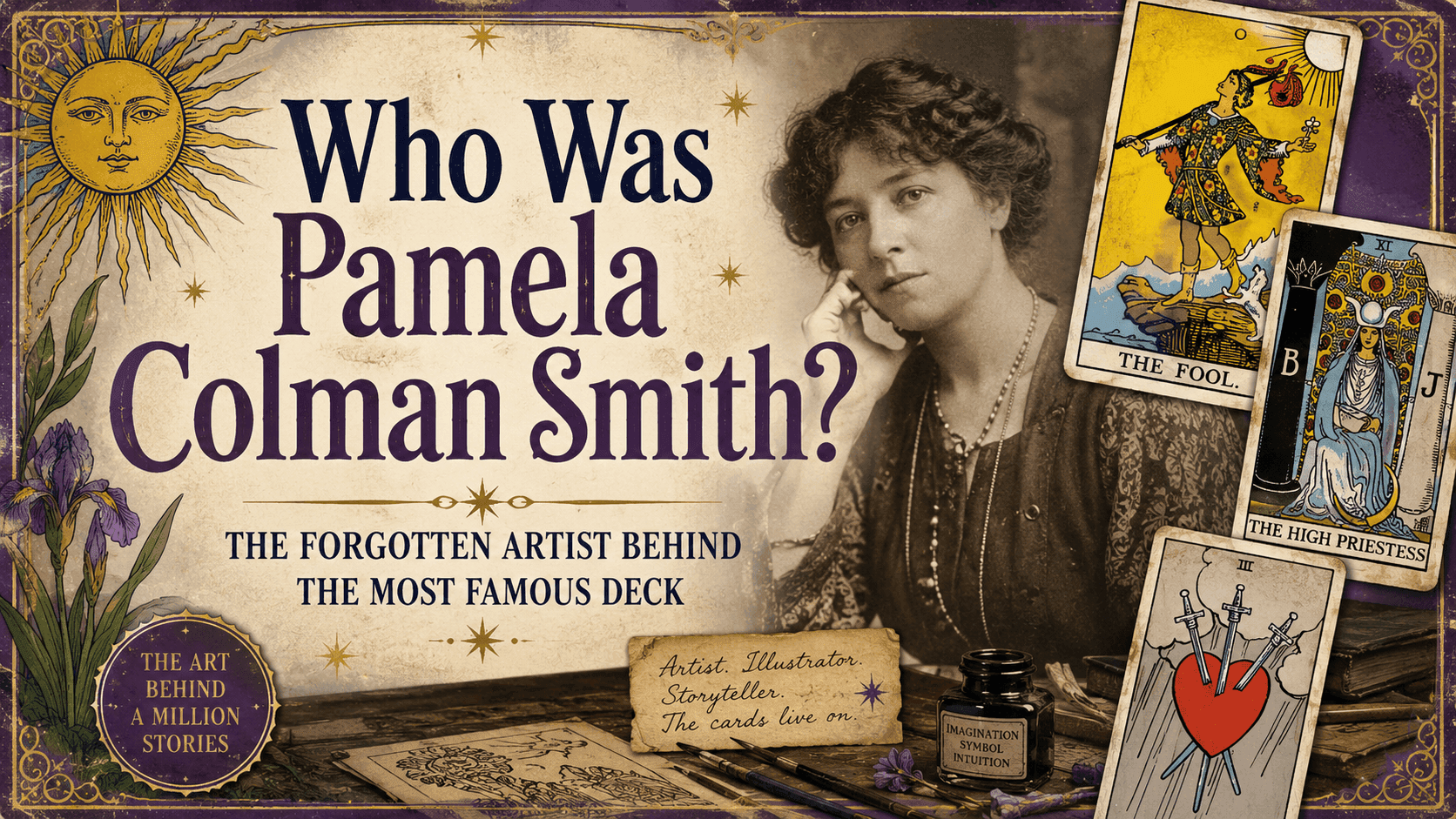
You almost certainly own her work. If you learned on the yellow-skied Fool, the two pillars of the High Priestess, or the three swords through a red heart, you learned on pictures drawn by a woman whose name was left off the box for sixty years. Most Pamela Colman Smith tarot cards are so familiar now that people forget somebody sat down and invented them, in a matter of months, for a one-off fee.
This post covers who she was, what she actually contributed as opposed to what her collaborator A.E. Waite contributed, why her name disappeared, and how knowing all that changes the way you look at a card. By the end you will have a specific method for reading her pictures, drawn from advice she gave art students herself.
The short version of her life
She was born in Pimlico, London, in February 1878, to American parents, and grew up between London, New York and Kingston, Jamaica, where her father had business interests. She trained at the Pratt Institute in Brooklyn in the 1890s. Back in England, she fell in with the Lyceum Theatre circle around Ellen Terry, Henry Irving and Bram Stoker, touring with them and working on costumes and sets. The nickname that stuck to her for life, Pixie, is usually credited to Terry.
Almost nothing about her career was narrow. She wrote and illustrated two collections of Jamaican folk tales, ran a magazine and then a small press that published mostly women writers, and illustrated more than twenty books. She had synesthesia, and painted the images that came to her while listening to music. Those paintings got her three shows at Alfred Stieglitz's New York gallery 291, starting in 1907, where she was the first non-photographer he exhibited. In 1901, W.B. Yeats introduced her to the Hermetic Order of the Golden Dawn. That is where she met Waite.
The commission that made everything else forgettable
In 1909 Waite asked her to illustrate a full tarot deck. She finished it inside the year. In November of that year she wrote to Stieglitz that she had just finished "a big job for very little cash!" and described it as a set of eighty designs for a pack of tarot cards. She was paid a flat fee. No royalties, then or ever, which is why a deck with well over a hundred million copies in circulation made its illustrator no money at all.
William Rider & Son published it in London in December 1909, sold as tarot cards accompanied by Waite's small guide. His fuller illustrated version, The Pictorial Key to the Tarot, followed shortly after, using her black and white drawings.
The division of labor matters if you want to read the cards accurately. Waite set the symbolic system and gave detailed instructions for the trumps; in his memoir he claimed he steered her closely on a few of them, naming the High Priestess, the Fool and the Hanged Man. For the 56 minor cards, the surviving evidence suggests he handed her lists of meanings rather than scene descriptions. So when you look at the Five of Cups or the Eight of Swords, you are looking at a working illustrator's solution to a brief, not an occultist's coded instruction.
What she actually invented
Here is the part beginners usually miss. Before 1909, the minor cards in nearly every deck were pips: the Six of Cups showed six cups, arranged decoratively, and nothing else. The Marseille tradition still works that way, and Marseille readers get meaning from suit, number and position rather than from a picture. Smith gave all 56 of those cards a scene with people in it.
That single decision is why modern tarot looks the way it does, and why you can pull the Ten of Wands and get something from it on day one without memorizing a table. Almost every illustrated deck sold today is descended from her solution, even when the art style is nothing like hers.
She was not working in a vacuum. The 15th-century Italian Sola Busca deck had illustrated pips, and photographs of it reached the British Museum around 1907, two years before she started. Researchers point to her Three of Swords and Ten of Wands as clear echoes of it. The rest looks like her own invention.
How to read a Pamela Colman Smith tarot card more closely
Smith left almost no commentary on the deck. She did, however, write an essay for art students called "Should the Art Student Think?" in which she described how to look at a picture and how to build one, and her advice works startlingly well as a reading method:
- Describe the card out loud, literally, before you name it. Who is in it, how many, where.
- Read the body. Posture, gesture, what the figure is doing with their hands and weight.
- Read the face and clothing. Where are the eyes pointed, and what does the dress say about the person's situation.
- Say what simple feeling the whole composition is built on: joy, fear, sorrow, refusal.
- Only then check a book, and notice where the book disagrees with what you saw.
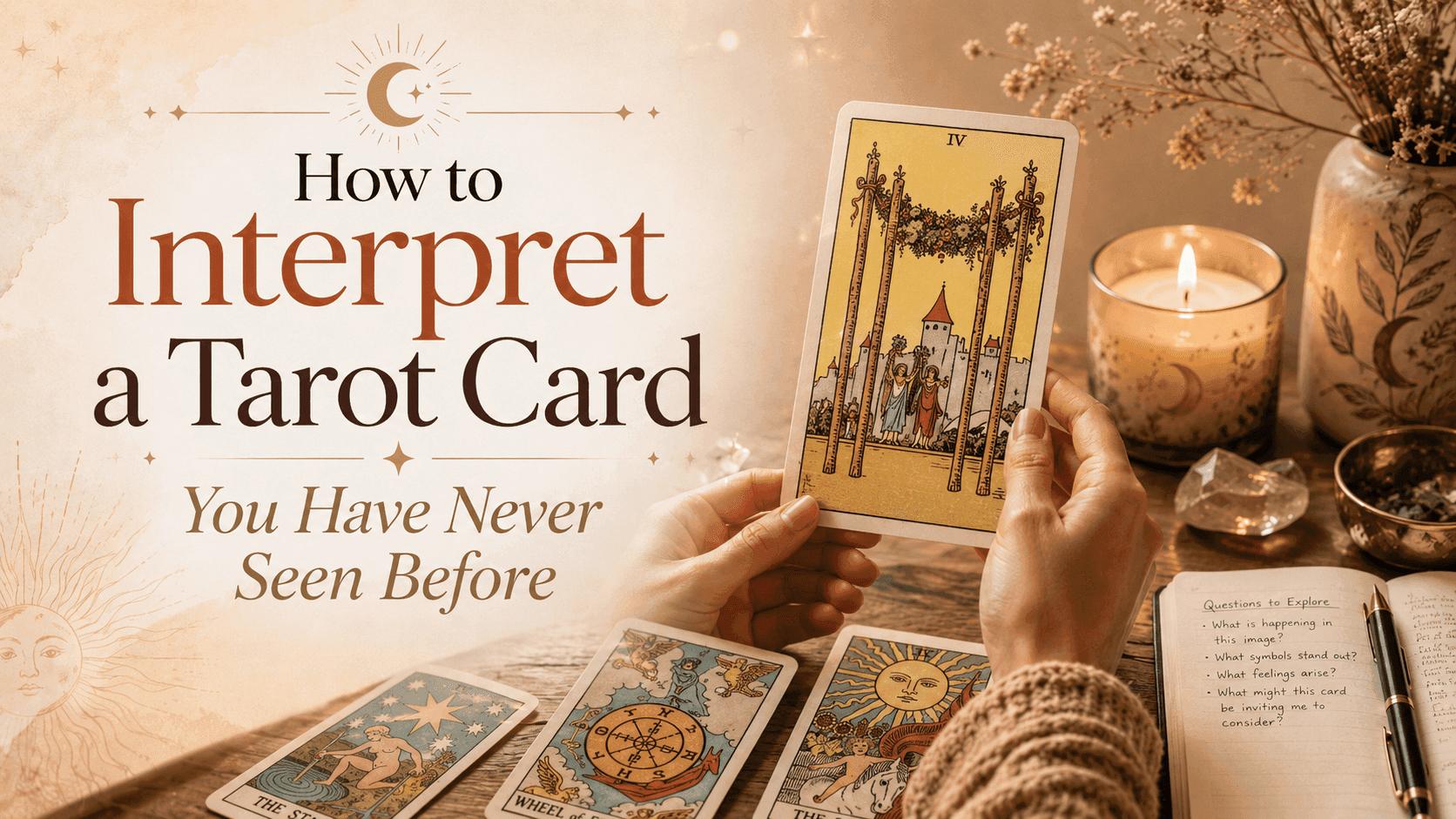
The common beginner mistake is doing this in reverse: looking up the keyword first, then hunting the picture for evidence of the keyword. That turns Smith's illustration into decoration and throws away the thing that makes her deck usable.
Imagine Rachel, a month into learning, who pulls the Eight of Cups and reaches straight for her guidebook, which says "walking away." She writes down "walking away" and feels vaguely guilty about her job for a day. Now imagine she does it in Smith's order instead. She describes it aloud: a figure in a red cloak, back turned, climbing over rocks at night, moon overhead, eight cups stacked behind him with a gap in the top row. The body reads as effortful, not decisive. The gap is what she notices most, because she was not looking for a keyword. Her note becomes: "Something is missing from a set I built, and leaving it is going to be uphill work in the dark." That is arguable in a way "walking away" never was, and it gave her something to test against her actual week.
If you want a low-cost way to build this habit, a daily one-card pull is the natural place for it. Sixty seconds of describing one picture, without opening a book, teaches you more about the deck in a month than a keyword list will.
Her signature is worth hunting for too. While studying Japanese design at Pratt, she built a monogram from her initials, and a version of that serpentine PCS sits somewhere on every card in the deck, tucked into rocks, hems, water and grass.
Why her name vanished, and how it came back
The deck was known for decades as the Rider-Waite, which credits the publisher and the man who commissioned it and leaves out the person who drew every line of it. Some of that is plain sexism, and some is that a flat-fee illustrator in 1909 had no standing to be named.
Her later life was hard. Work dried up after the First World War as tastes changed, she moved through Cornwall in increasing financial trouble, and she died in Bude in September 1951 in debt. Her possessions were auctioned to pay it. Nobody knows where her grave is.
The correction started in the early 1970s, when Stuart Kaplan's U.S. Games reissued the deck and credited the artwork to her. Most readers and writers now call it the Rider-Waite-Smith, or simply the Waite-Smith. Do use one of those names. It costs nothing and it is accurate, which is more than can be said for the old one.
Conclusion
The useful takeaway is not a sad story about credit, it is a reading habit: the Pamela Colman Smith tarot images were made by a narrative illustrator who thought pictures should tell a story before anyone explains them. Treat them that way.
Today, pull one card and spend a full minute on it before you look anything up. Describe it aloud, name the posture, name the feeling, then find her PCS monogram somewhere in the artwork. That last bit takes ten seconds and permanently changes how you see the deck.