WandsFire
Tarot Card Meaning

Ten of Wands

The Ten of Wands means burden, overload, and carrying too much responsibility. Explore its upright and reversed meanings, symbolism, and daily-pull guidance.

Ten of Wands tarot card
At a glance

Quick Keywords

Upright
  • burden
  • overload
  • responsibility
  • exhaustion from overcommitment
  • carrying too much
  • nearing completion despite strain
Reversed
  • releasing a burden
  • delegating
  • burnout
  • refusing to let go
  • collapse under pressure
Symbolism

What's in the Image

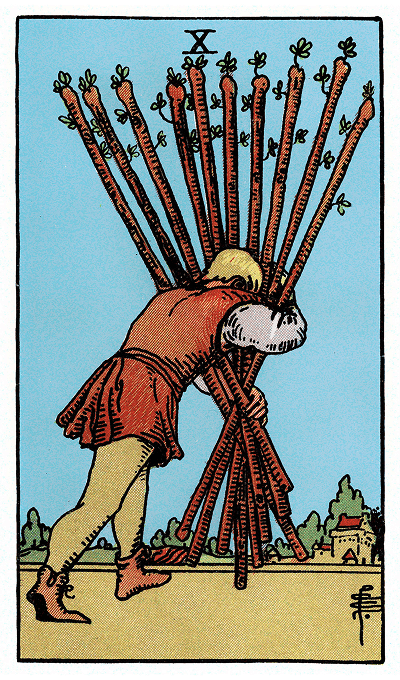
The Ten of Wands — Rider-Waite-Smith version
Rider-Waite-Smith
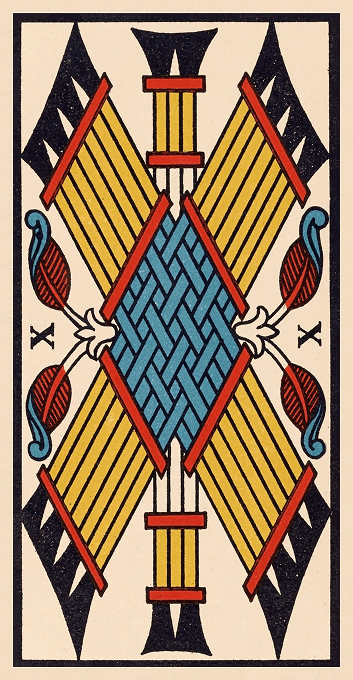
The Ten of Wands — Marseille version
Marseille
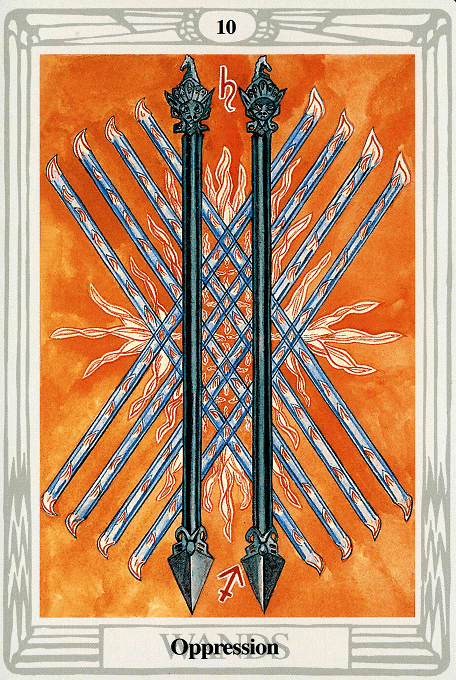
The Ten of Wands — Thoth version
Thoth

In the Rider-Waite-Smith deck, a figure trudges toward a distant town while carrying all ten wands bundled awkwardly in both arms, his head down and his posture bent forward under the visible weight and strain of the load. The core message concentrates in three details: the awkward, overloaded way he carries all ten wands at once rather than distributing the weight more manageably, his bent, straining posture, indicating real physical and mental exhaustion, and the town visible in the distance, suggesting the destination, and presumably some relief, isn't far off even though the immediate burden feels heavy. Together these describe carrying an excessive burden, often self-imposed, while still being close enough to a goal that abandoning the effort now would waste what's already been accomplished.

Waite's 1911 notes describe this card as representing "a burden" that's oppressive, yet also connect it to eventual gain or reward once the load has been carried to its destination, framing the difficulty as temporary and purposeful rather than permanent or pointless. Earlier decks, including the Tarot de Marseille, depict the tens of each suit without any illustrated scene, typically showing simply ten wands arranged decoratively, meaning the specific image of an overloaded figure struggling toward a distant town is Waite and Smith's addition, chosen to visually represent the suit's final number as a point of maximum strain rather than triumphant completion.

Upright Meaning

The Ten of Wands represents carrying an excessive burden, often more than necessary, while still working toward a goal or destination that's genuinely within reach. Its essential energy is strained responsibility: taking on more than is comfortable, sometimes because you've chosen to shoulder it all yourself rather than distributing the weight more sensibly.

In everyday situations, this often shows up as feeling overwhelmed by responsibilities you've taken on, whether at work, at home, or in a personal project, especially when you've been unwilling or unable to delegate or share the load. It can also describe the specific exhaustion of being close to finishing something significant, but feeling the accumulated weight of everything it took to get there.

A nuance beginners often miss is that this burden is often at least partly self-imposed, the figure could likely distribute the wands more manageably or ask for help, but instead carries all ten at once. Reading this card only as "life is simply too hard right now" misses the more actionable meaning: sometimes the excessive weight comes specifically from taking on more than necessary, or from resisting support that could genuinely lighten the load.

Readers disagree somewhat on how much this card should emphasize the nearness of relief versus the genuine difficulty of the present burden. Some traditions read the Ten of Wands as primarily hopeful, since the town in the image is visibly close, suggesting the strain will soon be rewarded once the destination is reached. Other readings focus more on the immediate, oppressive weight of the burden itself, treating the card as an honest acknowledgment of real overload that shouldn't be minimized just because relief is theoretically nearby. Both readings share the underlying theme of a heavy, often self-imposed load; they differ mainly in how much weight to give the promise of eventual relief.

Reversed Meaning

Reversed, the Ten of Wands doesn't simply mean the burden disappears instantly. That would just negate the upright meaning without describing the actual process involved. The more useful distinction is between genuinely releasing or redistributing the load and burnout that develops from continuing to carry it alone. Releasing the burden suggests actively delegating, asking for help, or letting go of unnecessary responsibilities, lightening the load described by the upright card.

A different shadow expression involves burnout: the cumulative weight of the upright card's overload finally catching up, leading to genuine exhaustion or collapse rather than continued, if strained, forward movement. This differs from active release, since here the person hasn't yet found relief, the burden has simply become unsustainable.

The reversed card can also point to refusing to let go: continuing to insist on carrying everything alone even when help or delegation is genuinely available, similar to the upright figure's choice to bundle all ten wands together rather than distributing them. This differs from burnout; here the issue is a persistent unwillingness to lighten the load rather than having already reached a breaking point.

It's worth noting that some readers don't use reversals at all, reading every card only upright and relying on surrounding cards for shading instead. If that's your approach, the release, burnout, and refusing-to-delegate readings above still apply, held as tensions that can appear within an upright Ten of Wands, particularly in a reading involving responsibilities that already feel unsustainable.

In a daily reading

Ten of Wands in a Daily Reading

As a single morning card, the Ten of Wands is worth reading as a nudge to notice where you might be carrying more than necessary today, and to consider whether some of that load could be shared or set down. It's a good day to ask honestly whether all the responsibilities you're holding are truly yours to carry alone.

Say you pull this card before a day that includes a heavy workload or a stretch of feeling responsible for more than feels manageable. The Ten of Wands doesn't suggest abandoning your responsibilities entirely; it suggests examining whether the burden could be distributed more sensibly, through delegation, asking for help, or simply letting go of something that isn't essential.

A daily-pull scenario

A Daily-Pull Scenario

Imagine pulling the Ten of Wands on a morning before a demanding stretch of finishing a big project largely on your own. A beginner's first instinct might be to read this as confirmation that you simply have to push through no matter the cost. A more useful reading treats the card as an honest prompt to examine whether the load could be lightened, since the figure in the image could likely carry the wands more manageably or ask for help, meaning the more useful question is whether you're taking on more than necessary rather than whether you can simply endure it.

Read with care

Common Misreadings

  • This card means life is just inherently difficult right now.

    The burden shown is often at least partly self-imposed, carried in an unnecessarily awkward way. This card points toward examining whether the load could be distributed more sensibly, not simply enduring an unavoidable hardship.

  • This card means I should give up before reaching the goal.

    The destination is visibly close in the image, suggesting real progress has already been made. The card supports finding a more sustainable way to finish, not abandoning the effort altogether.

  • Reversed always means I've completely collapsed.

    Reversed can describe burnout, but it can just as easily describe actively releasing or redistributing a burden, or simply an ongoing refusal to ask for help, different problems than total collapse.

Combinations

Cards That Change Its Meaning

  • Ten of WandsThree of Pentacles

    Amplifies the value of shared effort, suggesting the burden described here could be meaningfully lightened through genuine collaboration with others.

  • Ten of WandsFour of Swords

    Tempers ongoing strain with a clear need for rest, suggesting the wisest next step may be a deliberate pause rather than continuing to push forward under the full weight of the load.

  • Ten of WandsThe World

    Redirects heavy, ongoing burden toward genuine completion, suggesting the strain described here is nearing its actual end, with real accomplishment close at hand.

Sit with it

Questions for Reflection

  1. 1

    What responsibilities am I currently carrying that could realistically be shared or delegated?

  2. 2

    Is there a burden I've taken on unnecessarily, out of habit or reluctance to ask for help?

  3. 3

    How close am I to completing something significant, even if the current load feels heavy?

  4. 4

    What would it look like to set down or redistribute part of what I'm carrying today?