Somewhere in the first week of learning tarot you will read that the cards came from ancient Egypt, or from Romani travellers, or from the Kabbalah. Then you read something else that flatly contradicts it, and there is no obvious way to tell which one is doing the lying.
The documented history of tarot cards, origin story included, is actually well evidenced and far more interesting than the myths. It runs from an Egyptian export that had nothing to do with fortune telling, through a card game invented for Italian dukes, to a Paris bookseller in 1781 who made up the ancient wisdom story that is still repeated today. This post lays that out in order, and finishes with the part that matters at your kitchen table: what knowing the real sequence changes about how you read a card.
The cards arrived in Europe as an import
Playing cards were not a European invention. They reached Europe in the late fourteenth century through Mediterranean trade, and the most direct ancestor was the Mamluk deck from Egypt and Syria. The earliest known European mention is from 1371, in a Catalan rhyming dictionary, and within a decade cards were common enough across Italy, Spain, Germany and France that authorities were busy banning them.
The Mamluk pack had four suits: cups, coins, swords and polo sticks. Look at your deck. The cups and coins came across unchanged, the swords too, and the polo stick, a game unfamiliar in Europe, was reinterpreted as a baton or wand. The suit symbols you shuffle every morning are a fourteenth-century translation error that stuck.
So the 56 minor cards were not designed for reading. They were a game import, roughly a century older than tarot itself.
Italian courts added the trumps, and that was the invention
The thing that makes a tarot deck a tarot deck is the extra set of allegorical cards, and those were invented in northern Italy in the 1440s.
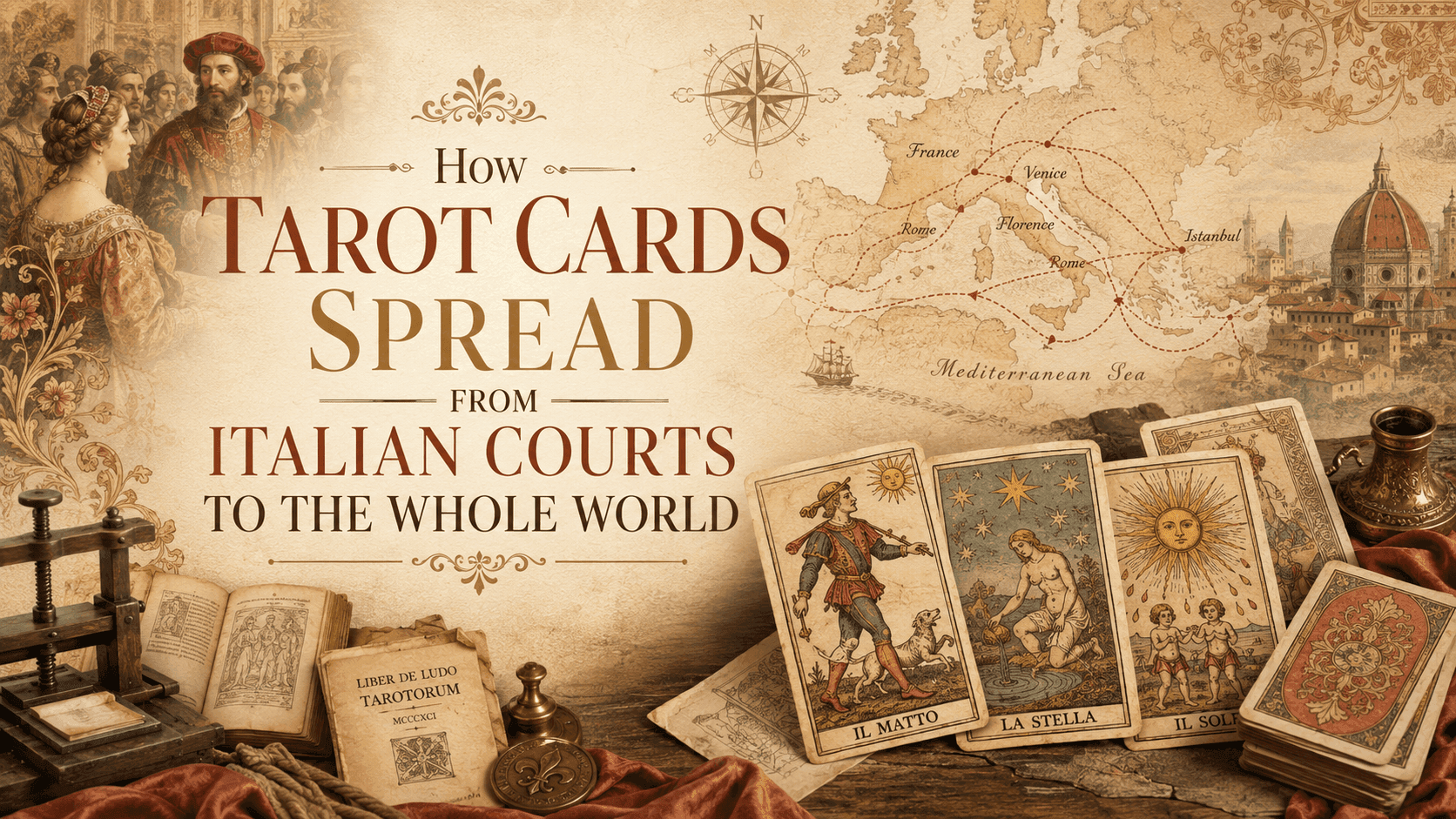
The earliest documented reference is from 1440, in the diary of a Florentine notary called Giusto Giusti, recording a pack of triumph cards he had made and gave to the nobleman Sigismondo Malatesta. Two years later, the account books of the ruling Este family in Ferrara record an order for four packs of trionfi. Milan, Ferrara, Florence and Bologna all show up in the record within that decade.
These cards were called carte da trionfi, triumph cards, which is where the English word trumps comes from. That is not a metaphor: they were a permanent trump suit for a trick-taking game, tarocchi, structurally not unlike bridge or hearts. The allegorical figures gave the trumps a fixed pecking order, so the Emperor beat the Empress and Death beat them both, and the Fool worked as an excuse card rather than as a spiritual protagonist.
The oldest surviving cards are the hand-painted Visconti-Sforza decks made for the rulers of Milan around the middle of the century, gold-leafed luxury objects, several of them associated with the painter Bonifacio Bembo. The word tarocchi itself does not appear until around 1505, in Ferrara and, that same year, as taraux in Avignon.
Printing carried the deck across the Alps
Hand-painted decks stayed with dukes. Woodblock printing made cards cheap, and cheap cards travelled: into France, Switzerland and southern Germany, where the game took hold and local printers standardised their own patterns.
The most consequential of these became known as the Tarot de Marseille, a printed pattern settled by the seventeenth and eighteenth centuries and used widely by French players. Its minor cards are pips, meaning the Six of Cups shows six cups and no scene. That is worth knowing because the Marseille tradition reads those cards through number and suit rather than through a picture, which is a genuinely different method rather than an older version of the one you probably learned.
Do not assume, then, that a card must have a scene on it. For most of tarot's history it did not.
1781: the history of tarot cards acquires an origin myth
Two things happened in eighteenth-century France that turned a game into a divination system.
The first is quieter and earlier. An anonymous manuscript from Bologna, dated to around 1750 and identified by the researcher Franco Pratesi, lists short divinatory meanings for 35 cards of the local tarocchino deck along with a basic way of laying them out. Plain, practical fortune telling, with no ancient wisdom attached.
The second is the one everybody repeats. In 1781, the French scholar Antoine Court de Gébelin published a volume of his encyclopedia Le Monde primitif arguing that tarot preserved the lost wisdom of ancient Egypt, a surviving fragment of a Book of Thoth. He had no evidence, and Egyptian hieroglyphs would not be deciphered for another forty years. Jean-Baptiste Alliette, working under the name Etteilla, built a career on the idea, and in 1789 published the first deck designed specifically for divination.
Here is the common mistake, and it is worth naming plainly: beginners treat age as authority, assuming that the more ancient a card's meaning sounds, the more reliable it must be. The Egyptian story is roughly 340 years younger than the cards. Any source that leads with it is repeating an eighteenth-century invention, which tells you something useful about how carefully that source checks anything else.
From occult societies to the whole world
Once the idea took hold it developed fast. In the mid-nineteenth century the French occultist Éliphas Lévi mapped the 22 trumps onto the Hebrew alphabet and the Kabbalistic Tree of Life. The Hermetic Order of the Golden Dawn, founded in London in 1888, built an elaborate system of astrological and Kabbalistic correspondences on top of that.
Two Golden Dawn members produced the decks that now dominate. A.E. Waite commissioned Pamela Colman Smith, and their deck was published by William Rider & Son in 1909 with every one of the 56 minor cards illustrated as a scene, which is why beginners can read it at all. Aleister Crowley and Lady Frieda Harris painted the Thoth deck between 1938 and 1943, published in 1969. The final step was commercial: reissues from the 1970s onward, particularly by U.S. Games Systems, put the Waite-Smith deck into ordinary bookshops worldwide.
What the history changes about your reading
Knowing the sequence is not trivia. It tells you where to look for a card's meaning: Renaissance allegory rather than Egyptian mysticism.
Imagine Elena, hypothetically, who pulls the Wheel of Fortune and searches for its meaning. She finds pages describing ancient cycles of karma and cosmic law, writes down something about destiny, and gets nothing usable from it. Then she tries the historical route instead. The wheel of fortune was a stock image in medieval and Renaissance moral art: figures cling to a turning wheel, one rising, one at the top, one being thrown off. The point of the image was that position is temporary and nobody arranges to stay at the top.
Read that way, her note stops being cosmic and becomes specific. She asks who in her situation is currently at the top of the wheel and what she is assuming will stay the same. Her answer is that she has been treating her team's current structure as permanent while quietly planning around one manager who may well move on. That is something she can act on this week, and it came from a fifteenth-century allegory rather than a nineteenth-century invention.
This is also where a daily one-card habit becomes more interesting. Pulling one card a day and asking what a Renaissance artist would have expected a viewer to understand from that image gives you a second, sturdier source of meaning alongside whatever your guidebook says.
Conclusion
The takeaway from the history of tarot cards: origin and purpose are two different questions, and the deck's origin as a fifteenth-century Italian card game does not disqualify anything you do with it now. It just means the authority comes from the images and from your own thinking, not from a fictional Egyptian pedigree.
Do this today. Take one trump card and look up the allegory behind it as an artwork rather than as an oracle, asking what a viewer in 1450 would have read into that figure. Compare that to your guidebook's keyword and note where they diverge.