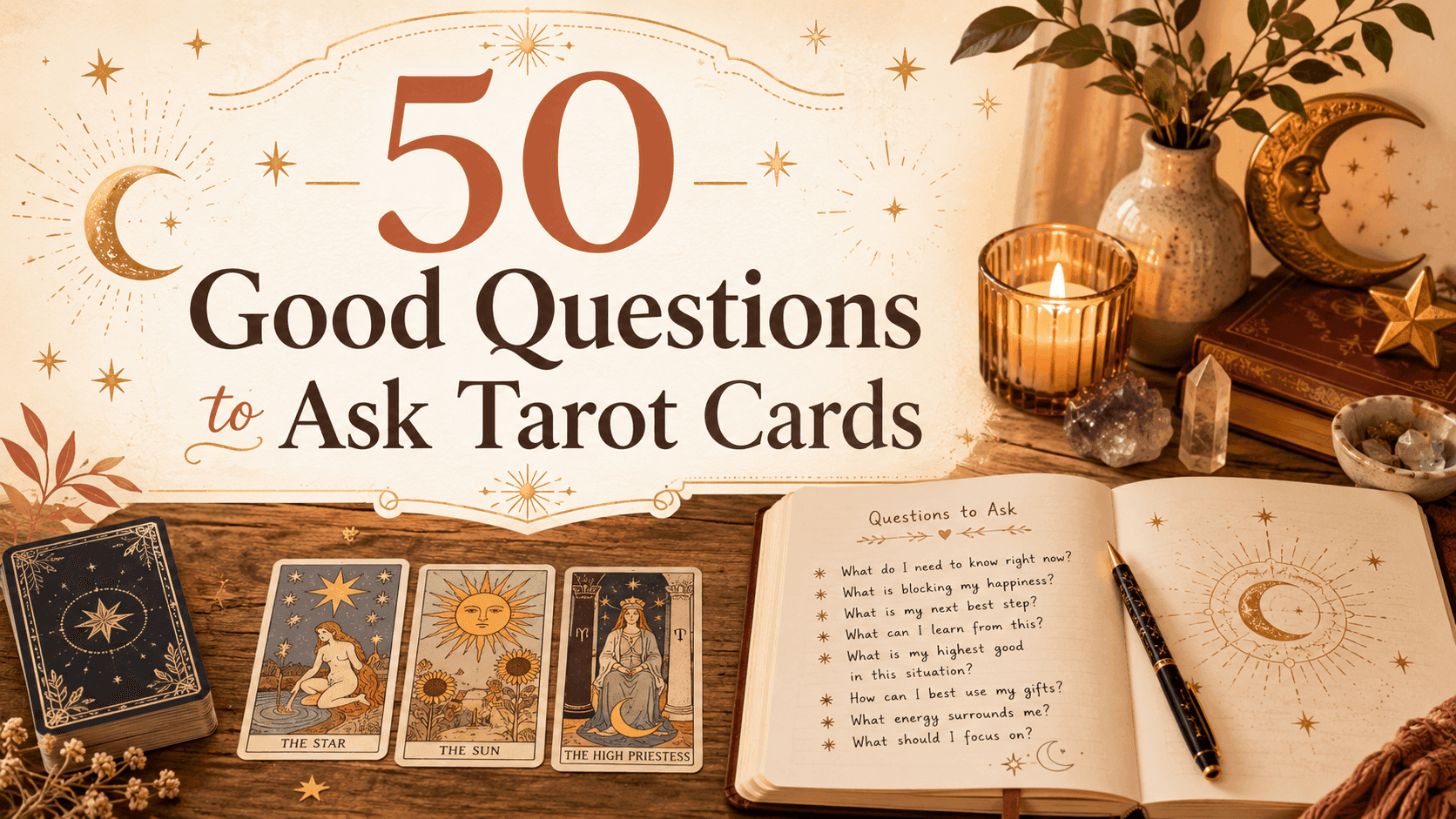
You've been pulling cards for a few weeks, and something's nagging at you: the readings evaporate. You had a sharp insight on Tuesday and by Friday you couldn't tell someone what card you drew, let alone what it meant. A tarot journal fixes exactly that, and it's the single habit that turns scattered pulls into actual fluency with the deck.
This post covers what to put in a journal, what to leave out, a simple entry format you can use tonight, and a set of tarot journal prompts for the days when you're staring at a card with nothing to say. By the end you'll have a system you can start today with paper you already own. No special notebook required, and definitely no waiting until you feel "ready."
Throughout, we're treating tarot as a reflection tool, a structured way to look at your own thinking, not a way to predict what's coming.
What a Tarot Journal Is Actually For
A tarot journal is not a diary of your feelings, and it's not a place to copy down "official" card meanings. It's a record of the gap between what you thought a card meant and what actually turned out to be useful about it. That gap is where all the learning lives.
Think of it like a lab notebook. You had a question, you drew a card, you made a read, and later you can look back and see whether that read held up. Do that thirty times and you'll know the Five of Cups not as a textbook keyword but as "the card that keeps showing up when I'm fixating on what went wrong." That's knowledge no guidebook can hand you, because it's built from your own patterns.
Here's the do and don't that matters most. Do write your own read of the card before you look anything up. Don't open the little white booklet, copy its keywords into your journal, and call it an entry. A journal full of borrowed meanings teaches you nothing, because you're recording someone else's associations instead of building your own.
What You Actually Need to Start
Almost nothing, and this is where a lot of would-be journalers trip: they decide they need a beautiful dedicated notebook, some special pen, maybe a wax seal, and the shopping becomes a way to postpone the actual writing. The notebook is not the practice. The writing is the practice.
A cheap spiral notebook works. The notes app on your phone works, and arguably works better, because it's always with you when you pull a card and you can search it later. If you want a dedicated tarot journal eventually, buy one after you've kept the habit for two weeks and know what layout you actually want. Earning the notebook is more satisfying anyway.
What to Put in Each Entry
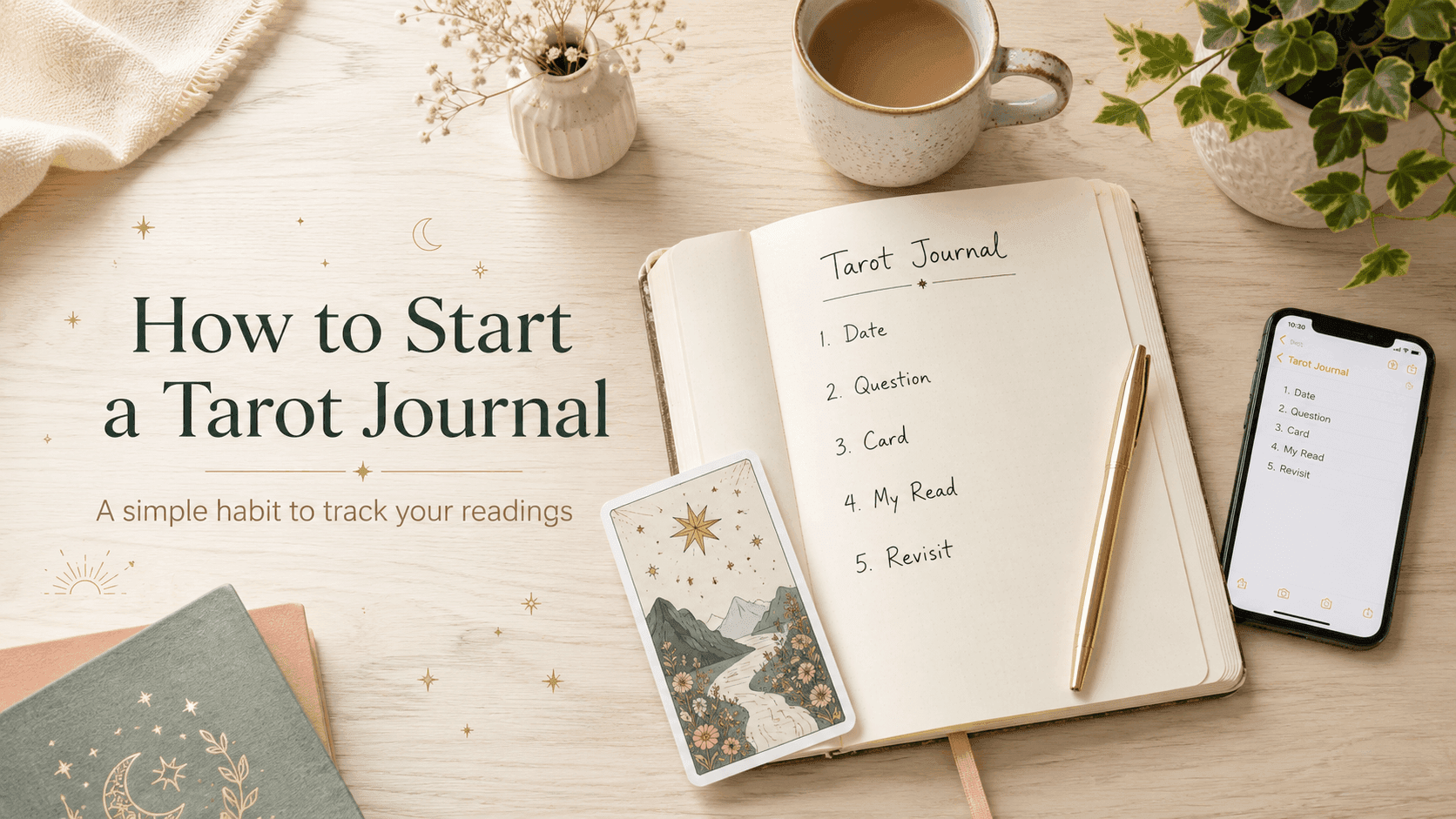
Keep entries short enough that you'll actually do them tomorrow. A sustainable entry has five parts, and it takes about three minutes:
- Date and, optionally, a word about your mood or what's on your mind, since context changes how you read.
- The question you asked, or "open pull" if you just drew a card to see what came.
- The card or cards, written out by name so your future self isn't decoding abbreviations.
- Your read, in your own words, before consulting anything: what does this card seem to be saying about your question?
- One line to revisit, something specific you'll watch for or do, so the entry connects to real life.
That's the whole template. The fifth part is the one beginners skip and the one that makes the journal worth keeping, because it gives you something to check against later. A read you can't verify is just a nice thought.
The daily one-card pull is the natural engine for this. One card a day, five quick fields, and within a month you'll have a searchable record of every card you've drawn and what you made of it, which is the fastest route to knowing the deck by feel rather than by memorization.
Tarot Journal Prompts for When You're Stuck
Some days you'll draw a card and your mind goes blank. That's normal, and it's exactly what prompts are for: they give you a specific angle to write from instead of the intimidating blank page. Pick one that fits the card in front of you.
- If this card described a person in my life right now, who would it be, and why that person?
- What is this card asking me to stop avoiding?
- Where did I already see this card's energy today, before I drew it?
- If this card is advice, what's the smallest action it points to?
- What would it mean if I read this card as a warning, and what if I read the exact same card as encouragement? Which fits better?
- What did I assume this card meant on sight, and where might that assumption be wrong?
- Which part of the card's picture did my eye go to first, and what was I reacting to?
- If I drew this same card a month from now, what would I hope had changed?
These work because they force a concrete answer rather than a vague feeling. Compare "this card is about change" (true of half the deck, useless on the page) with the answer to "what's the smallest action it points to," which gives you something you can do. A good prompt turns a card into a sentence you couldn't have written without it.
A Worked Example
Imagine Leo, three weeks into journaling, who draws the Four of Pentacles on an ordinary Wednesday and feels nothing. Instead of forcing profundity, he picks a prompt: if this card described a person right now, who would it be?
He writes down a coworker who guards every task and won't delegate, and then, mid-sentence, catches himself: the honest answer is that the person is him this week, sitting on a project he won't hand off because he's afraid it won't be done right. His read, in his own words: "holding on so tight nothing can move, including me." His one line to revisit: send the half-finished draft to Sam by Thursday instead of polishing it alone.
None of that required the card to predict anything. The prompt gave him an entry point, and his own honesty did the rest. That's a journal working exactly as intended, hypothetically speaking.
Conclusion
The habit that makes everything else click: write your own read before you look anything up, and always leave one line you can check later. That single discipline is what separates a tarot journal that teaches you from a pile of copied keywords that doesn't.
So start tonight. Draw one card, open whatever notebook or app is closest, and fill in the five fields, using one of the tarot journal prompts above if the card leaves you blank. Three minutes. Then do it again tomorrow, and let a month of small entries show you the deck in a way no single reading ever could.