PentaclesEarth
Tarot Card Meaning

Four of Pentacles

The Four of Pentacles means control, security, and holding on tightly. Explore its upright and reversed meanings, symbolism, and daily-pull guidance.

Four of Pentacles tarot card
At a glance

Quick Keywords

Upright
  • control
  • security
  • holding on tightly
  • conservatism
  • material stability
  • caution
  • possessiveness
Reversed
  • releasing control
  • generosity
  • financial insecurity
  • loosening attachment
  • fear of loss
  • greed
Symbolism

What's in the Image

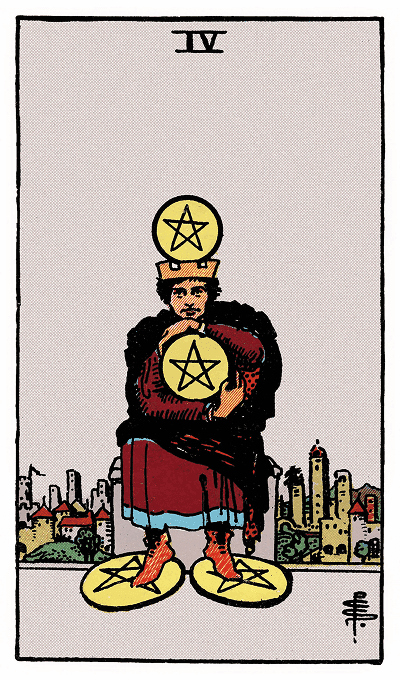
The Four of Pentacles — Rider-Waite-Smith version
Rider-Waite-Smith
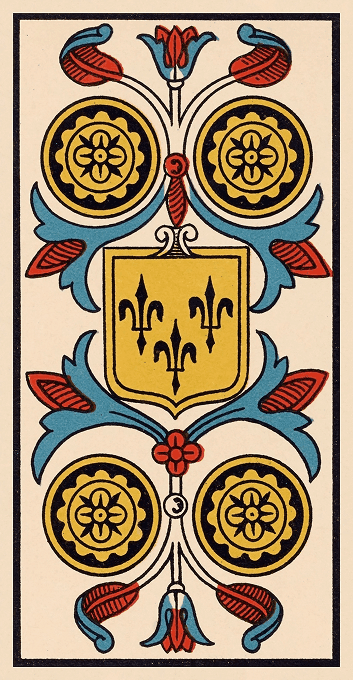
The Four of Pentacles — Marseille version
Marseille
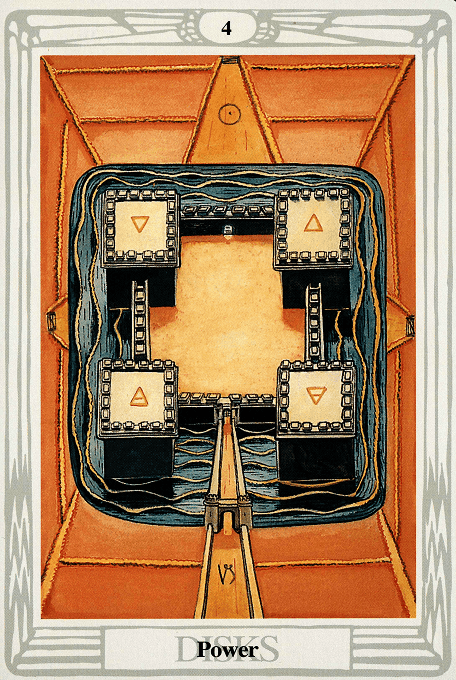
The Four of Pentacles — Thoth version
Thoth

In the Rider-Waite-Smith deck, a man sits rigidly on a stool, clutching one pentacle tightly against his chest, with another balanced on his head, and two more pinned firmly beneath his feet. A city rises in the background, suggesting this scene takes place amid the material world of commerce and property rather than in nature or isolation. The core message concentrates in three details: his tightly crossed arms holding the coin close to his body, his stiff, immobile posture, unable to easily move or shift given the coin balanced precariously on his head, and the coins pinned beneath his feet, suggesting a stability purchased at the cost of freedom of movement. Together these describe security maintained through tight control, at the expense of flexibility or openness to change.

Waite's 1911 notes describe this figure as someone who is "leaving nothing to providence and chance," gripping his gains tightly rather than risking anything further, a detail that frames the card's caution as deliberate and somewhat anxious rather than simply prudent. Earlier decks, including the Tarot de Marseille, depict the fours of each suit without any illustrated scene, typically showing simply four pentacles arranged decoratively, meaning the specific image of a man clutching his coins is Waite and Smith's addition, chosen to visually represent possessiveness and rigid self-protection rather than the tone-neutral suit symbol alone.

Upright Meaning

The Four of Pentacles represents security achieved through tight control, often at some cost to flexibility or openness. Its essential energy is protective caution: holding onto what you have firmly, sometimes out of genuine prudence and sometimes out of fear of loss.

In everyday situations, this often shows up as being financially careful or conservative, saving diligently, or generally resisting change in favor of maintaining a stable, familiar status quo. It can also describe emotional guardedness: holding tightly to a relationship, a role, or a sense of identity out of fear of losing it, rather than allowing natural growth or change.

A nuance beginners often miss is that this card's caution isn't automatically framed as wrong or unhealthy. Genuine financial prudence and careful planning share real overlap with this card's imagery, meaning the difference between healthy caution and unhealthy rigidity often depends on degree rather than kind. Reading this card only as "greed" oversimplifies a state that can just as easily reflect reasonable, protective care over hard-earned stability.

Readers disagree somewhat on how critically this card should be read. Some traditions treat the Four of Pentacles fairly critically, emphasizing the rigidity and isolation of the figure's posture as a caution against excessive control or possessiveness. Other, more measured readings acknowledge that holding onto stability isn't inherently negative, especially after a period of instability or hard work, and treat the card as simply describing a state of protective caution without automatically judging it as unhealthy. Both readings share the underlying theme of tightly held security; they differ mainly in how much concern to attach to that tight grip.

Reversed Meaning

Reversed, the Four of Pentacles doesn't simply mean total financial ruin or complete loss of stability. That would just negate the upright meaning too flatly. The more useful distinction is between healthily releasing control and instability arising from genuine insecurity. Releasing control suggests loosening an overly tight grip, becoming more generous or open after a period of rigid caution, in a way that feels like relief rather than danger.

A different shadow expression involves genuine financial or material insecurity: a real lack of stability, rather than a healthy loosening of excessive control, which can look and feel very different depending on the circumstances surrounding the reading. This differs from healthy release, since here the instability isn't chosen or welcomed, it's simply present and needs addressing.

The reversed card can also point to greed tipping past the upright card's caution into something more excessive, an intensified grip rather than a loosened one, holding on so tightly that it starts to actively harm relationships or opportunities rather than simply providing stability. This differs from insecurity; here the issue is an excess of control rather than a lack of resources.

It's worth noting that some readers don't use reversals at all, reading every card only upright and relying on surrounding cards for shading instead. If that's your approach, the release, insecurity, and intensified-greed readings above still apply, held as tensions that can appear within an upright Four of Pentacles, particularly in a reading involving money, possessions, or control that already feels like a source of tension.

In a daily reading

Four of Pentacles in a Daily Reading

As a single morning card, the Four of Pentacles is worth reading as a nudge to notice where you're holding on tightly today, whether to money, a plan, or a relationship, and to ask whether that grip still serves you. It's a good day to distinguish reasonable caution from fear-driven rigidity.

Say you pull this card before a day that includes a financial decision, like whether to spend on something you've been saving for. The Four of Pentacles doesn't tell you whether to spend or save; it suggests examining whether your instinct is coming from thoughtful planning or from anxiety about loss, and choosing deliberately rather than automatically defaulting to holding on tighter.

A daily-pull scenario

A Daily-Pull Scenario

Imagine pulling the Four of Pentacles on a morning before deciding whether to share resources, time, or credit with someone else on a joint project. A beginner's first instinct might be to read this as a warning that you'll lose something if you share at all. A more useful reading treats the card as a prompt to examine whether your instinct to hold tightly is protecting something genuinely at risk, or simply reflecting habitual caution that isn't actually necessary in this particular situation, since the man in the image is rigid even without any clear threat shown in the scene itself.

Read with care

Common Misreadings

  • This card always means greed.

    The Four of Pentacles can describe possessiveness, but it often simply reflects reasonable caution or a desire for stability, especially after a period of hard-won security. Greed is one possible reading, not the only one.

  • This card means I should never save or plan for the future.

    The card doesn't discourage financial prudence itself. It points to the cost of excessive rigidity specifically, not to careful planning or reasonable saving, which can be perfectly healthy.

  • Reversed always means financial disaster.

    Reversed can describe genuine insecurity, but it can just as easily describe a healthy loosening of excessive control, or greed intensifying rather than stability collapsing.

Combinations

Cards That Change Its Meaning

  • Four of PentaclesThe Hermit

    Amplifies withdrawal and self-protection, suggesting the tight control described here is paired with genuine isolation, pulling back from others as well as from material risk.

  • Four of PentaclesThe Empress

    Tempers rigid control with a pull toward generosity and openness, suggesting a tension between holding on tightly and allowing something to grow or be shared more freely.

  • Four of PentaclesThe Tower

    Redirects careful, controlled stability toward sudden disruption, suggesting the security being tightly held onto may be about to be shaken by an unexpected event.

Sit with it

Questions for Reflection

  1. 1

    Where am I holding on tightly out of genuine need versus out of fear of loss?

  2. 2

    Is there a resource, relationship, or plan I could afford to hold a little more loosely?

  3. 3

    What would reasonable caution look like here, distinct from rigid control?

  4. 4

    Am I protecting something that's actually at risk, or defending against a threat that isn't really present?