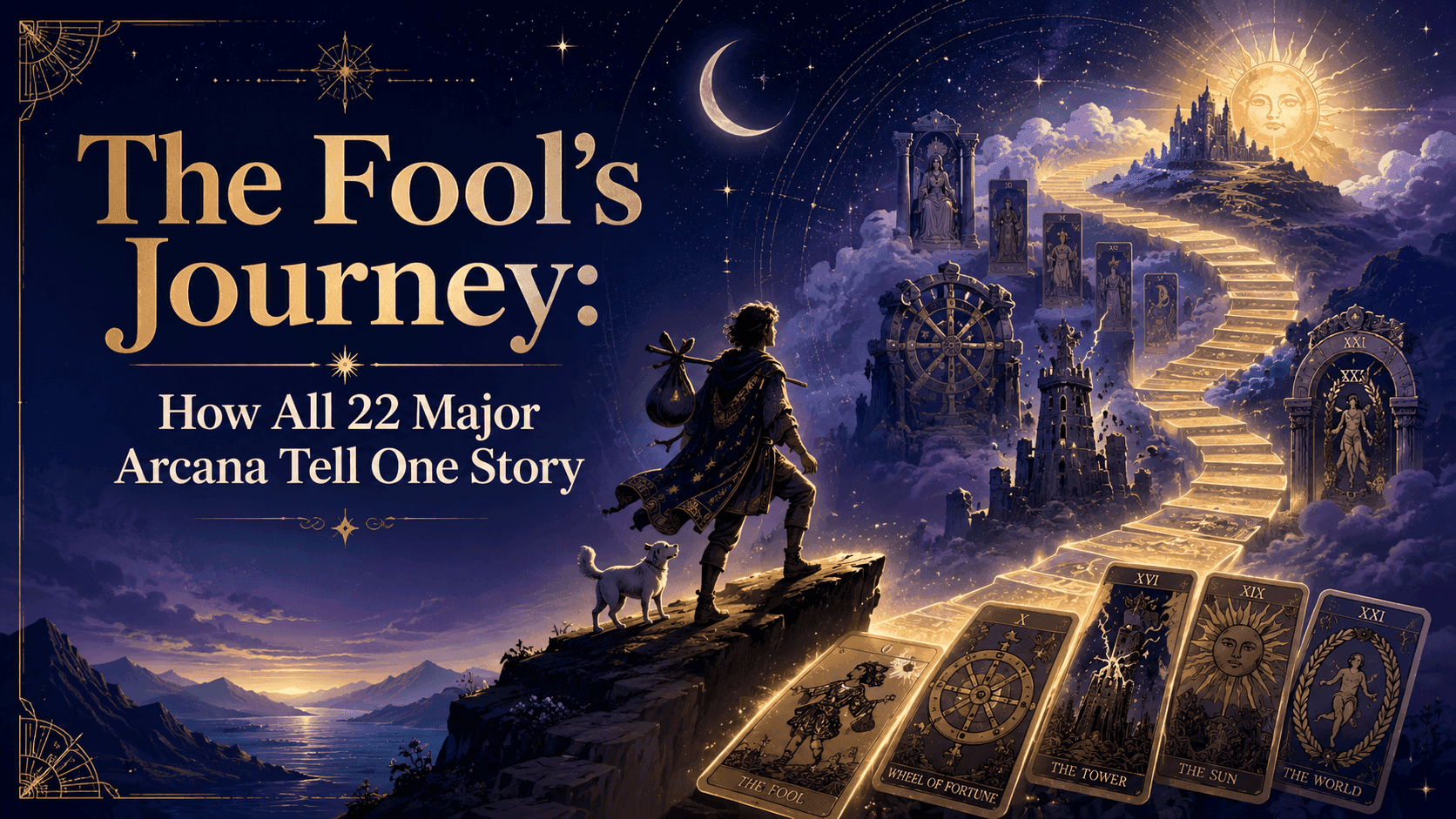
You've been pulling from the Major Arcana and something bugs you: the cards feel like 22 unrelated symbols. The Magician, then a High Priestess, then Death, then a Tower. Is there any logic here, or is it just a random pile of archetypes? There is a logic, and it has a name. The Fool's Journey tarot framework treats all 22 Major Arcana as a single story: one character, the Fool, moving from card 0 to card 21 and learning something at every stop.
This post walks that story act by act, explains where the idea came from, and shows you how to use it in an actual reading. By the end, you'll be able to pick up any Major Arcana card and know roughly where it sits in the arc, and what that placement tells you before you recall a single keyword.
Where the Fool's Journey tarot concept comes from
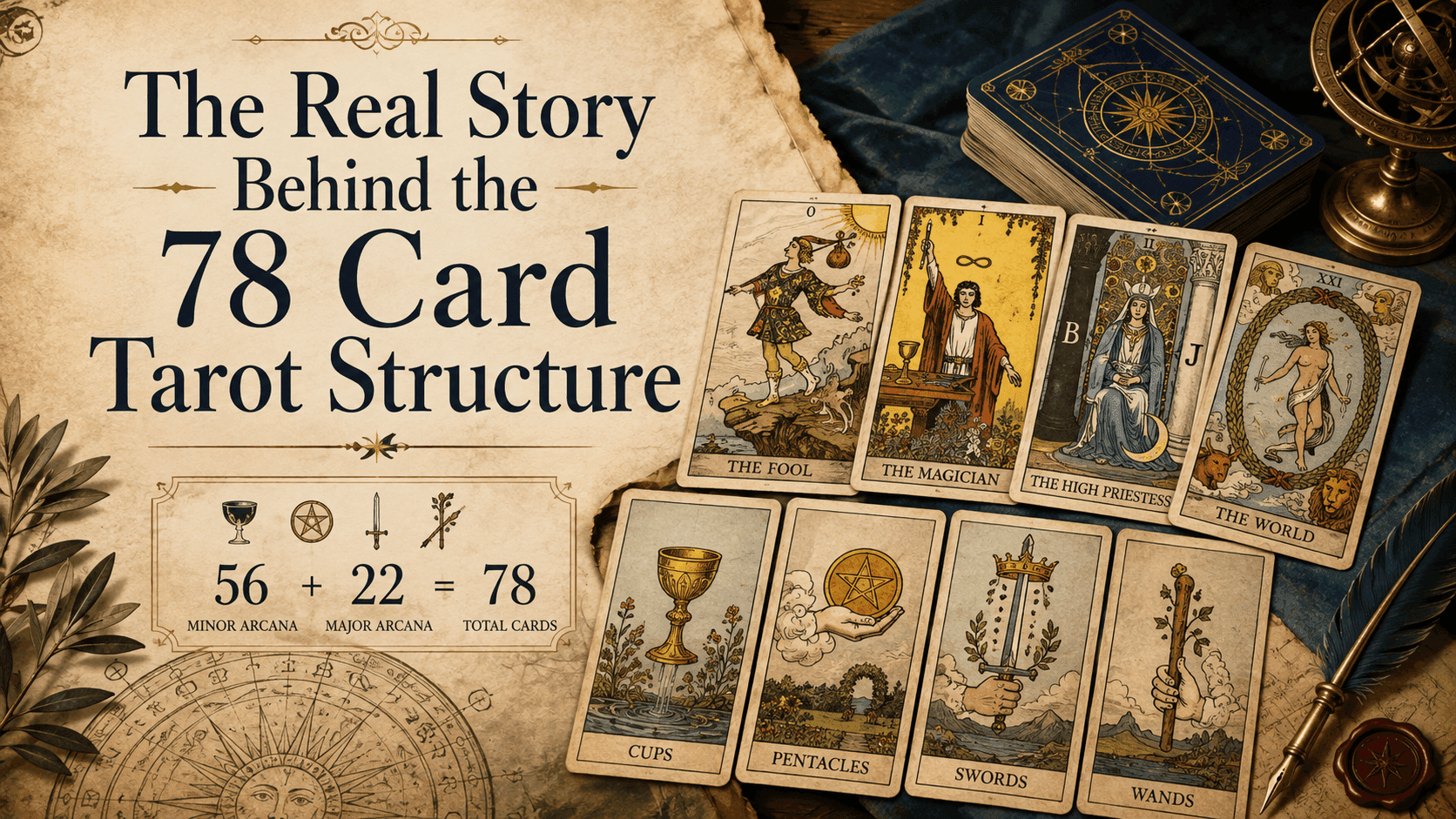
The 22 Major Arcana are numbered 0 through 21, and that numbering is what makes a story possible. The Fool is card 0, the number before everything, which is exactly why he works as the main character. He's the blank slate who hasn't started yet, so every other card becomes something he encounters along the way.
Reading the cards as one connected sequence is usually credited to tarot writer Eden Gray, who popularized the "Fool's Journey" idea in the mid-twentieth century. The cards themselves are far older, and the numbering isn't even fixed across traditions. In the Tarot de Marseille, Justice is card 8 and Strength is card 11; A.E. Waite's deck (illustrated by Pamela Colman Smith and published in 1909) swapped them, so Strength became card 8. Waite's 1911 guide, The Pictorial Key to the Tarot, follows that revised order. The Fool, meanwhile, sometimes opens the deck, sometimes closes it, and sometimes floats unnumbered.
The takeaway: the journey is a lens, not scripture. It's a genuinely useful way to organize meaning, but it's a teaching tool people built on top of the cards, not a rule baked into them.
Act one: finding your feet in the world (cards 1–7)
After the Fool steps off the cliff at card 0, the first seven numbered cards are about the outer world and building a self inside it. Think of it as growing up.
The Magician (1) says you have tools and the will to use them. The High Priestess (2) balances that with inner knowing you can't force or rush. The Empress (3) and the Emperor (4) are two complementary kinds of power: the Empress as creative, nurturing abundance, the Emperor as structure, order, and authority. They're often described as archetypal mother and father energies. The Hierophant (5) is tradition and institutions: the rules and beliefs your culture hands you. The Lovers (6) is a real choice, usually one about values or connection. The Chariot (7) is pulling it all together and driving forward with focused will.
Here's how that plays out in practice. Say you pull the Emperor before a chaotic week. Read through the journey, it isn't "a powerful man enters your life." It's a question about this stage of the arc: where do you actually need more structure right now?
Act two: turning inward (cards 8–14)
The middle stretch turns away from the outer world and toward the inner one. Strength (8) is mastering impulse through patience rather than force. Note that the classic image shows a calm figure gentling a lion, not overpowering it. The Hermit (9) withdraws to reflect. The Wheel of Fortune (10) turns things you don't control; it's about cycles and chance. Justice (11) is cause and effect, and honest accountability for your choices. The Hanged Man (12) is a deliberate pause that lets you see from a new angle. Temperance (14) blends everything back into balance.
Between them sits Death (13), the card beginners fear most. Traditionally it almost never points to a literal death. It marks an ending that clears space, something finishing so the next thing has room to arrive. Read as self-reflection, the useful question is: what's already over that you're still holding onto? Imagine someone pulling Death the week they're weighing whether to leave a stable but draining job. Placed on the journey, it isn't a warning; it's a prompt to name what needs to end so they can decide honestly.
Act three: breakdown, hope, and completion (cards 15–21)
The final act is the most dramatic, and it's where the story earns its shape. The Devil (15) is feeling trapped, though traditionally the chains on the figures are loose enough to slip off, a hint that the trap is often self-made. The Tower (16) is sudden collapse: a shock that breaks apart something that was never solid. Picture a plan falling through at the last minute. Jarring, but it exposes what was already unstable rather than destroying what was sound.
From there the mood lifts. The Star (17) is calm and hope after the shock. The Moon (18) is uncertainty and illusion, the stretch where things aren't yet clear. The Sun (19) is warmth and clarity, things coming fully into the light. Judgement (20) is a reckoning and an honest self-review. And the World (21) is completion and wholeness.
One detail beginners miss: the World loops straight back to the Fool. The journey is a circle, not a finish line. Reaching card 21 isn't the end of growing. It's the readiness to begin a new cycle.
How to actually use the journey in a reading
The practical move is simple. When you draw a Major Arcana card, place it on the arc before you reach for the specific meaning. Three quick steps:
- Ask which act it belongs to: outer world (1–7), inner work (8–14), or breakthrough (15–21).
- Read the card's meaning through that frame.
- Check its neighbors, if any, since context shifts the tone (the Star right after the Tower reads very differently than the Star alone).
A low-pressure way to make this second nature is a daily one-card pull. Draw one card each morning, and when it's a Major, name its act before you look anything up. Over a few weeks the arc stops being a list you memorize and becomes something you feel.
Here's the whole method on one card. Imagine someone, call her Priya, starting a new job next week and quietly convinced she's out of her depth. She pulls one card for reflection and gets the Hermit (9). Instead of searching "Hermit meaning" and stopping there, she places it: an act-two, inward card, the part of the story about stepping back and consulting yourself rather than rushing to perform. So she doesn't read it as "you'll be lonely at work." She reads it as a nudge to take one quiet evening before day one and get clear on what she actually wants from the role, her own standards, instead of absorbing everyone else's expectations on the first morning. Same card, but the journey turned a vague symbol into one concrete thing she can do tonight.
The common mistake to avoid: treating the journey as a ranking or a fixed timeline. Drawing the World (21) doesn't mean you're "further along" or better than someone who drew the Magician (1), and you don't pass through the cards in order in real life. The numbering is a teaching sequence, not a scoreboard and not a prediction of how your year will unfold. A card's position tells you what kind of lesson it points toward, not how advanced you are.
Conclusion
The one thing to hold onto: the Fool's Journey tarot framework isn't a fortune-telling map, it's a memory aid and a perspective tool. Knowing whether a card belongs to the outer world, the inner work, or the final breakthrough gives you a frame before you recall a single meaning.
So here's today's action. Pull one Major Arcana card (shuffle until you get one if you need to) and do just one thing: name which of the three acts it belongs to, and why. Don't look up the meaning yet. Getting the act right first is how those 22 cards stop being a list and start being a story you can actually read.