You're looking at two decks, maybe in a shop or in an open browser tab, and one is labeled tarot and the other oracle, and nothing on the box explains why you'd choose one over the other. They look similar. They get used in similar ways. So what's the actual difference, and does it matter for what you want to do?
This post lays out how tarot and oracle cards differ, where they overlap, and how to pick between them for your own practice. The short version of tarot vs oracle cards: one is a fixed 78-card system with centuries of shared tradition, the other is an open format that changes from deck to deck. By the end you'll know which suits a beginner, when to reach for each, and how people use both without tangling themselves up.
Tarot: one standardized system
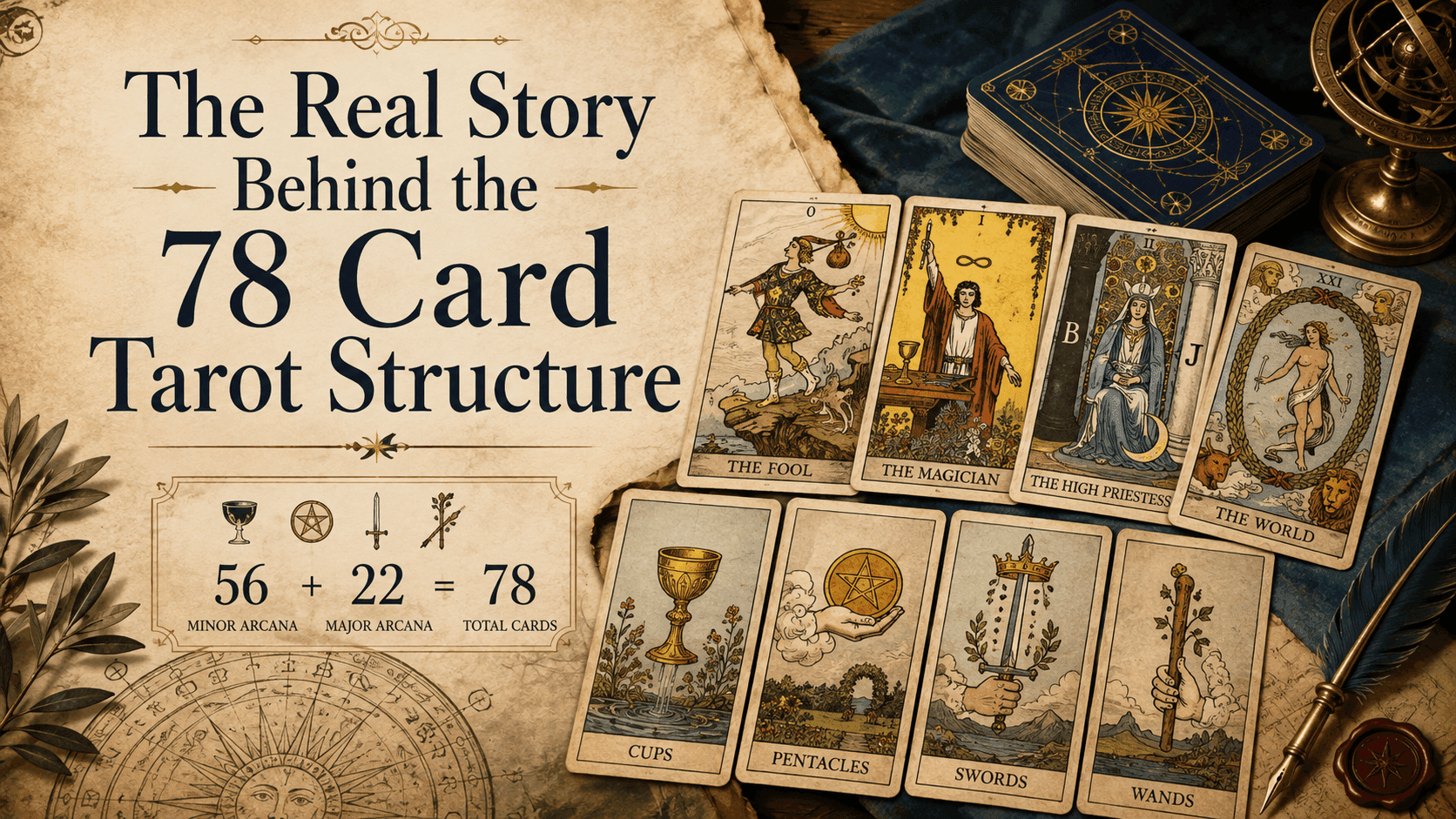
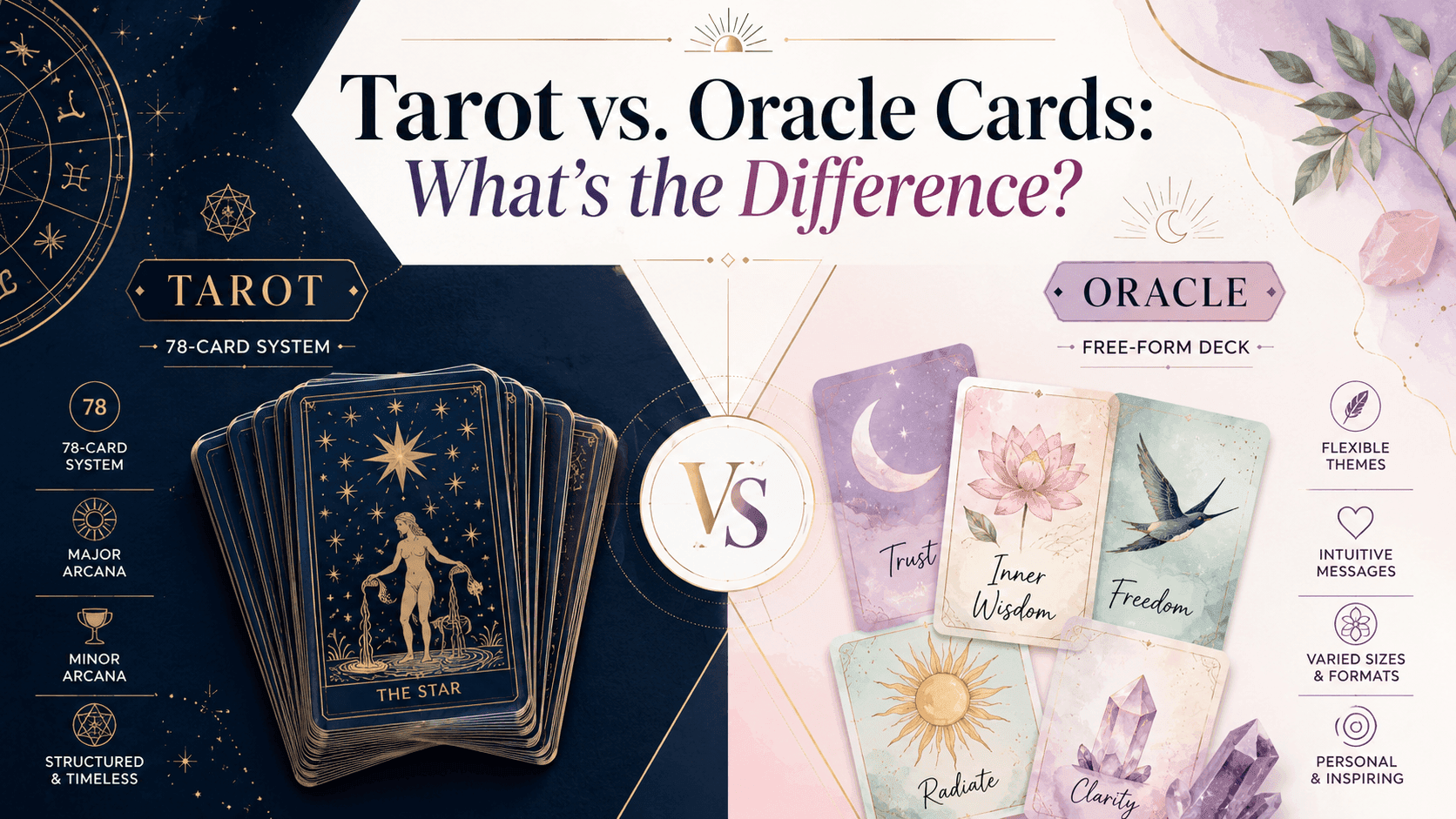
Tarot is a specific, standardized system. Almost every tarot deck, whatever its art style, shares the same skeleton: 78 cards, split into 22 Major Arcana (big-theme cards like the Fool or the Star) and 56 Minor Arcana spread across four suits, traditionally cups, coins or pentacles, swords, and wands. Each suit runs ace through ten plus four court cards.
That shared structure is the whole point. Because the framework is consistent, what you learn on one tarot deck carries over to the next. If you know roughly what the Three of Cups tends to signify, you can pick up a wildly different tarot deck, find its Three of Cups, and expect a related meaning, even when the picture looks nothing alike. Centuries of shared tradition, much of it shaped by the Rider-Waite-Smith deck of 1909, sit behind those meanings. Learning tarot means learning that one system and reusing it everywhere.
Oracle cards: an open format with no fixed rules
Oracle cards are the opposite: an open category with no required structure at all. An oracle deck can have 30 cards or 60, follow any theme its creator dreamed up, and organize itself however the maker likes. One deck might be 44 cards built around phases of the moon; another might be 52 single-word affirmations; another might feature animals, plants, or pure abstract art. Nothing governs the category or ties the decks together.
Because of that, each oracle deck is essentially its own small language. The meanings live in that deck's guidebook and usually nowhere else, so what you learn from one oracle deck rarely transfers to the next. Many oracle cards also print a word or short phrase right on the card, something like "rest" or "begin again," which makes them quick to read at a glance but leaves less room for the layered interpretation tarot invites. That's not a flaw; it's just a different design goal.
Tarot vs oracle cards: the core differences
Put side by side, the contrast is easy to hold in your head:
- Structure: Tarot has a fixed 78-card system; oracle decks have no set structure and vary completely from one to the next.
- Learning curve: Tarot takes longer to learn, but the effort transfers across decks; oracle decks are quick to pick up, yet you relearn each new one.
- Interpretation: Tarot rewards layered reading through suits, numbers, and card combinations; oracle cards tend to deliver a clearer, more direct prompt.
- Consistency: Tarot meanings are anchored by shared tradition; oracle meanings are defined entirely by that deck's creator.
None of these makes one deck better than the other. They're different tools with different strengths. Tarot gives you depth and a language you keep reusing. Oracle cards give you flexibility and a low-friction way in. The useful question isn't which is superior, but which fits what you actually want from a deck.
Which should you start with?
The honest answer depends on what you're after, not on which is more "legitimate." If you want a system you can study and grow into over years, where today's effort pays off across every future deck, tarot is the stronger starting point. If you want something gentle and immediate, with printed prompts and no memorizing, an oracle deck lowers the barrier to simply picking a card and reflecting.
This is also where beginners most often go wrong: treating oracle cards as "training wheels" for tarot, a simpler version you graduate out of. They aren't. Oracle cards are a separate category, not a beginner's tarot, and plenty of longtime readers use them by choice rather than as a stepping stone. Choosing an oracle deck isn't picking the easy mode of tarot; it's picking a different thing entirely.
Either one works well for a daily one-card pull, the simple habit of drawing a single card each day as a reflection prompt. If a daily practice is your real goal, choose whichever deck you'll actually want to sit with each morning.
Imagine someone named Leah in a shop, a tarot deck in one hand and an oracle deck in the other, wanting a five-minute morning habit. She asks herself one question: does she want to learn a craft over time, or just get a gentle nudge to think about her day? She likes the idea of slowly building skill, so she picks the tarot deck, planning to draw one card each morning and look up whatever she doesn't recognize. Had she wanted zero study and instant prompts, the oracle deck would have been the better call. Same goal, different fit, decided by what she wanted from the process rather than which box looked prettier.
Using both together
You don't have to choose forever. Plenty of people keep both and reach for whichever suits the moment, and some use them together in a single sitting. A common pairing is to pull one tarot card for a detailed, layered picture of a situation, then draw one oracle card for a plain-language takeaway or a shift in tone. The tarot card gives you something to chew on; the oracle card hands you a word to carry.
One thing not to do: don't expect the two cards to line up neatly, and don't panic if they seem to "disagree." They're separate lenses, not two witnesses who have to corroborate each other. If a tarot card raises a hard question and the oracle card says "be patient," that isn't a contradiction to solve; it's two angles on the same moment. Let them sit side by side and take what's useful from each.
Conclusion
The core of tarot vs oracle cards comes down to structure: tarot is one fixed system you learn once and reuse everywhere, while oracle cards are an open format that changes with every deck. Neither is deeper or more real than the other; they're built for different kinds of use.
Your move today: decide what you want from a deck before you buy or open one. If you crave a craft to grow into, start with tarot and pull a single card this evening. If you want a gentle, immediate prompt, an oracle deck delivers that from the very first draw. Match the tool to the want, then actually pull a card.