CupsWater
Tarot Card Meaning

Three of Cups

The Three of Cups means celebration, friendship, and shared joy. Explore its upright and reversed meanings, symbolism, and daily-pull guidance.

Three of Cups tarot card
At a glance

Quick Keywords

Upright
  • celebration
  • friendship
  • community
  • joy
  • shared success
  • abundance
  • gathering
Reversed
  • overindulgence
  • gossip
  • exclusion
  • canceled plans
  • superficial connection
  • strained friendships
Symbolism

What's in the Image

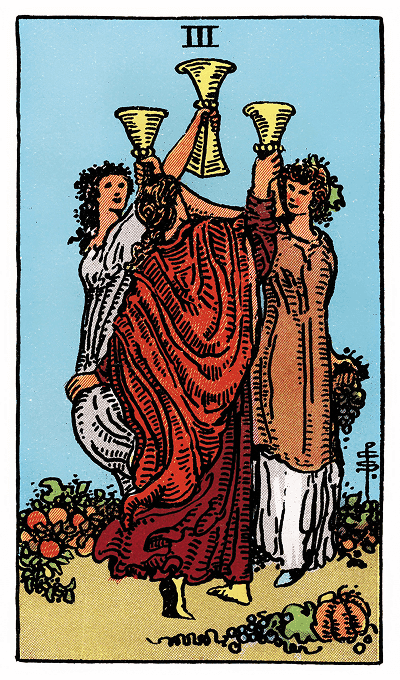
The Three of Cups — Rider-Waite-Smith version
Rider-Waite-Smith
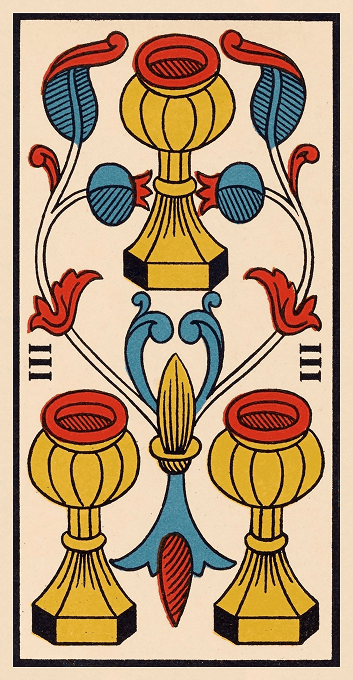
The Three of Cups — Marseille version
Marseille
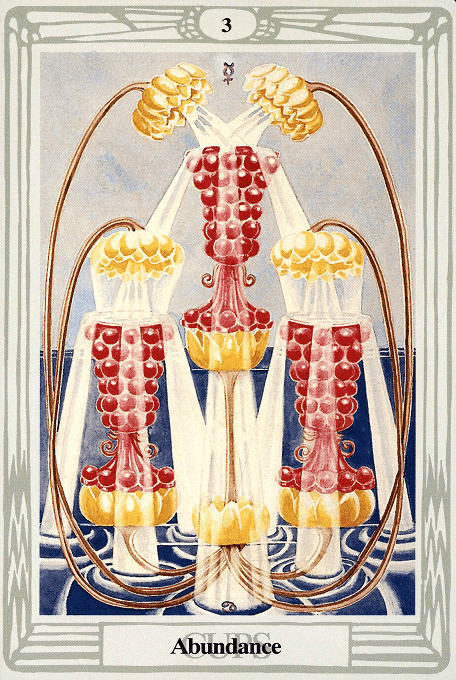
The Three of Cups — Thoth version
Thoth

In the Rider-Waite-Smith deck, three women stand in a circle in an open harvest field, raising their cups together in a toast. Each wears a different colored garment, and fruit and gourds rest on the ground near their feet, suggesting the scene takes place at the end of a successful harvest. The core message concentrates in three details: the circular formation of the three figures, suggesting equality and shared celebration rather than one figure being central, the raised cups meeting at a shared point above them, and the harvest imagery on the ground, tying the celebration to the fruits of completed effort rather than to leisure alone. Together these describe joy shared among equals, specifically arriving after collective work has paid off.

Waite's 1911 notes describe this card as representing "the conclusion of any matter" in terms of "plenty, good cheer, and satisfaction," language that ties the celebration directly to the successful ending of an effort, not to spontaneous, unearned festivity. Earlier decks, including the Tarot de Marseille, show the threes of each suit without any illustrated scene, typically just three cups arranged decoratively, meaning Waite and Smith's specific choice to depict three women celebrating together was a significant interpretive addition rather than an inherited image. Some later readers have connected this scene to figures from Greek mythology, particularly the three Graces, though Waite's own notes don't make that connection explicit.

Upright Meaning

The Three of Cups represents joy shared among a community rather than experienced alone. Its essential energy is celebration: taking the time to mark a shared success or simply to enjoy connection with others, especially after a period of effort or work.

In everyday situations, this often shows up as a genuine celebration with friends, a gathering marking a shared milestone, or simply spending time with a close circle of people who understand and support you. It can also describe a wider sense of community, feeling connected to a group working toward something in common, even outside a single specific event.

A nuance beginners often miss is that this card specifically emphasizes celebration among equals, three matched figures in a circle, rather than one person being honored while others merely attend. Reading this card only as "a party is coming" misses its more precise meaning: connection and joy that are mutual and shared, not centered on a single individual's achievement while others simply applaud.

Readers disagree somewhat on how directly this card should be tied to a literal event, like a wedding or party, versus a broader sense of community and belonging. Some traditions read the card fairly literally, pointing to an actual upcoming celebration or social gathering. Other, more general readings treat the card as describing a quality of connection, feeling genuinely supported by a community, regardless of whether any specific event is involved. Both readings share the underlying theme of shared joy; they differ mainly in whether that joy is tied to a specific occasion or to an ongoing sense of belonging.

Reversed Meaning

Reversed, the Three of Cups doesn't simply mean the total absence of friendship or celebration. That would just negate the upright meaning too flatly. The more useful distinction is between genuine exclusion and celebration that's tipped into excess. Exclusion suggests feeling left out of a group or gathering, a sense of being on the outside of a connection others are sharing, which is a distinctly different problem than there being no celebration at all.

A different shadow expression involves overindulgence: too much of the upright card's good cheer, showing up as excessive celebration, overdoing it in a way that leaves you depleted rather than genuinely nourished by the connection. This is nearly the opposite of exclusion, yet both meanings appear under a reversed Three of Cups depending on the reading's context.

The reversed card can also point to superficial connection or gossip within a group, friendships or gatherings that look celebratory on the surface but involve strain, exclusion of someone else, or connection that doesn't run as deep as it appears. This differs from simple overindulgence; here the issue is the quality of the connection itself rather than its intensity.

It's worth noting that some readers don't use reversals at all, reading every card only upright and relying on surrounding cards for shading instead. If that's your approach, the exclusion, overindulgence, and superficial-connection readings above still apply, held as tensions that can appear within an upright Three of Cups, particularly in a reading involving a friendship or group dynamic that already feels complicated.

In a daily reading

Three of Cups in a Daily Reading

As a single morning card, the Three of Cups is worth reading as a nudge to make time for genuine connection with friends today, rather than letting busyness crowd it out. It's a good day to notice a small success worth sharing with people who'll genuinely celebrate it with you.

Say you pull this card before a day that includes a casual get-together with close friends. The Three of Cups doesn't guarantee the gathering will be perfect; it suggests approaching it with openness to genuine enjoyment, and appreciating the mutual support of the people around you rather than treating the time as simply another item on your schedule.

A daily-pull scenario

A Daily-Pull Scenario

Imagine pulling the Three of Cups on a morning before attending a friend's celebration, like a birthday or work milestone. A beginner's first instinct might be to read this as a guarantee that the event will be enjoyable without any effort on your part. A more useful reading treats the card as an encouragement to actively participate in the shared joy, genuinely celebrating the other person rather than staying on the sidelines, since the card's imagery of three equal figures raising their cups together points toward mutual, active participation rather than passive attendance.

Read with care

Common Misreadings

  • This card always predicts a specific party or wedding.

    The Three of Cups can point to an actual celebration, but many readers treat it more broadly as describing a quality of shared joy and community connection, not necessarily one specific upcoming event.

  • This card means any group gathering is automatically good.

    The card describes genuine, mutual celebration among equals, not simply any group activity. A gathering marked by exclusion or superficial connection doesn't match the card's core meaning as fully.

  • Reversed always means my friendships are ending.

    Reversed can describe genuine exclusion or strain, but it can just as easily describe overindulgence or superficial connection within an otherwise intact friend group, different problems than a friendship actually ending.

Combinations

Cards That Change Its Meaning

  • Three of CupsTen of Cups

    Amplifies the sense of shared joy, suggesting the celebration described here connects to a deeper, more lasting sense of happiness and family or community fulfillment, not just a single event.

  • Three of CupsFive of Pentacles

    Tempers celebration with a reminder of hardship, suggesting the joy being shared coexists with real difficulty for someone in the group, adding a layer of complexity to an otherwise straightforward gathering.

  • Three of CupsSeven of Swords

    Redirects genuine community connection toward gossip or hidden tension, suggesting not everyone in the celebration is being fully honest or straightforward with each other.

Sit with it

Questions for Reflection

  1. 1

    When did I last genuinely celebrate a success with people who support me?

  2. 2

    Is there a friendship or community connection I've been neglecting lately?

  3. 3

    Where might I be seeking connection that looks celebratory on the surface but doesn't feel genuinely supportive?

  4. 4

    What would it look like to actively participate in someone else's joy today, rather than staying on the sidelines?