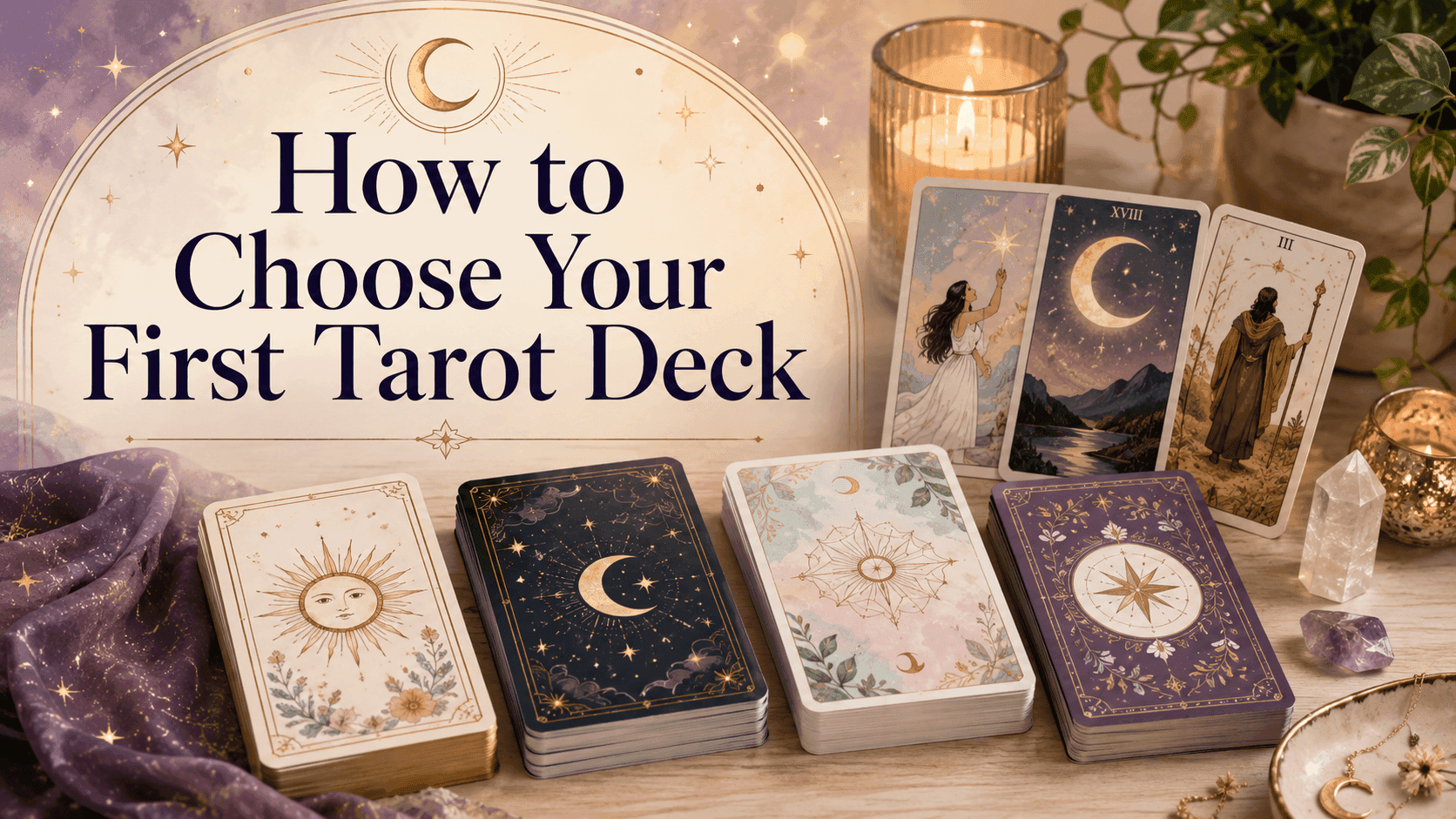
You're ready to start reading tarot, and now you're staring at hundreds of decks, all beautiful, all promising to be "the one." The good news is that figuring out how to choose a tarot deck is far simpler than the options make it look. Most of what sellers emphasize (rare art, special editions, a deck's "energy") barely matters for a beginner, while the few things that genuinely help you learn are easy to spot. This post covers what makes a deck easy to read from, the single decision that matters most, and the practical details worth checking before you pay. By the end, you'll be able to look at any deck and judge whether it's a smart pick for your first one.
Get clear on what a first deck is for
A first deck is a learning tool, not a collector's piece, and that reframes every choice you're about to make. You'll handle it constantly, look up meanings, forget them, and look them up again. So the question isn't which deck is most striking; it's which one you can read fastest while you're still a beginner. Tarot works as a reflection tool: you look at a card, notice how it lands against a question, and think it through. A daily one-card pull is the most common way beginners build that habit, so you specifically want a deck whose individual cards are easy to interpret at a glance. Don't shop for the advanced reader you hope to become in a year. Shop for the slightly confused person holding the cards this week.
The one choice that matters most: illustrated or pip
If you get only one thing right, make it this. Tarot decks split into two broad styles, and the difference decides how hard your first months will be.
Fully illustrated decks put a scene on every one of the 78 cards, including the minor arcana. The Rider-Waite-Smith deck, illustrated by Pamela Colman Smith and published in 1909, is the classic example, and most modern beginner decks follow its imagery. When you draw the Ten of Wands, you see a figure struggling under a bundle of ten staves, and the meaning half-suggests itself.
Pip-style decks, in the older Tarot de Marseille tradition, illustrate the Major Arcana but render the minor arcana as plain arrangements of suit symbols: five cups in a row, eight coins in a grid, with no scene to interpret. Experienced readers love them, but they lean heavily on memorized meanings.
For a beginner, illustrated wins easily. Reading a pip deck is like playing music from memory with no sheet in front of you; a scenic deck is a picture book that prompts you as you go. So do this: pick a deck where the numbered minor cards show scenes, not just tidy suit symbols.
Pick art you'll actually want to look at
Because reading tarot is mostly interpreting pictures, the artwork isn't decoration. It's your working surface, so pick a style you find both legible and genuinely pleasant to sit with. Classic, modern line-art, botanical, richly colored: any of these can work, as long as the images read clearly to you.
Here's where a lot of beginners get burned. A deck can be gorgeous on the box and still be hard to learn from, either because the art is so busy or low-contrast that the details vanish, or because the symbolism strays so far from tradition that standard guidebooks and websites no longer match what you're holding. The common mistake is judging a deck by the three or four dramatic Major Arcana cards used in the marketing photos. So before buying, look up a few of the plainer minor cards online, like the Three of Swords or the Ten of Wands, and ask yourself whether you could actually read them.
How to choose a tarot deck: a practical checklist
Once you've settled on an illustrated deck with art you like, the rest is quick. Before you pay, confirm four things:
- It's a tarot deck, not an oracle deck. Tarot has a fixed 78-card structure; oracle decks have no standard structure and won't match the meanings you're learning. This is the mix-up that trips up the most beginners.
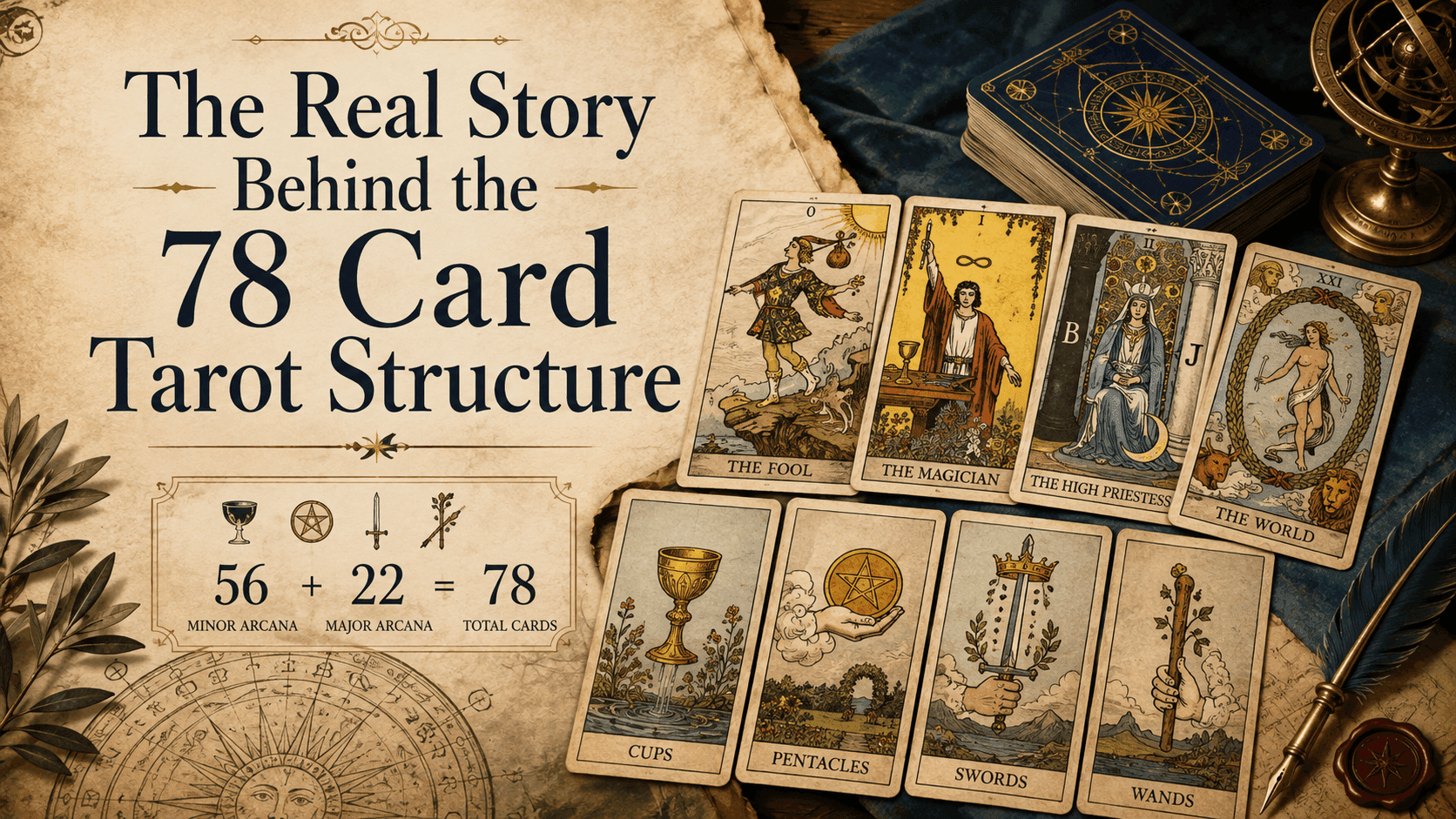
- It has all 78 cards: 22 Major Arcana and 56 minor. Some novelty decks quietly cut cards.
- The cards fit your hands. Oversized "art" cards look stunning and are miserable to shuffle; standard size is easier for daily use.
- It includes a guidebook, or you've confirmed a solid free reference exists for that deck's imagery.
If a deck clears those four, it's a perfectly good first deck. Everything beyond this (box design, gilded edges, limited runs) is preference, not quality.
Imagine someone, call her Priya, deciding between two decks she likes. The first is a dreamy watercolor deck whose sample images online are all Major Arcana. When she digs up its minor cards, the numbered suits turn out to be bare pips with no scenes, and reviewers mention the meanings drift from the usual ones. The second is a plain, RWS-based deck: less glamorous, but every minor card tells a small story, and it ships with a guidebook. Priya notices she can already half-read the second deck's Ten of Wands just by looking at it. She buys that one, saves the watercolor deck as a someday second deck, and starts pulling a card each morning the day it arrives. That's the choice working exactly as it should.
Where to buy it, and the "must be a gift" myth
Buy your own deck. The belief that a tarot deck has to be given to you as a gift is folklore with no basis in tarot's history, and waiting on it only delays you. New or secondhand both work fine, so choose whichever you prefer. The one thing worth doing regardless of where you shop is previewing the minor arcana first, since that's the part sellers rarely feature and the part you'll lean on most.
Conclusion
Strip away the marketing and how to choose a tarot deck comes down to three things: a fully illustrated deck, art you can read comfortably, and a genuine 78-card tarot set rather than an oracle deck. Everything else is taste.
Do this today: pick three decks that catch your eye, look up the same minor card in each (say the Ten of Wands), and compare. Buy the one whose picture you can start to read without the book. Then pull a single card the day it arrives, and you've already begun.