You shuffle a deck that looks old and a little mysterious, and somewhere along the way you've absorbed the idea that these cards come from ancient Egypt or some secret order of priests. It's a great story. It also isn't what happened. The real history of tarot cards is shorter, stranger, and honestly more interesting than the myth.
This post traces tarot from a 15th-century Italian card game to the self-reflection tool people reach for today, with the key people and dates that turned one into the other. By the end you'll be able to tell the difference between tarot's documented past and the marketing that grew up around it, and to hold your own deck with a clearer sense of where its images actually came from.
Tarot began as a card game, not a mystical practice
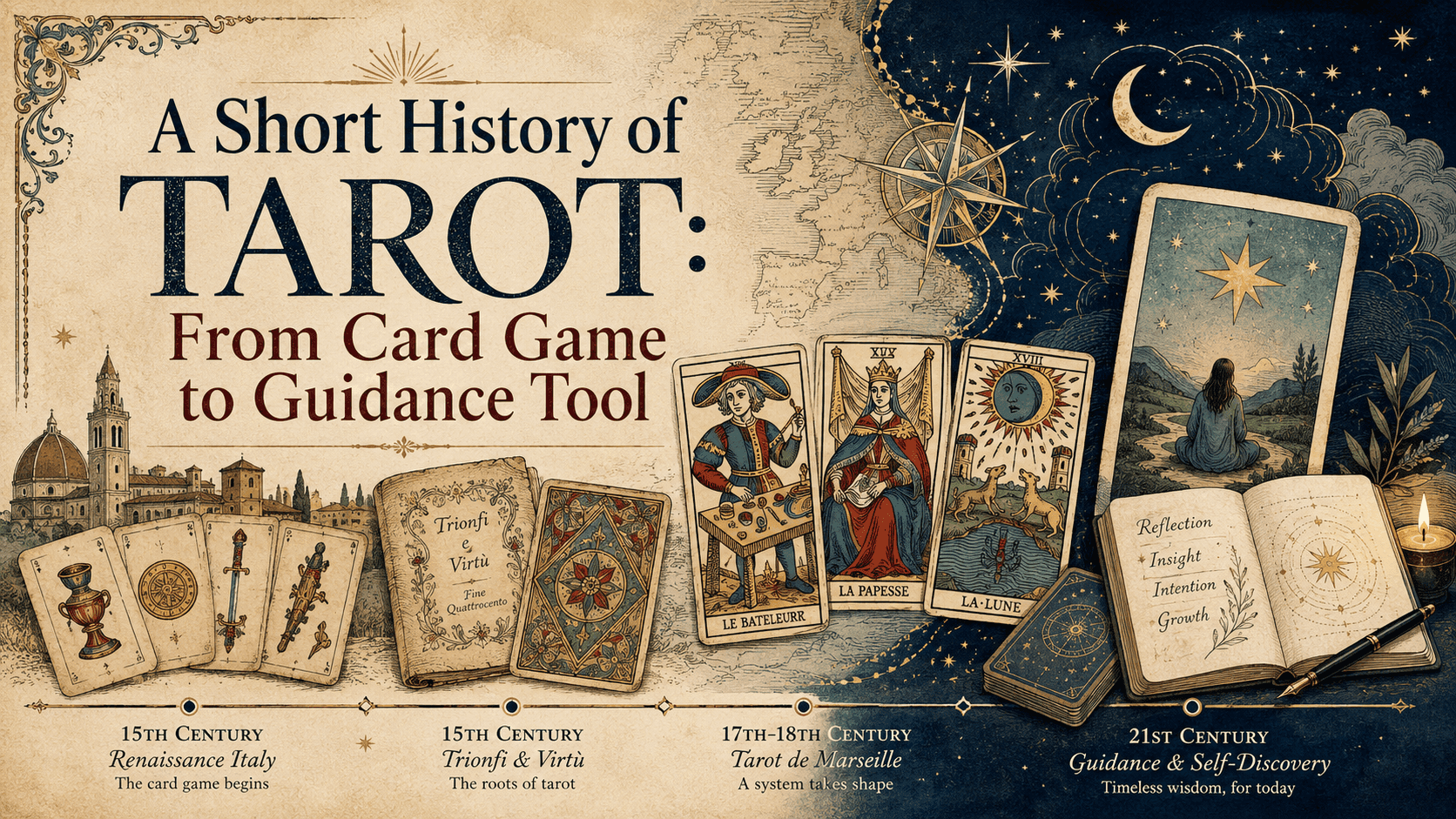
The oldest tarot decks we can point to come from mid-1400s northern Italy, and they were made for playing, not fortune-telling. The most famous survivors are the hand-painted Visconti-Sforza cards, commissioned for the ruling families of Milan in the 15th century. A few of these luxurious decks still exist in museums and libraries.
The game was a trick-taking game, closer in spirit to bridge or euchre than to anything occult. It used a special set of picture cards that outranked the regular suits, and here's a detail worth keeping: our word "trump" comes from "trionfi," the Italian for "triumphs," which is what those special cards were called. So the Major Arcana you shuffle today started life as, essentially, the trump cards in a Renaissance card game.
The game spreads: suits, trumps, and the Marseille pattern
A full tarot deck settled into a structure of 78 cards, and if you own one, this is what you're holding: 56 suit cards across four suits, traditionally cups, coins, swords, and batons (or wands), plus 22 trump cards. Compared with a modern 52-card poker deck, tarot has an extra court card in each suit and that whole additional run of 22 illustrated trumps.
As the game moved from Italy into France and beyond, printers standardized a woodcut version that became known as the Tarot de Marseille. For a couple of centuries it was simply a popular gaming pattern, printed cheaply and played widely. Nobody shuffling a Marseille deck in 1650 was reading fortunes with it; they were trying to win tricks. The divination came later, and it came from a specific, identifiable moment.
The 1700s: how tarot became a fortune-telling tool
Tarot's turn toward divination has a surprisingly precise starting point. In 1781, a French scholar named Antoine Court de Gébelin published an essay arguing that tarot secretly preserved the wisdom of ancient Egypt, encoded by priests and smuggled into Europe disguised as a game. It was a confident theory. It was also unsupported by any historical evidence, and Egyptologists since have found nothing to back it up.
The idea caught on anyway. Around the same period, a Frenchman working under the name Etteilla built a business around reading cards and produced decks designed specifically for fortune-telling, helping turn cartomancy into a popular pursuit.
Here's where beginners most often go wrong: assuming tarot is an ancient mystical system thousands of years old. It isn't. The cards are roughly 600 years old, and the fortune-telling layer is only about 250, bolted on long after the game itself. That gap is oddly freeing once you notice it, because it means the card meanings aren't ancient commandments. They're an evolving tradition you're allowed to think about critically.
The occult revival and the deck you probably own
Through the 1800s, occult writers kept layering meaning onto the cards. The French author Éliphas Lévi connected the tarot's structure to Kabbalah and the Hebrew alphabet, and later the Hermetic Order of the Golden Dawn, an influential English occult society founded in 1888, wove tarot into a larger system of esoteric correspondences.
That society produced the deck most beginners now learn on. In 1909, two of its members, Arthur Edward Waite and the artist Pamela Colman Smith, published what's usually called the Rider-Waite-Smith deck, with Rider being the publisher. Waite followed it with a guidebook, "The Pictorial Key to the Tarot," in 1911.
Its big innovation was practical. Earlier decks usually left the numbered suit cards as plain arrangements of the symbol, so a five of cups was just five cups in a row. Smith illustrated every one of those cards with a full scene, which made the deck far easier to read by looking rather than by memorizing lists. That single design choice is a large part of why this deck, and the many decks modeled on it, still dominate beginner shelves.
From prediction to self-reflection: what the history of tarot cards means for you today
Over the 20th century, the way people use tarot shifted again. As interest in psychology grew, many readers moved away from strict fortune-telling and toward tarot as a mirror: a way to reflect on a situation, name what you're feeling, and consider an angle you'd missed. That's the framing most modern beginner guidance uses, including the daily one-card practice this site is built around, where you draw a single card as a prompt for thinking rather than a forecast.
The history actually supports that shift. A tradition assembled over centuries and revised by gamers, occultists, and artists is better understood as a rich shared language of images than as a fixed oracle handed down intact.
Imagine someone named Priya who buys her first deck believing tarot is an unbroken ancient-Egyptian oracle. She pulls a card, gets a meaning she doesn't like, and feels stuck, as if the deck has issued a ruling she has to obey. Then she learns the real timeline: Renaissance game first, divination added in the 1780s, her specific deck designed in 1909. Nothing about the cards changed, but her relationship to them did. Now when she pulls the Tower and feels a jolt, she treats it as a strong image to think with, asking "what in my life feels shaky right now?" instead of "what disaster is coming?" The history didn't make the cards less useful. It made them less frightening and more genuinely reflective.
Conclusion
If you take one thing from the history of tarot cards, let it be this: these are a roughly 600-year-old set of images with a 250-year-old fortune-telling tradition attached, not an ancient oracle you're bound to obey. That turns the deck into a tool you get to think with, on your own terms.
Try this today: pull one card, and instead of asking what it predicts, ask what situation in your life its picture reminds you of. Read it as a Renaissance-born image built for reflection, and notice how much more room that gives you to actually use it.