It's morning, you've got a few minutes and a deck, and a single card feels a little thin for the kind of day ahead. You want more shape to your reading, but not a fifteen-position layout you'll never finish before breakfast. That's exactly what a good daily tarot spread gives you: a small, repeatable structure that adds perspective without eating your morning.
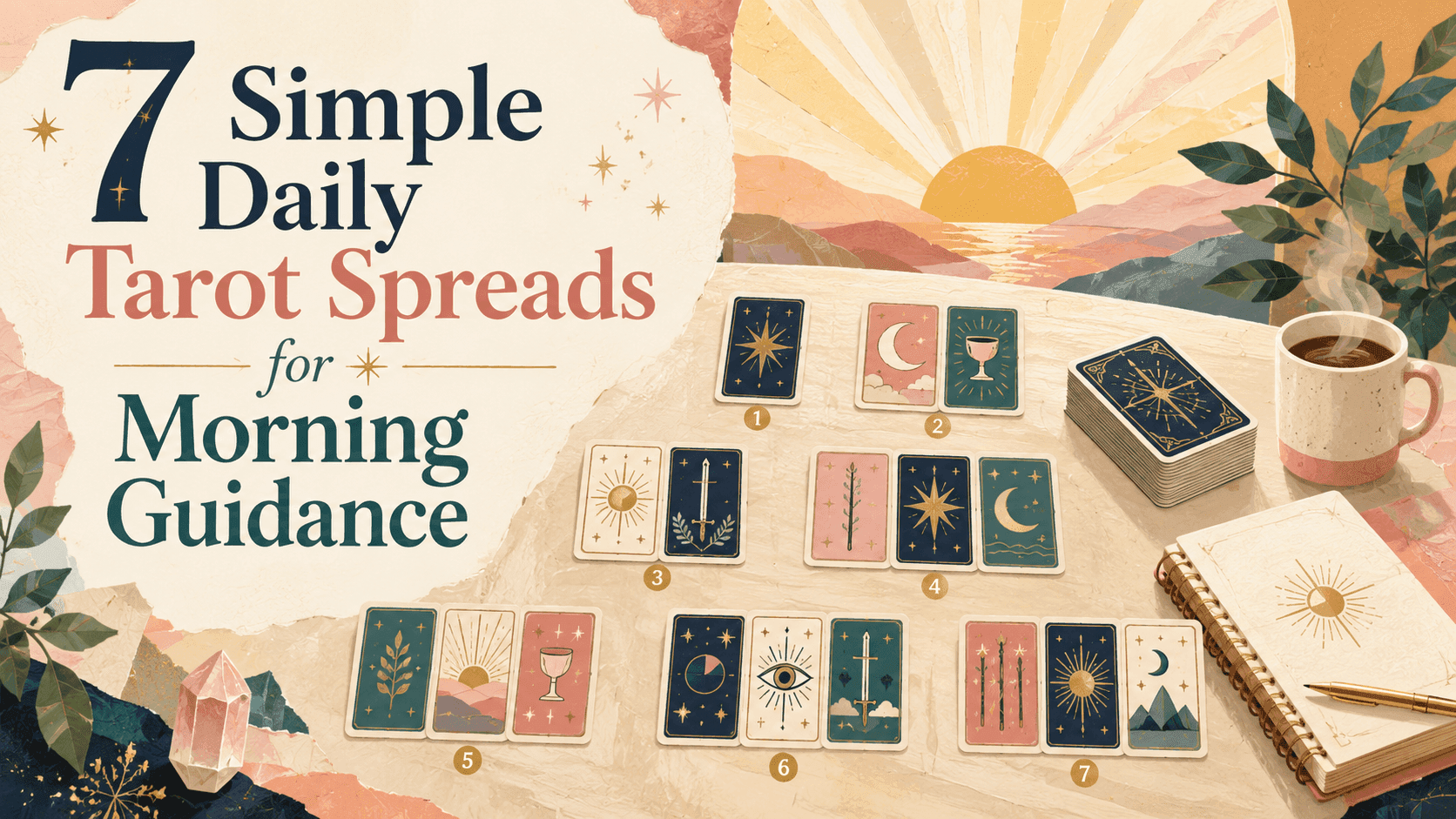
This post gives you seven simple spreads built for morning reflection, ranging from a single card up to three, with the positions spelled out and a quick sense of when to reach for each. Every one is beginner-friendly and takes just a few minutes. By the end you'll have a small menu to choose from depending on what your morning actually needs, rather than defaulting to the same layout on autopilot.
How to use these daily tarot spreads
Each spread below assigns a job to every card. That's the whole value of a spread over a loose handful of cards: the position tells you what question the card is answering. Pull your cards however you like, then read each one specifically against its position rather than as a vague clump.
That last point is where beginners most often trip. It's tempting to lay out three cards and read them as three separate mini-fortunes, ignoring the structure you just set up. Don't. If a card sits in a "what to set aside today" position, read it through that lens even when its usual meaning points elsewhere, because the position is doing half the interpretive work. A three-card spread read without its positions is just three disconnected pulls.
One more piece of advice: match the spread to the morning you actually have. A rushed Monday might call for a single card; a slower Sunday can hold three. Bigger isn't better, and a spread you finish beats an ambitious one you abandon halfway.
The one-card spread
The simplest daily tarot spread is a single card, and it's the backbone of the daily one-card practice this whole site is built around: one card, one question, a couple of minutes of reflection. For morning guidance, a reliable question is "what should I keep in mind today?" Draw one card and read its image against that question.
Say you pull the Four of Swords, traditionally an image of rest and stillness, since its picture shows a figure lying at rest. Against a packed morning, that might land as a reminder to build in a pause rather than sprinting from task to task. The single card isn't telling you what will happen; it's handing you one idea to carry into the day. When you're short on time or brand new to spreads, this is the one to default to.
Two two-card spreads for a quick read
When one card feels too sparse but three feels like a lot, a pair is the sweet spot. Here are two worth knowing.
Focus and Caution
Two cards, two jobs. The first marks where your energy is best spent today; the second flags something to stay mindful of, a tendency or distraction worth watching. Draw the first and ask "where is my attention best placed?" Draw the second and ask "what should I be careful not to let run the show?"
If the second card is the Knight of Wands, often linked with bold, restless, charge-ahead energy, you might read it here as a nudge to watch for impatience rather than a command to gallop off. The caution position reframes a card's usual push as something to hold lightly.
Let Go and Invite In
This pair suits a more intention-setting morning. The first card represents something to release or stop carrying today; the second, a quality to welcome in. Ask "what can I set down?" and then "what would help to make room for?"
It's gentler and more reflective than the others, closer to journaling than problem-solving. If the "let go" card reads as harsh self-criticism and the "invite in" card as steadiness, you've got a clear, usable intention for the next few hours, with no prediction involved.
Three three-card spreads for a fuller morning
Three cards give you enough room to tell a small story about your day. These three do different jobs, so pick by what your morning calls for.
Morning, Midday, Evening
Three cards mapped to the arc of your day, the first for your morning, the second for midday, the third for evening. A useful framing here isn't "what will happen then" but "what quality would serve me in each stretch." Read the evening card, for example, as the tone you'd like to arrive home in, and let it shape small choices earlier on.
Situation, Action, Attitude
A light problem-solving spread for a morning with something on your mind. The first card describes the situation as it stands, the second suggests a helpful action, the third points to a mindset to hold while you act. It's a way to think a small challenge through, not a set of orders to obey.
Imagine someone named Sam who wakes up tense about a first day at a new job and lays out this spread. The situation card is the Five of Pentacles, traditionally an image of feeling left out in the cold, which Sam reads as "I feel like an outsider here." The action card is the Six of Cups, often associated with kindness and simple warmth, which Sam takes as "reach out and be openly friendly to someone today." The attitude card is Temperance, traditionally linked with balance and patience, read as "go steady and don't force it." In four minutes Sam has a small plan: expect the outsider feeling, counter it by being warm first, and stay patient. Nothing was predicted; Sam just built a usable frame for the morning.
Head, Heart, Gut
For a morning when you're weighing something, this spread separates three inputs you might be blending together. The first card reflects what your head thinks about the matter, the second what your heart feels, the third what your gut senses. Laying them side by side can show you where those three disagree, which is often the real source of feeling stuck. Keep in mind this is a reflection aid: it surfaces your own perspectives, it doesn't make the decision for you.
A one-word spread to close
The last one is barely a spread, and it's better for it: draw a single card and boil it down to one word to carry through the day. Not a full interpretation, just a word. Pull the Eight of Pentacles, traditionally an image of focused, patient craft, and your word might be "diligence," or simply "focus." Write it somewhere you'll see it.
This is a good option on mornings when you don't have the attention for interpretation but still want a small anchor. It also builds the habit of distilling a card to its essence, which sharpens your reading over time. Think of it as the espresso version of a morning pull.
Conclusion
The thread running through all seven: a daily tarot spread is only as useful as the questions its positions ask, so let the structure guide the read instead of pulling cards into a vague pile. Start small, and let the spread fit the morning you actually have.
Your next step, today or tomorrow morning: pick just one spread from this list, the single card if you're unsure, and run it once with a real question about your day. One finished spread teaches you more than five you read about and never try. Keep the deck where you'll see it, and tomorrow is covered too.