You learned Past-Present-Future, you've pulled it a dozen times, and it's starting to feel like the only tool in the box. The problem usually isn't you or the cards. It's that Past-Present-Future answers exactly one kind of question, and most of what you actually want to ask isn't shaped like a timeline.
The three card tarot spread is the most useful format a beginner can own, precisely because the three slots can mean almost anything you decide they mean. This post gives you 12 ready-to-use variations, each with a question it's built for, plus a simple way to match the right layout to whatever's on your mind today. By the end you'll be able to pick a spread on purpose instead of defaulting to the timeline every time.
One ground rule throughout: we're using these as reflection tools, ways to look at your own situation from a fixed angle, not as forecasts of what will happen.
Why the Positions Do the Real Work
Here's the thing beginners take a while to notice: in a three-card layout, the card matters less than the slot you put it in. The same card means something different depending on the question that position is asking.
Say you pull the Five of Pentacles, which traditionally pictures two figures out in the cold passing a lit window. In a "Past" slot it reads as a hardship you came through. In an "Obstacle" slot it reads as a scarcity mindset that's currently in your way. In an "Advice" slot it might read as: stop walking past the help that's right there. One card, three readings, all driven by the position, not the picture.
That's why swapping the labels on the three slots gives you a genuinely different spread rather than a cosmetic one. Learn to design the slots and you've learned the whole format.
The 12 Variations
Each of these is just three labeled positions. Deal one card to each, left to right, and read it against that slot's question. Pick the one whose purpose matches yours:
- Past / Present / Future : the classic, for seeing a situation as a trajectory rather than a frozen moment.
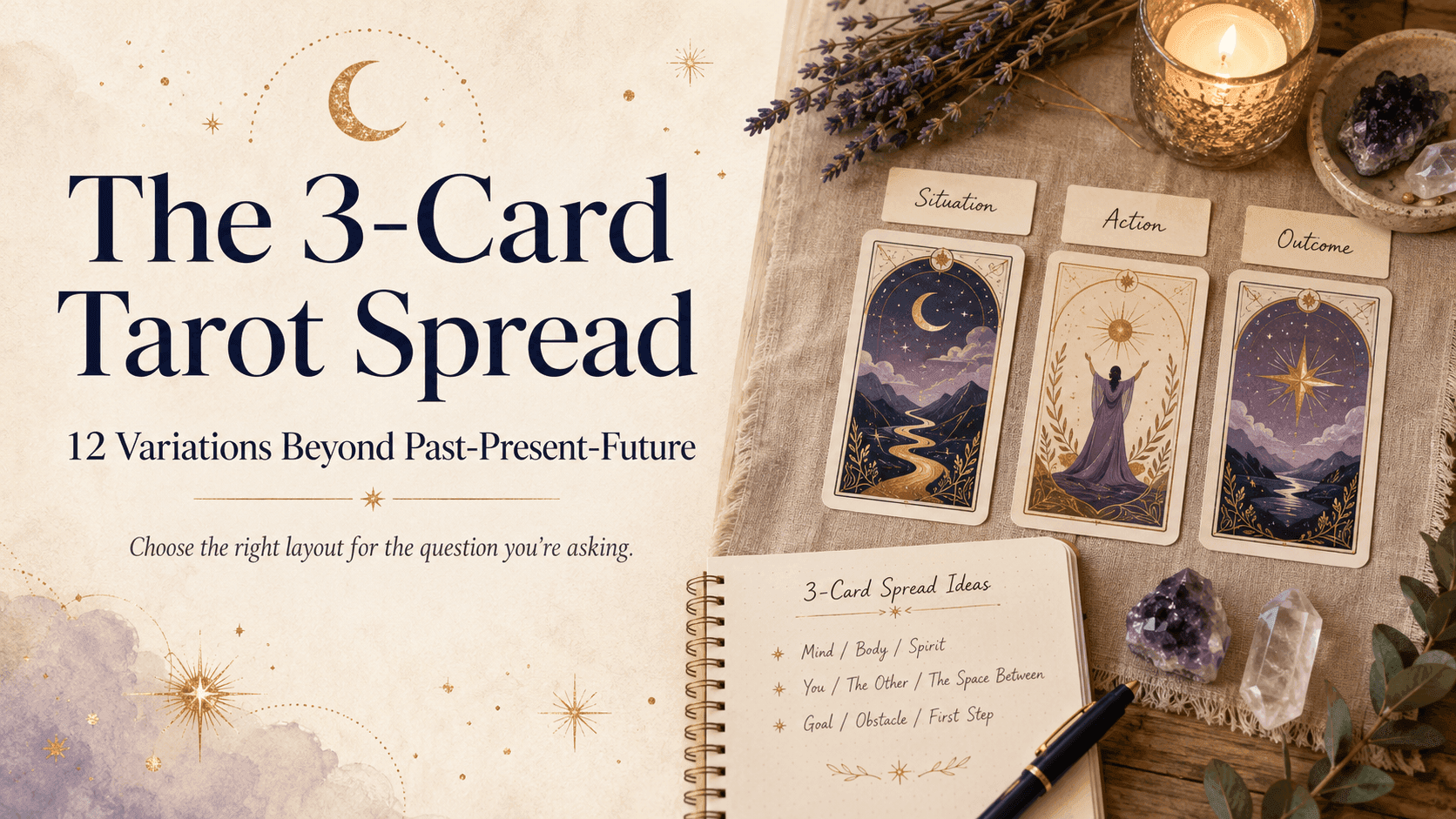
- Situation / Action / Outcome : when you know the problem and want to think through one possible response and where it leads.
- Mind / Body / Spirit : a check-in spread for when you feel "off" but can't locate where.
- You / The Other / The Space Between : for a relationship, reading yourself, the other person's position, and the dynamic itself as three separate things.
- Strengths / Weaknesses / Advice : for approaching a challenge you already know is coming, like a hard conversation.
- Stop / Start / Continue : a habit-and-behavior review, borrowed from how teams run retrospectives.
- What Helps / What Hinders / What I'm Missing : for when you're stuck and suspect there's a factor you haven't named.
- Option A / Option B / What to Weigh : a decision spread; the third card names the deciding factor rather than picking for you.
- Root / Pattern / Release : for a problem that keeps recurring, to look at its source and what you keep doing with it.
- Head / Heart / Gut : when those three are disagreeing about the same decision and you want them laid out separately.
- Goal / Obstacle / First Step : for turning a vague intention into one concrete next action.
- Morning / Midday / Evening : a gentle day-planning pull, three tones to carry into three parts of your day.
You don't need to memorize these. Screenshot the list, or better, write the three slot labels on an index card before you shuffle so you're committed to the question before you see a single card.
How to Match a Spread to Your Question
The variations are only useful if you can pick one quickly, and the shortcut is to notice what shape your question is. A question about how something developed wants a timeline (variation 1). A question weighing two roads wants a decision layout (8 or 10). A question that's really "why does this keep happening" wants Root / Pattern / Release (9). A vague "how am I doing" wants a check-in (3 or 6).
Here's where beginners most reliably go wrong: reading three cards as three unrelated one-card pulls stacked next to each other. The whole point of a spread is that the cards talk to each other. If your "Obstacle" card and your "First Step" card seem to contradict, that tension is the reading, not a mistake to smooth over. Before you finish, always ask one question of the full row: what story do these three tell together? If you skip that, you've done three readings, not one spread.
And if three positions feel like too much to juggle at first, there's no shame in going back to the single card. A daily one-card pull is the fastest way to get fluent in what each card feels like, which is exactly the vocabulary you need before three of them in conversation will make sense.
A Worked Example
Imagine Marcus, who's been offered a role on another team at his company and can't decide whether to take it. Past-Present-Future would tell him a story about the job he already has, which isn't his question. So he picks variation 8, Option A / Option B / What to Weigh: stay, go, and the factor he should be deciding on.
Option A (stay): Four of Cups, the figure ignoring a cup being offered. Option B (go): Eight of Cups, someone walking away from what they built. What to Weigh: the Page of Wands, traditionally a spark of new curiosity.
Read separately, these are just three cards. Read as a row, a shape appears: staying looks like quiet dissatisfaction, going looks like a real but real departure, and the deciding factor the last slot points at is whether he's actually curious about the new work or just bored with the old. That's the question he takes to his week, hypothetically. Notice the cards didn't choose for him. They sharpened what he needs to figure out.
Reversals and Other Optional Add-Ons
You can run any of these twelve with reversed cards or without, and readers genuinely split on this. Some read a reversed card as its energy blocked or turned inward; others read every card upright and let context supply the shadow. For a three-card spread specifically, there's a practical case for keeping it upright while you're learning: you already have three positions to interpret and read as a set, and adding reversals triples the variables before the basic format is comfortable.
Whatever you choose, choose it before you deal, not after you see a card you don't like. Deciding reversals matter only when an upsetting card lands upside-down isn't reading, it's negotiating.
Conclusion
The one habit worth taking from all of this: define your three slots before you shuffle, and read the finished row as a single story rather than three separate cards. That single move is what turns the three card tarot spread from a party trick into something you'll actually use.
So try it today. Pick one variation from the list that matches a real question you're sitting with, write the three position labels on paper, and deal. Then, before you interpret anything, read the row left to right and say out loud what the three cards seem to be telling you as a group. Start there.