It is the first week of January, or your birthday is coming, and you want to lay out twelve cards and see what is waiting for you. Then you do it, and you are looking at a table full of pictures with no idea what to do next, because "June: Five of Pentacles" is not information you can use.
This post walks through how to lay out a year ahead tarot spread, how to read the whole wheel before you read any single month, how to turn each card into a question rather than a forecast, and what to do when one of the months looks alarming. By the end you will have a full-year reading you can actually return to in March and get something from, plus a short review routine that keeps it alive instead of leaving it in a notebook.
Decide what the spread is for before you shuffle
A twelve-card year spread cannot tell you what will happen. It has no access to next October. What it can do is hand you twelve different lenses and force you to think about the year in twelve separate pieces instead of one anxious blur, which is genuinely useful and much less exciting to advertise.
That difference changes what you write down. "August: the Eight of Pentacles means I will get promoted" is a prediction, and it will either fail or make you passive while you wait for it. "August: what would it look like to spend this month practising something badly until I am better at it?" is a prompt, and you can act on it in August. Write the second kind. This holds for every position, and it is what keeps the reading honest about money, health and other people, none of which the cards can forecast.
How to lay out a year ahead tarot spread
Readers do this differently and none of the variations is the correct one. The version below is the simplest.
- Choose your start point. January is the common choice, but your birthday month works just as well, and some readers prefer the winter solstice. Pick one and note it at the top of the page, because in four months you will not remember.
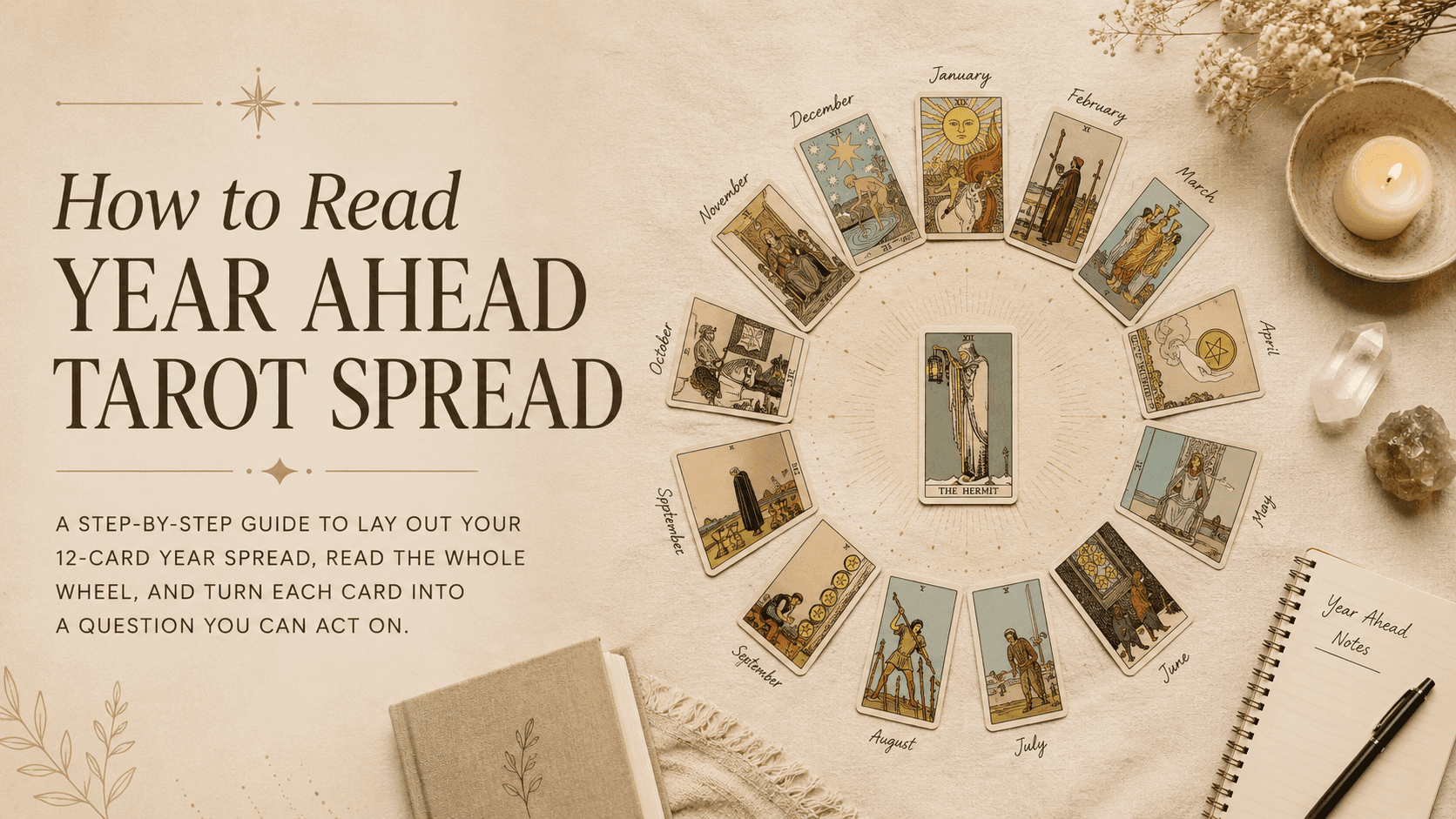
- Shuffle and lay twelve cards face down in a circle, like a clock face, starting at one o'clock and moving clockwise. A straight line left to right does the same job if your table is small.
- Add a thirteenth card in the centre for the theme of the whole year. Optional, but it gives the reading a spine.
- Turn them all face up at once, before interpreting anything.
That last step matters more than it sounds. If you flip and interpret one card at a time, you will build a story out of January and then bend February to fit it.
Some readers assign the twelve positions to the astrological houses rather than to calendar months, so position one becomes self and identity, position two resources, and so on. That is a real variation with a following, and it is a different reading rather than a deeper one. If you do not already know the houses, skip it. Months are easier to check against your actual calendar.
Read the whole wheel before you read a single month
This is where most beginners go wrong. They start at January and work around card by card, treating the spread as twelve unrelated one-card readings, and arrive at December having learned nothing that twelve separate pulls would not have told them. The value of a year spread is in the shape of the whole thing.
Before you interpret any individual month, scan the wheel for four things:
- Major Arcana clustering. Where are they? Three majors in a row suggests you already sense that stretch of the year carries weight. A wheel with one major and eleven minors reads as a year of ordinary maintenance.
- Suit dominance. Lots of Cups and few Pentacles is a different year from the reverse. Note which suit is missing entirely, because the absent one is often the area you have stopped thinking about.
- Repeated numbers. Three Fives scattered across the year is worth more attention than any one of them alone.
- Court cards. These often read as people or as roles you are being asked to play. Four of them means a year that involves other people heavily.
Only after that should you go month by month. The patterns give you the context that makes each individual card mean something specific rather than generic.
Turn each month into a question you could answer
Take each card and write one sentence in the form of a question about your own behaviour, not the world's.
Imagine Marcus, hypothetically, laying out his wheel on New Year's Day. His centre card is the Hermit, and his first pass at March is the Three of Cups, which he initially writes down as "March: fun with friends, something social." Useless, and also not really a reading, since it is just the keyword.
So he checks it against the wheel. The Hermit in the centre suggests a year with a solitary, heads-down quality, and he notices that Cups appear only twice in the whole spread. Read against that context, the Three of Cups in March stops being a prediction of a good party and becomes a flag: this is one of the only points in the year where his own reading of the wheel points outward. His note becomes a question instead, "In March, who have I not seen since last year, and what would it take to organise it?", with a reminder to look at it again in late February. That is a card he can act on rather than wait for.
What to do with a month that looks alarming
Sometimes the Tower lands on your birthday month and your stomach drops. The honest position: the card is not a warning about an event, because tarot does not have access to events, and treating it that way turns a reflection tool into a source of dread you will carry around for months.
What it can reasonably do is describe a quality of attention. The Tower asks what you have built on foundations you would rather not examine. That question is worth sitting with in any month. Do write it down as a question. Do not write "September: something bad happens" and then read every ordinary setback in September as the prophecy arriving, which is the actual harm in this kind of reading.
If a card genuinely frightens you, the useful move is to name what specifically you are afraid of. That fear is usually already in you, and the card just gave it a picture. And if the anxiety is about your health, your finances, or a legal situation, the reading is not the place to resolve it. Those need the relevant professional, and the card at most tells you what to ask them.
Keep the reading alive across the year
A year spread that gets photographed and forgotten is a nice ritual and nothing more. Two things make it useful.
Photograph the layout and transcribe it, with the questions rather than the keywords, into whatever you actually check. Then put three review dates in your calendar, roughly quarterly. At each one, read what you wrote for the months just past and add one line about what actually happened, without grading the cards for accuracy.
The daily one-card practice pairs well with this. The year spread gives you a theme for the month, and a one-minute daily pull gives you a place to notice whether that theme is showing up at all. After a few weeks you will have a running commentary underneath the annual overview, which is far more informative than either on its own.
Conclusion
The takeaway: a year ahead tarot spread is a planning tool with twelve prompts in it, and the read on the whole wheel matters more than any single month.
Do this today. Lay out your twelve cards, turn them all over at once, and before you interpret anything, write down the four patterns: where the majors sit, which suit dominates, which suit is missing, and any repeated numbers. That takes five minutes and it will be the part you refer back to in June.