Some weeks you are not in crisis and not doing well either. The thing you meant to start is still not started, you have run out of patience with yourself about it, and every attempt to think it through arrives at the same tired conclusion. That is the state this self-love tarot spread is built for: five cards that give you a fairer picture of a stuck patch than the one your own head keeps producing.
This post walks through the layout position by position, shows you how to read the five cards as one piece rather than five separate verdicts, covers what to do when a card lands that you did not want, and ends with a single action you can take today. You do not need a special deck or any experience beyond knowing how to shuffle.
What "stuck" usually turns out to be
Stuck rarely means you have no options. More often it means every option has an argument attached to it that you have already lost. Compare two internal sentences: "I don't know what to do about my job" and "I know exactly what I'd do, and I've decided I'm not the kind of person who gets to do it." Only the second one is honest, and only the second one has anything you can work with in it.
That is why a self-compassion reading is not the same as a decision reading. A decision spread asks which door. This one asks what you are carrying that makes every door look too heavy. If you already know your options and keep circling anyway, the circling is the subject.
Worth saying plainly: spreads built around self-compassion are a modern invention. Waite's 1911 Pictorial Key to the Tarot describes a Celtic Cross layout and a longer alternative method, both aimed at divination in the fortune-telling sense. Reading tarot as a mirror for your own thinking grew mostly in the twentieth century, alongside interest in Jungian psychology. That does not make it less useful. It just means nobody handed this down, so you are allowed to adjust the positions to fit your situation.
Before you shuffle
Set the reading up so it has something to bite on. A question like "how do I love myself more?" is too big to produce a usable answer, and you will end up nodding vaguely at five cards. Name the specific stuck patch instead: the unsent message, the unstarted application, the habit you keep restarting on Mondays.
- Write the stuck thing in one sentence at the top of a page, in plain language, including the part you find embarrassing.
- Shuffle however you like, holding that sentence in mind rather than a general mood.
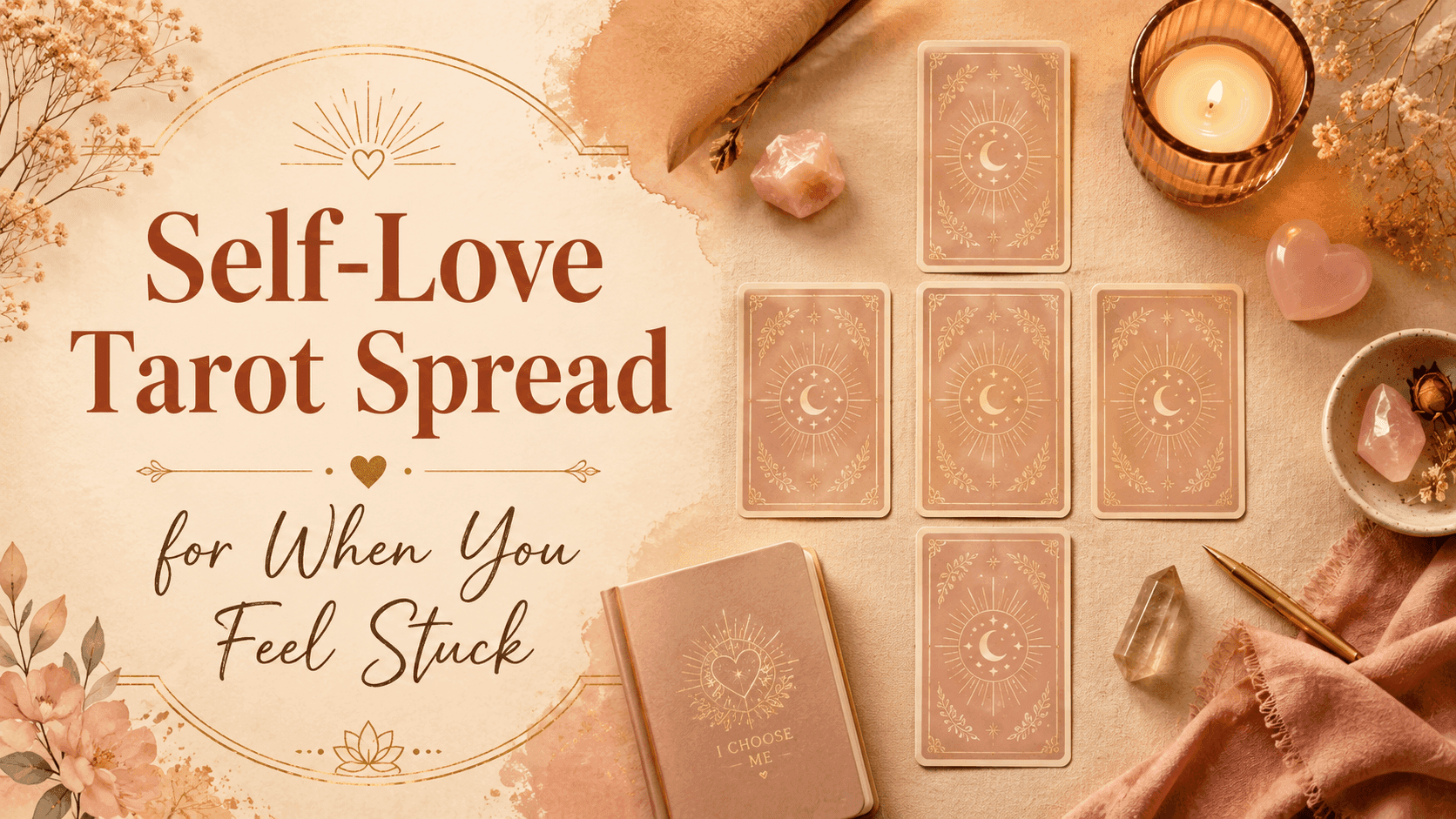
- Deal five cards face down: three in a row left to right, one below the middle card, one above it.
- Turn them over one at a time, in the order below, and write a line about each before moving on.
That last instruction matters more than it sounds. Turning all five at once means you read them as a group first, which almost always means you read them as a verdict on yourself. One at a time keeps each card doing its own job.
The self-love tarot spread, position by position
Cards one, two and three are the row, left to right. Card four sits below the middle. Card five sits above it.
1. Where I am actually stuck
The left card describes the shape of the situation, not your feelings about it. Read it as a description of conditions.
Say the Four of Cups turns up here, traditionally a picture of dissatisfaction: a figure ignoring an offered cup. In this position that suggests the problem may not be a shortage of options but a lack of appetite for the ones in front of you, which is a completely different problem to solve. Do resist the urge to skip ahead and fix it. Write what the card describes, then move on.
2. The story I have been repeating
The middle card names the sentence running underneath the stuckness. This is usually the most useful card in the spread and the one people rush past.
The Eight of Swords, a bound figure surrounded by blades with a clear path out that she cannot see, reads here as a story about having no room to move. The question that follows is not "is that true?" but "how long have I been saying it, and who did I first hear it from?"
3. What staying here protects me from
The right card is the one that makes this a self-love spread rather than a scolding. Stuck states usually persist because they are doing a job. Naming the job is kinder and more accurate than assuming laziness.
If the Four of Pentacles lands here, traditionally a figure holding tightly to what he has, the protection might be obvious: moving would risk something you are gripping, whether that is a salary, an identity, or the option of not having tried yet. Do not turn this into an excuse. Do treat it as information about what any next step will need to account for.
4. What I am not counting
The card below the row points at a resource you have already discounted. Most people asking a spread like this are running an unbalanced ledger, thorough about failures and vague about everything else.
The Page of Pentacles here, traditionally a beginner absorbed in learning something practical, might point at the class you took and dismissed because you never finished it, or the small skill you use daily and never think of as a skill.
5. The next kind thing
The top card suggests a next move that treats you decently. Read it as an action, not a mood.
The Four of Swords, an effigy at rest in a quiet chapel, is a good example of how this position works. It does not mean "feel restful." It means the honest next step is rest, actually scheduled, not the collapsed scrolling that stands in for it.
Reading the five as one picture
Once all five are down, read across the row first: conditions, story, protection. Then check whether the bottom card offers anything the top card needs. If card five suggests a step and card four names something you already have that supports it, you have a plan. If they contradict each other, that gap is the reading.
Imagine someone called Tomas, two months into meaning to apply for other jobs, who has not opened a single listing. His row comes out as the Four of Cups, the Eight of Swords, and the Four of Pentacles: options he has no appetite for, a story about having no room, and a grip on the stability he already has. Below sits the Page of Pentacles, which he connects to a certification he half finished and stopped mentioning. Above sits the Four of Swords.
What Tomas would actually notice is that his stuck patch is not about applications at all. He is exhausted, and he has been treating exhaustion as a character problem. The move the spread points at is not a job listing. It is finishing one module of the certification after a genuinely restful weekend, which is small enough to survive contact with a Monday.
When you pull a card you did not want
Here is where beginners most often go wrong with a spread like this: they decide in advance that a self-love reading should produce nice cards, and then reinterpret anything difficult into a compliment. The Devil becomes "honoring your desires." The Five of Pentacles becomes "you are so resilient." Do that and you have removed the only part of the reading that could have told you something.
The more useful move is to sit with the literal image before reaching for a meaning. What is the figure doing, and what would it be like to be them? A harsh-looking card in position three often reads as relief rather than accusation, because it names a cost you had been carrying without acknowledging it.
Reversals are optional. Some readers skip them entirely, which is reasonable for this spread, since positions two and three already invite you to look at the difficult side of things. If you do use them, treat a reversal here as a matter of intensity or inward direction rather than the card turning against you.
If five cards feels like too much to hold, this spread also works split across a week of daily one-card pulls, one position each morning. You lose the at-a-glance picture, but you gain a day of noticing between each card, and position two in particular tends to reveal more that way.
One thing to do today
The point of a self-love tarot spread is not to feel better by the end of the reading. It is to swap the version of your situation that your tiredest inner voice wrote for one with more of the facts in it, including the resources you had stopped counting.
So do the short version today: write your stuck thing in one honest sentence, pull a single card for position five alone, and ask what kind next step that image suggests. Then do the smallest recognizable piece of it before you go to bed. One position, one card, one action is a real reading, and it beats a beautiful five-card layout you never act on.