You've got the one-card and three-card readings down, and now you want to try the big one: the ten-card layout you see on the cover of every tarot book. Then you look at the diagram, with its cross and its column and its overlapping cards, and it looks less like a spread and more like a wiring diagram. The Celtic Cross tarot spread is the most information-dense layout most beginners meet, but it runs on a simple logic once someone walks you through it. This post explains all ten positions in order, shows you how to lay them out, and walks through reading them as one connected picture rather than ten separate cards. By the end, you'll be able to run one yourself for a real question.
How to lay out the Celtic Cross tarot spread
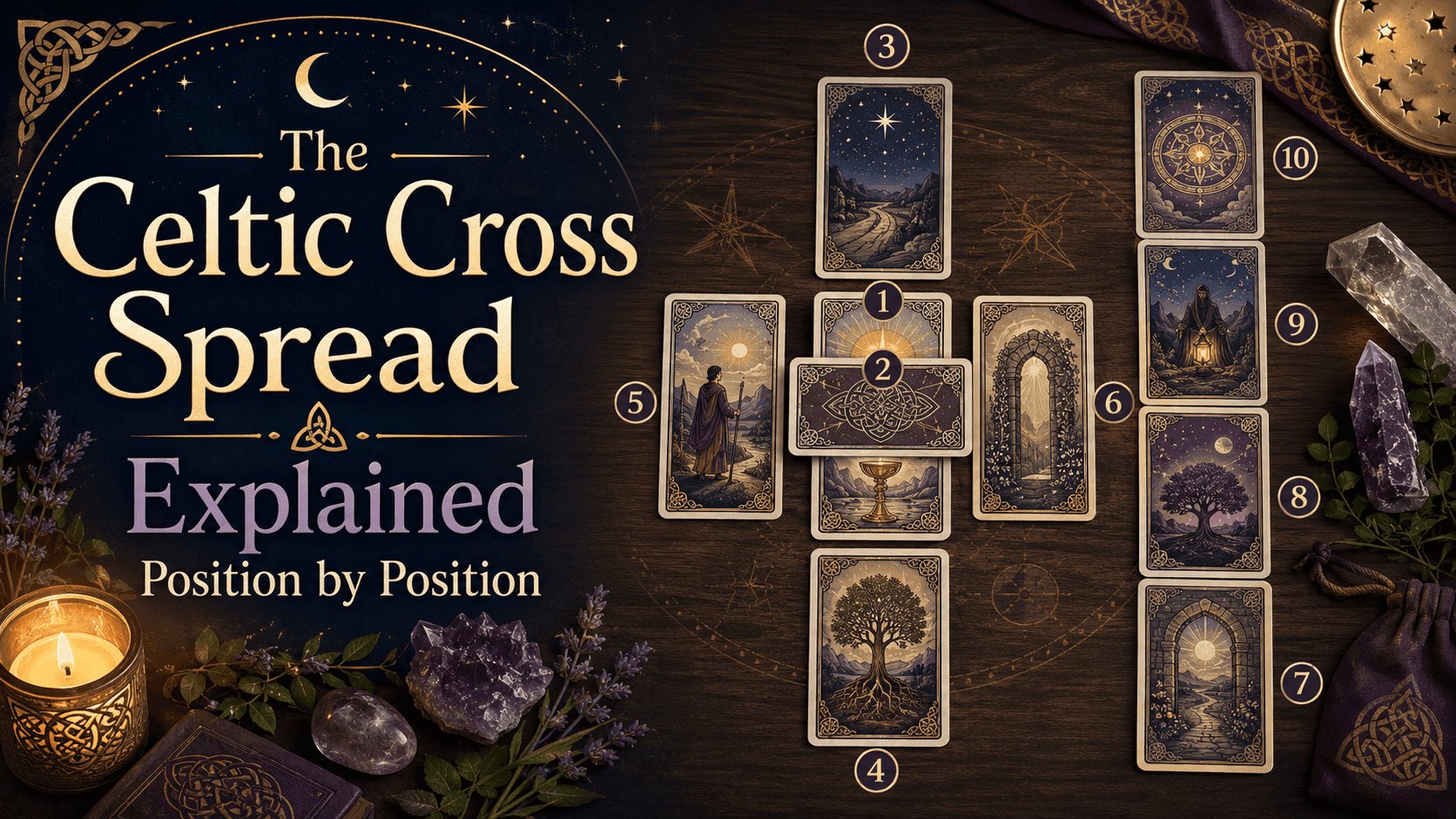
The spread is ten cards in two parts: a central cross of six cards, and a vertical staff of four cards beside it. A.E. Waite laid out this version in his 1911 book The Pictorial Key to the Tarot, and his arrangement became the standard most decks and books still teach.
One optional step comes first. Waite's method has you choose a significator, a single card picked to represent the person asking, before dealing the rest. Plenty of modern readers skip it entirely and simply deal ten cards, and neither choice is more correct. Here's the placement order:
- Place card 1 in the center. This is the heart of the matter.
- Lay card 2 sideways across card 1, so they form a small plus sign.
- Put card 3 above the center and card 4 below it.
- Set card 5 to one side and card 6 to the other; in the common convention, the recent past sits on the left and the near future on the right.
- Deal cards 7 through 10 in a vertical column to the right of the cross, reading from the bottom card up.
Don't agonize over perfect geometry. The meaning of each position matters far more than millimeter-accurate placement. And because the Celtic Cross assumes you can already read a single card in context, a daily one-card habit is the quiet groundwork that makes a ten-card spread feel manageable rather than overwhelming.
The cross: positions one through six
Position 1: The heart of the matter
The center card names what the reading is really about: the present situation, or the core of your question. If you asked about a stalled project, this card points to where your energy actually sits right now. Everything else in the spread orbits it.
Position 2: What crosses it
Laid sideways over the first card, this is the obstacle or the force in tension with it, which can be a genuine problem or sometimes a useful challenge. Because it sits sideways, many readers read it upright no matter how it falls. Think of it as the thing you keep bumping into.
Position 3: What's above (your aim)
Above the center sits your conscious goal: the best outcome you're picturing, or simply what's front of mind. Some readers treat this as what you're aiming for, others as what you think the situation is about. Either way, it's the daylight version of the matter, the part you're already aware of.
Position 4: What's below (the foundation)
Beneath the center is the root: the history or underlying basis the situation grew from, often something already set in motion. Many readers also read it as the subconscious driver you're less aware of. If position 3 is what you think you want, position 4 is often why you really want it.
Position 5: The recent past
This card points to an influence that's passing away, something that mattered recently but is loosening its grip. Read against position 6, it shows the direction of travel: what you're moving away from.
Position 6: The near future
Its partner shows what's coming into view, the influence arriving next. Read it as where things point if the current pattern holds, a prompt to think a step ahead, not a locked prediction of what must happen.
The staff: positions seven through ten
Position 7: You
The bottom of the staff is you: your attitude and stance, how you're actually showing up to the situation, which isn't always how you'd prefer to see yourself.
Position 8: Your environment
Above you sits everything around the situation: other people, circumstances, and outside pressures. A tense card here paired with a calm one in position 7 might suggest the friction is coming from outside you, not from within.
Position 9: Hopes and fears
This position holds what you most hope for and most fear, and the striking thing is how often those are the same card. A card about success here can read as both "I want this" and "I'm afraid of it," which is worth sitting with rather than resolving too quickly.
Position 10: Where it's heading
The top card is traditionally called the outcome, but it's better understood as a snapshot of where the current trajectory points if nothing changes. Treat it as a reflection prompt, not a prophecy, and don't lean on it to forecast things like your health, a legal result, or money. If you don't like where it points, that's useful information, not a sentence.
Reading the ten cards as one story
Here's where beginners most often go wrong: they read the Celtic Cross as ten separate one-card readings, end up with ten disconnected scraps, and feel more confused than when they started. The spread only works when the cards talk to each other. Read them in pairs and arcs instead: position 1 with position 2 (the situation and its challenge), position 5 with position 6 (where you're coming from and heading), position 9 with position 10 (what you fear against where things point). A card that seems flat on its own often sharpens the second you set it beside its neighbor.
One more thing makes or breaks the reading: the question. A focused question like "what's blocking this decision?" gives the ten positions something specific to answer. A vague one like "tell me about my life" scatters them into noise.
Imagine someone, call them Sam, who lays a Celtic Cross for one focused question: what's really keeping them from applying to go back to school? Sam doesn't try to read all ten cards at once. They start with the center pair: position 1 shows a stuck, stalled feeling, and position 2 shows a fear of wasting effort. Then they glance down at position 4, the foundation, and notice it points to an old story about not being "the academic type." Position 9, hopes and fears, echoes the same worry. Read together, those three cards suggest the real obstacle isn't the application at all; it's a belief Sam holds about themselves. Position 10 simply reflects that while that belief goes unexamined, nothing moves. The spread's job here isn't to predict whether Sam gets in. It's to show them what's actually in the way.
Conclusion
The thing to hold onto: the Celtic Cross tarot spread isn't ten separate answers, it's one layered picture of a single question, read from the center outward. The positions hand you a structure; your job is to let them talk to each other.
So try it today. Pick one specific question you actually care about, lay all ten cards, and read only positions 1 and 2 first, the heart and the challenge, before you touch anything else. Get comfortable with that core pair, then build outward from there. One honest question and two cards is more than enough to begin.