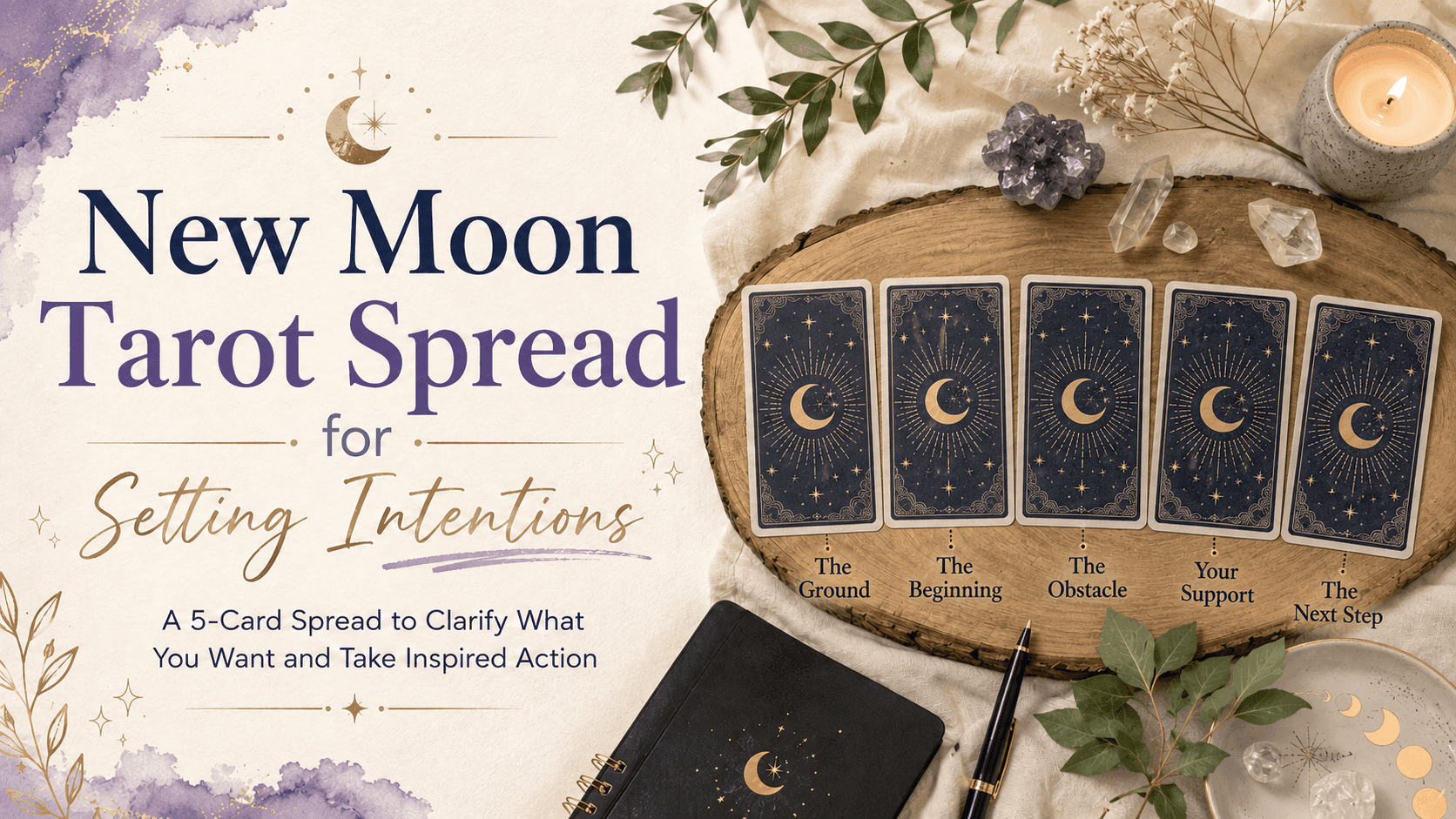
It's the night of the new moon, you've got your deck out, and you're staring at a blank page trying to write down what you want for the next few weeks. Nothing comes, or everything comes at once and none of it feels honest. That's the gap this new moon tarot spread is built to close: not to tell you what will happen, but to help you figure out what you actually want to commit to, and what's been getting in the way of saying it plainly.
Below is a five-card layout with a clear job for each position, guidance on writing the intention afterward, and a worked example so you can see the whole thing land. You'll be able to run this tonight, with any deck, in about twenty minutes.
Why the new moon works as a checkpoint
Worth being upfront about this: pairing tarot with the lunar cycle is a modern practice, not something you'll find in older tarot writing. Tarot began as a fifteenth-century Italian card game, and the classic occult guides, including Waite's 1911 Pictorial Key to the Tarot, say nothing about timing readings to the moon. Readers disagree about whether lunar timing adds anything. Some build their whole practice around it, others ignore it entirely, and neither camp is doing tarot wrong.
Here's the case for doing it anyway, in plain terms. The lunar cycle runs about 29.5 days, which means the new moon gives you a recurring date roughly once a month that isn't tied to a Sunday night or the first of the month or any other calendar peg you've already learned to ignore. At the new moon the sky is dark, since the moon sits between Earth and the sun with its lit face turned away from us. That's a genuinely useful piece of symbolism for intention-setting: nothing visible yet, which is exactly the state a new commitment is in.
Use it as a checkpoint, not a magic window. A reading done two days late works just as well as one done at the exact hour.
Before you shuffle: narrow the focus
The single biggest thing that separates a useful new moon reading from a vague one is deciding what area you're asking about before you touch the cards. "What's my intention for this cycle" is too wide, and the cards will answer it with something equally wide that you'll interpret however you already felt.
Pick one area and one only. Some prompts to choose between:
- The thing I keep starting and dropping. Good if you have a project with three false starts behind it.
- The relationship I've been coasting in. Friendship, family, or partner, but pick one person.
- The habit I want to build, not the ten I want to build. One habit.
- The thing I'm avoiding deciding. Not for the cards to decide, but to see what's making the decision sticky.
Write your chosen focus at the top of the page in one sentence before shuffling. Do not skip this step and plan to "see what comes up." A spread read without a focus tends to confirm whatever mood you walked in with.
The new moon tarot spread, position by position
Shuffle however you like, then lay five cards in a row, left to right. The order matters more than the shape, so a straight line is fine.
Position 1: The ground you're standing on
This card describes your actual starting conditions in the area you chose, not the version you'd describe to a coworker. If it looks unflattering, that's the position doing its job. A Five of Pentacles here might describe feeling depleted and under-resourced; a Four of Wands might describe more stability than you've been giving yourself credit for.
Position 2: What you're ready to begin
Not what you should want. This card points at what's genuinely available to start now, at this size, with the energy you currently have. Read it as a scope suggestion: an Ace-heavy or Page-heavy card suggests something small and early, while a card like The Chariot suggests you have more momentum available than you're using.
Position 3: What's in the way
Read this as an internal obstacle first, not a prediction of external trouble. The Devil here isn't a warning about a person; it's a prompt to look at what you feel trapped by and whether the trap is one you're maintaining. The Seven of Cups points at too many appealing options and no commitment to any of them.
Position 4: What you already have going for you
The support card, and the one most people underweight. It names a resource that's already in your possession: a skill, a relationship, a stretch of free time, a piece of stubbornness. Whatever shows up here, your job is to name the real-world version of it. "Strength means I'm resilient" is too vague to use. "Strength means I've kept up the Tuesday thing for four months even when I hated it" is usable.
Position 5: The first concrete step
The action card, and it has to convert into something you can do this week. If it's abstract, force it down to specifics: Eight of Pentacles becomes "thirty minutes of practice on Wednesday and Saturday," not "apply myself more."
Turning five cards into one intention
Read positions 1 through 4 for the picture, then write your intention as a single sentence built around position 5. The format that works: I'm starting [position 2's scope], despite [position 3's obstacle], using [position 4's resource], beginning with [position 5's action].
Imagine someone, call him Tomas, focusing on a language app he's abandoned twice. He draws the Four of Swords, the Page of Wands, the Seven of Cups, the Nine of Pentacles, and the Two of Pentacles. Read in order: he's more tired than he'd admit (Four of Swords), what's realistically available is beginner-level enthusiasm rather than a grand relaunch (Page of Wands), his obstacle is scattering across too many shiny options like adding a tutor and a podcast and a new app (Seven of Cups), and his real resource is that he's built self-sufficient routines before (Nine of Pentacles). The Two of Pentacles as his action points at juggling and balance, which he translates into something concrete: ten minutes after dinner, one app, nothing else added. His intention sentence writes itself, and it's smaller and more honest than the one he'd have written on the blank page.
The common mistake: treating position 3 as a forecast of what will go wrong, then quietly abandoning the intention because the cards "warned" you. That's backwards. The obstacle card is diagnostic, not predictive. It's showing you the thing to plan around, which is the entire reason you drew it before committing rather than after.
Keeping the intention alive after the new moon
An intention set on one night and never revisited is just a nicely worded note. Two things make it stick.
First, keep the five cards visible, or photograph the spread and set it as your lock screen for the cycle. Seeing position 5 daily does more work than remembering it did.
Second, this is where a daily one-card pull earns its place. Draw one card each morning and read it against your intention rather than against your whole life: does this card comment on the thing I committed to? Some mornings it won't, and you say so and move on. But the practice keeps the intention in view, which is most of the battle.
Then, at the full moon roughly two weeks later, pull one card and ask a single question: what have I actually done since the new moon? That's a check-in, not a grade.
Conclusion
The takeaway: a new moon tarot spread isn't for finding out how things will turn out. It's for writing an intention that's honest about your starting point, your obstacle, and your first step, which is why it tends to survive contact with real life better than a wishful one.
Tonight, do the short version even if you don't have twenty minutes. Write your one-sentence focus, pull three cards for positions 1, 3, and 5, and turn the last one into something you can do before the weekend. That's the whole method compressed, and it still works.