Major ArcanaCard 15Capricorn
Tarot Card Meaning

The Devil

The Devil tarot card means attachment, unhealthy patterns, and self-imposed limits. Explore its upright and reversed meanings, symbolism, and daily-pull guidance.

The Devil tarot card
At a glance

Quick Keywords

Upright
  • bondage
  • attachment
  • temptation
  • unhealthy patterns
  • materialism
  • restriction
  • obsession
  • denial
Reversed
  • breaking free
  • releasing a pattern
  • reclaiming control
  • awareness of a trap
  • gradual detachment
  • confronting a dependency
Symbolism

What's in the Image

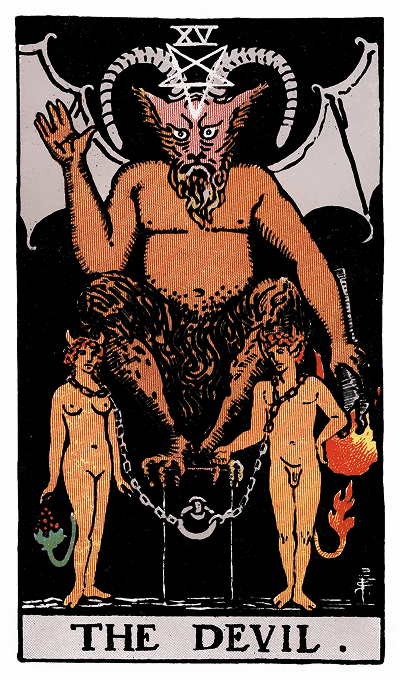
The The Devil — Rider-Waite-Smith version
Rider-Waite-Smith
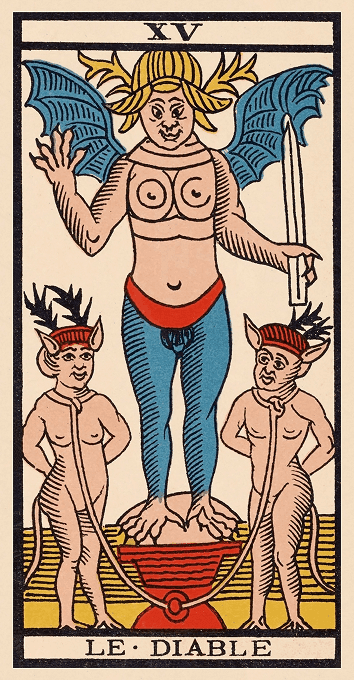
The The Devil — Marseille version
Marseille
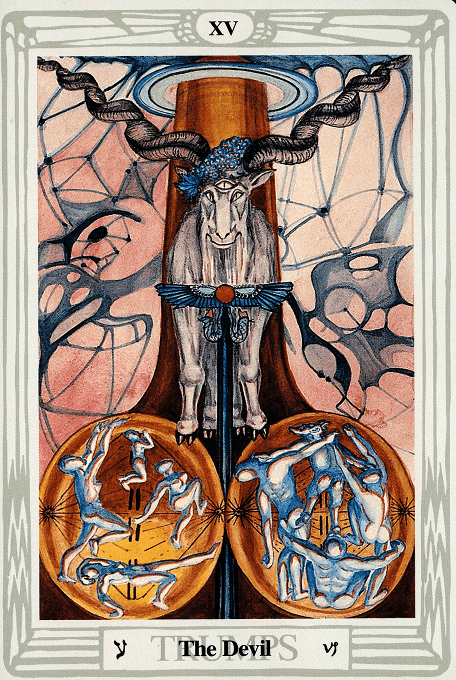
The The Devil — Thoth version
Thoth

In the Rider-Waite-Smith deck, a horned, bat-winged figure sits on a pedestal above a man and woman chained loosely at the neck. Both figures have small horns and tails, suggesting a gradual transformation into something closer to the Devil's own likeness, and an inverted pentagram appears on the pedestal above the figure's head. The core message concentrates in three details: the loose chains, which could be lifted off easily if the two figures chose to, the emerging horns and tails on the chained pair, and the raised hand of the Devil figure, which mimics the same blessing gesture used by the Hierophant but inverted, suggesting a corrupted or false version of guidance. Together these describe entrapment that persists mainly through consent and habit, rather than through anything physically inescapable.

Waite's 1911 notes describe the chains as loose enough for the two figures to remove, calling this a deliberate suggestion that "materiality" binds people more through choice than through force, a detail modern readers frequently miss while focusing on the more visually dramatic horned figure itself. This card, sometimes called Le Diable in the Tarot de Marseille, appears there in a broadly similar form, a horned figure above two smaller chained or bound humanoid figures, suggesting this core image of voluntary bondage predates Waite and Smith rather than being their invention. The Rider-Waite-Smith version's specific detail of loose chains, however, sharpens that older image into a clearer statement about the role of choice.

Upright Meaning

The Devil represents a pattern that restricts you but persists partly through your own participation in it. Its essential energy is entrapment through attachment: a habit, belief, relationship, or material desire that has taken on more control than it initially seemed to have.

In everyday situations, this often shows up as a habit that feels hard to break, even when its costs are becoming clear, or a relationship dynamic that's become unhealthy but familiar enough to stay in without question. It can also describe an excessive focus on material success or appearance, chasing something external in a way that starts to feel compulsory rather than freely chosen.

A nuance beginners often miss is that this card isn't describing something forced on you entirely from outside. The loose chains in the image are a key detail: they suggest the restriction could be loosened, which is a very different message than a card about being trapped with no way out. Reading this card only as "something bad is happening to me" skips over its more challenging, and more useful, implication that some amount of choice remains available, even if it doesn't feel that way yet.

Readers disagree somewhat on how much weight to give this card's connection to specific vices, like substance use or compulsive behavior, versus its broader connection to any limiting attachment, including ones that look perfectly respectable from the outside. Some traditions read the card primarily through the lens of harmful habits and dependency in a fairly direct sense. Other, more expansive readings apply it just as readily to unhealthy relationships, materialism, or self-limiting beliefs that don't resemble a stereotypical "vice" at all. Both readings share the theme of restriction maintained through familiarity or fear; they differ in how narrowly or broadly that restriction is defined.

Reversed Meaning

Reversed, the Devil doesn't simply mean the restriction is already gone. That would just negate the upright meaning without describing the actual process involved. The more useful distinction is between recognizing a trap and having fully broken free of it. Recognition suggests becoming aware of a pattern's grip for the first time, seeing clearly how something has been limiting you, even if you haven't yet taken action to change it.

A different shadow expression involves active movement toward release: taking real steps to loosen a habit's hold, ending an unhealthy dynamic, or starting to separate your sense of worth from something material or external. This is a meaningfully different stage from simple awareness, since it involves action rather than just recognition, though both can appear under a reversed Devil depending on the reading's context.

The reversed card can also point to a partial or incomplete release: having stepped back from a pattern in one way while still being pulled toward it in another, a common and realistic middle stage rather than a clean, finished break. This differs from full detachment; here the pull is weaker but not entirely gone.

It's worth noting that some readers don't use reversals at all, reading every card only upright and relying on surrounding cards for shading instead. If that's your approach, the recognition, active-release, and partial-detachment readings above still apply, held as tensions that can appear within an upright Devil, particularly in a reading involving something the person already senses isn't serving them well.

In a daily reading

The Devil in a Daily Reading

As a single morning card, the Devil is worth reading as a nudge to notice where a habit or pattern has more control over your day than you'd like to admit. It's a good day to ask honestly whether something you're doing out of routine still genuinely serves you, or whether it's continuing mostly out of familiarity.

Say you pull this card before a day that includes a familiar temptation, like reaching for your phone the moment you feel bored or uncomfortable. The Devil doesn't predict you'll fail to resist it; it suggests simply noticing the pull with more awareness than usual, and considering whether the chain here is looser than it feels.

A daily-pull scenario

A Daily-Pull Scenario

Imagine pulling the Devil on a morning before a day that includes an argument you tend to have repeatedly with the same person, following a familiar, unhelpful script. A beginner's first instinct might be to read this as a warning that something sinister is at play. A more useful reading treats the card as a prompt to notice the pattern itself: is there a predictable back-and-forth you both fall into automatically, and what would it take to consciously choose a different response today rather than following the usual, well-worn script?

Read with care

Common Misreadings

  • This card means something evil or sinister is happening.

    The Devil describes attachment and restrictive patterns, not literal evil or malevolent forces. Reading it as an ominous warning skips over its more useful, self-reflective meaning about habits and choices.

  • This card means I'm completely trapped with no options.

    The loose chains in the image are a deliberate detail suggesting the restriction could be loosened. The card points toward limited but real agency, not total, inescapable entrapment.

  • Reversed always means I've already broken free.

    Reversed can describe genuine release, but it can just as easily describe simply recognizing a pattern for the first time, or a partial, still-ongoing process of detachment rather than a finished one.

Combinations

Cards That Change Its Meaning

  • The DevilTen of Swords

    Amplifies the sense of a pattern reaching a breaking point, suggesting an unhealthy dynamic or habit that has run its course so fully it's becoming impossible to sustain any longer.

  • The DevilThe Star

    Tempers restrictive attachment with a sense of hope, suggesting that even amid a difficult pattern, some genuine possibility for healing or release is also present.

  • The DevilThe Tower

    Redirects gradual, chosen release toward sudden, forced disruption, suggesting a restrictive pattern may end abruptly rather than through the slower process of recognition and choice the card usually implies.

Sit with it

Questions for Reflection

  1. 1

    What habit or pattern in my life feels harder to change than it might actually be?

  2. 2

    Where have I been telling myself I have no choice, when some amount of choice might still exist?

  3. 3

    Is there a relationship or dynamic that continues mainly out of familiarity rather than genuine value?

  4. 4

    What would it look like to loosen my attachment to something, even slightly, today?