You have a deck, a question, and a nagging suspicion that you're supposed to feel something before you start. You don't.
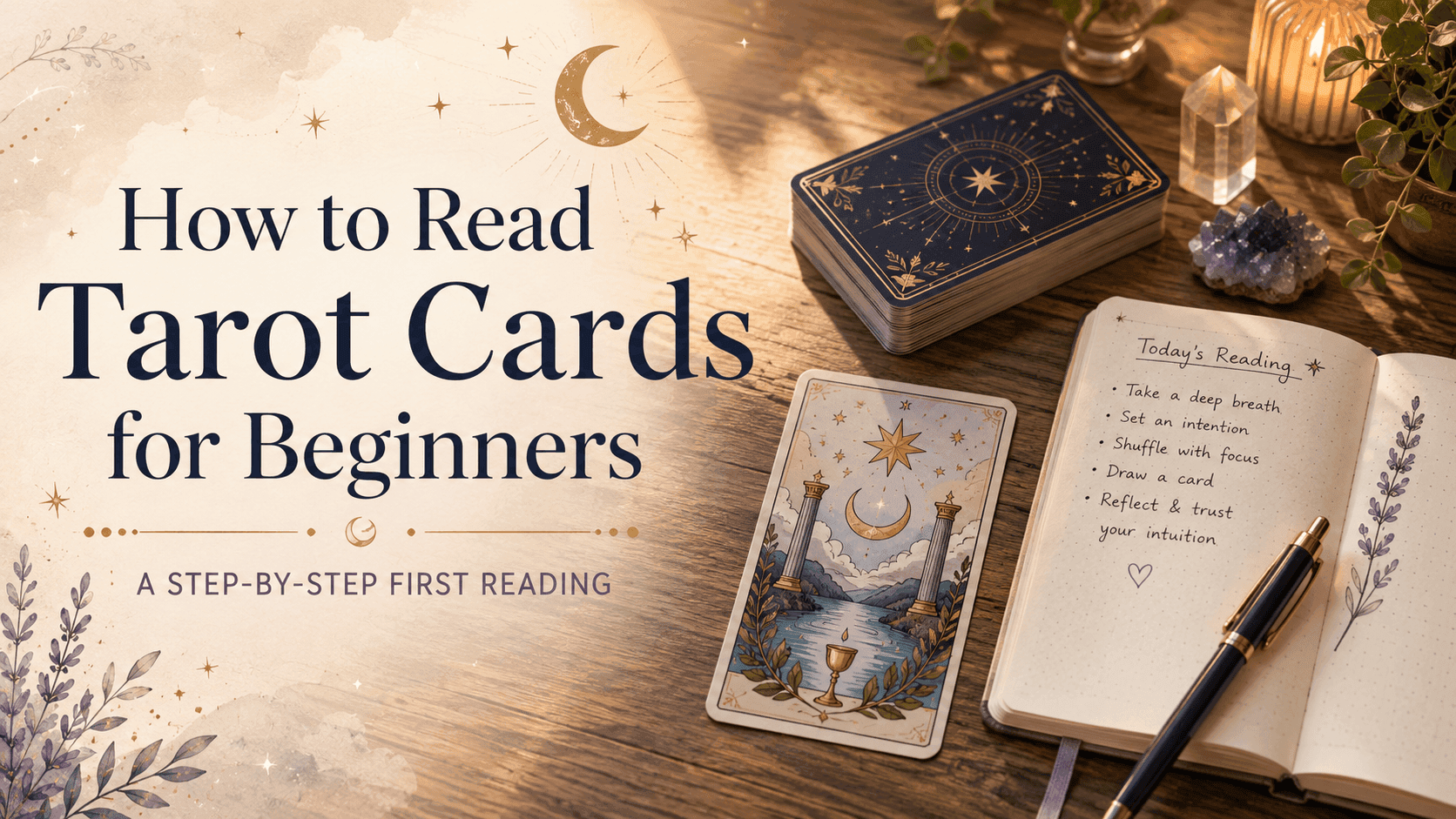
Most advice on how to read tarot cards for beginners either buries you in card meanings or tells you to trust your intuition and then leaves you sitting there. This post does neither. It walks through one complete reading end to end: choosing a question a card can actually help with, handling the deck, reading a single card in three passes, and writing the result down so it's worth something to you next week. By the end you'll have done a real reading, not read about one.
One thing up front. Tarot here is a reflection tool, a structured way to look at your own situation from an angle you didn't choose. Not a forecast, and not a substitute for a doctor, a lawyer, or an accountant.
Pick a Question the Cards Can Actually Help With
The question does most of the work, and beginners almost always ask the wrong kind. "Will he text me back?" has exactly two answers, and a card can't hand you either one. What it can do is show you something about your own position that you'd skated past.
The fix is mechanical: turn every closed or predictive question into an open one about you, now.
- "Will I get the job?" becomes "What am I not seeing about how I'm approaching this application?"
- "Should I break up with him?" becomes "What's driving my hesitation here?"
- "Will the money come through?" becomes "How am I handling the not-knowing?"
- "Is this the right move?" becomes "What would I need to be true to feel settled about this?"
Notice the pattern. Every rewrite points the card at your perspective rather than at the future. Don't ask about anyone's health, a pending court date, or which numbers to play. Those aren't questions tarot can answer, and treating them as if it can is the fastest way to make a bad decision with borrowed confidence. Do ask something you could plausibly journal about for ten minutes.
If nothing specific is bothering you, "What should I pay attention to today?" is a perfectly good question. It's also the one that makes a daily one-card habit work, which we'll get to.
Handle the Deck: What's Ritual, What's Necessary
Take the deck out. Shuffle it however you shuffle cards: riffle, overhand, or spread them face-down on the table and swirl them around with both hands, which is the gentlest option on a new deck's edges. Shuffle until you feel like stopping. That's not mystical vagueness; it's a real instruction, because the point of shuffling for thirty seconds instead of three is that it gives you time to hold your question in mind and arrive.
Cut the deck once if you like. Then pull the top card and turn it face-up.
Here's where beginners most commonly get stuck: waiting to feel ready. The rules people worry about (that a deck must be a gift, that it needs to be wrapped in silk, that a card touched by the wrong hands is spoiled) are customs, not requirements, and readers disagree about all of them. Waiting for a mood to descend before you pull is the single biggest reason a deck stays in its box for a year. Pull the card. The reading is what happens after.
How to Read Tarot Cards for Beginners: The Three-Pass Method
You're looking at a card and you don't know what it means. Good, that's the normal starting condition. Read it in three passes, in this order.
First pass: the picture. Before you look anything up, say out loud what you actually see. Who's in the scene, what are they doing, where are they looking, what's the weather? On the Eight of Cups in the Rider-Waite-Smith deck, you'd say: a figure walking away from a stack of cups, at night, uphill, back turned. That's it. No interpretation yet. This pass matters because it's yours, and because the scenic illustrations exist to be read this way. The 1909 Rider-Waite-Smith deck, drawn by Pamela Colman Smith under A.E. Waite's direction, was notable for giving every card a scene, where older decks in the Marseille tradition left the numbered suit cards as bare arrangements of coins, cups, swords, and wands.
Second pass: the tradition. Now look it up, in the little booklet that came with your deck or in a reference you trust. Waite's Pictorial Key to the Tarot (1911) is the source most modern meanings descend from, and it's free and public domain, though its prose is stiff. You're not looking for the "right" answer. You're looking for what other people have noticed in this card that you didn't.
Third pass: the question. Hold the card's core idea against the specific thing you asked, and be concrete. Not "the Eight of Cups means leaving." Rather: what, in the situation I asked about, am I already halfway out the door on? If nothing comes, ask a smaller version: what's the one thing in this card I'd rather not think about? That's usually the reading.
Reversals: Decide Before You Pull, Not After
A reversed card is one that lands upside-down. Whether it means anything is a genuine open question among readers, not a settled fact.
Waite gave reversed meanings for every card, and plenty of readers still use them, often reading a reversal as the card's energy blocked, delayed, internalized, or overdone. Plenty of other readers skip reversals entirely and read every card upright, on the grounds that a card already contains its own shadow and flipping it just doubles the memorization for no gain.
Both camps produce readings that help people. What doesn't work is deciding in the moment. If you pull a card, dislike it, and then remember reversals exist, you're negotiating with yourself, not reading. So choose now: for your first month, read everything upright. It's fewer moving parts, and you can add reversals later once the seventy-eight cards feel familiar.
A Worked Example
Imagine Dani, three weeks into a new job, who can't tell whether she's struggling or just new. She doesn't ask "am I going to get fired." She asks: "What's making this feel harder than it should?" One card, upright, no reversals.
She pulls the Two of Swords: a blindfolded figure, seated, two swords crossed over the chest, water and a moon behind.
First pass, just the picture: she's struck by the blindfold, and by the fact that it's self-imposed, since nobody else is in the scene. Second pass, the booklet: stalemate, a decision avoided, refusing to look. Third pass, against her question: the thing she hasn't looked at is that she hasn't asked her manager a single clarifying question in three weeks, because asking would mean admitting she's lost. The card didn't tell her that. It gave her "you're not looking," and she supplied the rest, which is the whole mechanism.
Her note that evening is one line: Blindfold is mine. Ask Priya what "done" looks like on the Q3 doc by Friday. That's an actionable reading. It took four minutes.
Write It Down, or It Doesn't Compound
A reading you don't record is a mood you had on a Tuesday. Keep it short: date, question, card, and one sentence of what you'd do or watch for. Dani's line above is the whole format.
This is where the daily one-card pull earns its reputation as the best beginner practice going. One card, one question, one line, every morning. After three weeks you'll have twenty-one entries, and you'll start noticing which cards keep showing up and what you tend to do with them. That teaches you the deck faster than any memorization list, because the meanings arrive attached to real situations of yours.
Conclusion
The whole of how to read tarot cards for beginners comes down to one habit: describe before you interpret. Say what's in the picture, then check the tradition, then aim it at your question. Everything else, including spreads, reversals, and memorized keywords, is refinement on top of that.
So do it today. Pull one card, ask "what should I pay attention to today?", and write a single sentence about what you'll do differently. Four minutes. Then do it again tomorrow, and let the deck teach you at the pace real situations arrive.