PentaclesEarth
Tarot Card Meaning

Two of Pentacles

The Two of Pentacles means balance, juggling priorities, and adaptability. Explore its upright and reversed meanings, symbolism, and daily-pull guidance.

Two of Pentacles tarot card
At a glance

Quick Keywords

Upright
  • balance
  • juggling priorities
  • adaptability
  • managing change
  • resourcefulness
  • flexibility
  • multitasking
Reversed
  • overwhelm
  • poor prioritization
  • dropped commitments
  • disorganization
  • difficulty adapting
  • overcommitment
Symbolism

What's in the Image

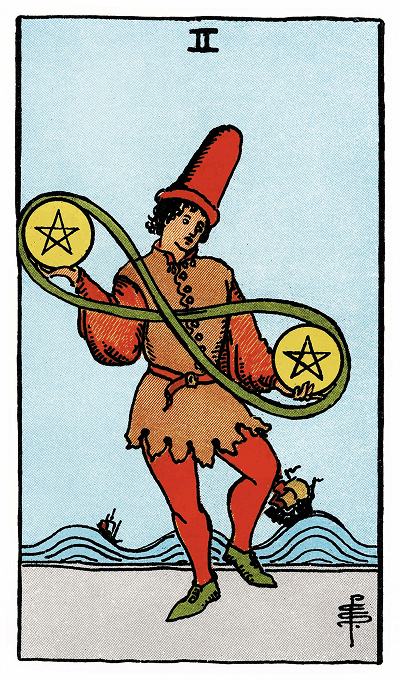
The Two of Pentacles — Rider-Waite-Smith version
Rider-Waite-Smith
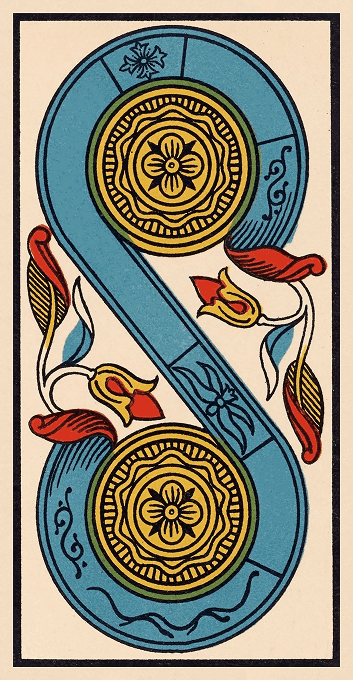
The Two of Pentacles — Marseille version
Marseille
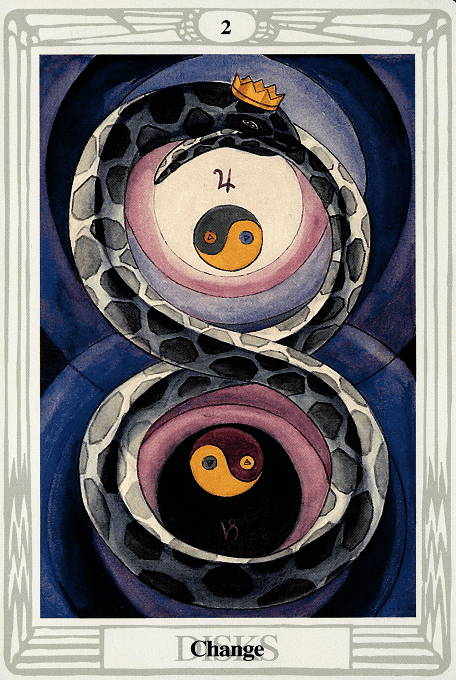
The Two of Pentacles — Thoth version
Thoth

In the Rider-Waite-Smith deck, a young figure juggles two large pentacles connected by an infinite loop of ribbon, one in each hand, while balancing on one foot in a lighthearted, almost dance-like pose. Behind him, two ships ride the choppy waves, rising and falling with the water. The core message concentrates in three details: the infinity-shaped ribbon connecting the two coins, suggesting an ongoing, cyclical balancing act rather than a problem with a fixed solution, his playful, dance-like stance, indicating that this juggling can be approached with agility and even enjoyment rather than only strain, and the ships in the background, tossed by waves that mirror the up-and-down rhythm of managing multiple demands at once. Together these describe active, ongoing balance, managing shifting priorities gracefully rather than seeking a single, final resolution.

Waite's 1911 notes describe this card in terms of "gaiety" and recreation found even amid occupation, along with news and messages arriving amid the balancing act, framing the scene as more playful than strained despite the genuine effort involved, a tone modern readers sometimes miss when they read the card only through the lens of stress. Earlier decks, including the Tarot de Marseille, depict the twos of each suit without any illustrated scene, typically showing simply two pentacles connected by a ribbon in a similar looping shape, meaning the specific image of a juggling figure is Waite and Smith's addition built on top of an already-present ribbon motif.

Upright Meaning

The Two of Pentacles represents managing multiple demands or priorities with flexibility and resourcefulness. Its essential energy is dynamic balance: not a fixed equilibrium reached once and maintained forever, but an ongoing, adaptive process of shifting attention between competing needs.

In everyday situations, this often shows up as juggling work and personal life, balancing two projects with overlapping deadlines, or managing shifting financial priorities that require regular adjustment rather than a single, set plan. It can also describe adapting well to unexpected change, staying light on your feet when circumstances shift rather than becoming rigid or overwhelmed.

A nuance beginners often miss is that this card's balance isn't static. The infinity symbol formed by the ribbon suggests this juggling act continues indefinitely rather than resolving into permanent stability, meaning success here often looks like ongoing adaptability rather than eventually reaching a fixed, settled state. Reading this card only as "you need better balance" misses its more accurate meaning: developing the skill of continuous, graceful adjustment, since the demands themselves are likely to keep shifting.

Readers disagree somewhat on how much this card should emphasize the difficulty of managing competing demands versus the genuine skill and even enjoyment involved in doing so well. Some traditions read the card as pointing mainly to the challenge of overcommitment, treating it as a caution about taking on too much. Other, more encouraging readings lean into Waite's language about gaiety and playfulness, treating the card as evidence that a person is handling real complexity with genuine skill and lightness rather than struggling under it. Both readings share the underlying theme of managing multiple demands; they differ mainly in whether the emphasis falls on strain or on graceful capability.

Reversed Meaning

Reversed, the Two of Pentacles doesn't simply mean total chaos or complete failure to manage anything. That would just negate the upright meaning too flatly. The more useful distinction is between genuine overwhelm and simple disorganization that hasn't yet become a crisis. Overwhelm suggests too many demands competing for attention at once, past the point where the upright card's graceful juggling is still possible, leading to real stress or dropped commitments.

A different shadow expression involves poor prioritization: not necessarily having too much to manage, but handling it inefficiently, spending energy on the wrong things at the wrong times rather than adapting flexibly as the upright card describes. This can look like disorganization more than overload, a distinct problem from simply having too many demands.

The reversed card can also point to difficulty adapting to a specific change, resisting a needed shift in priorities rather than adjusting fluidly, similar to the ships in the background struggling against choppy water rather than moving with it. This differs from overwhelm and poor prioritization; here the issue is specifically resistance to change rather than volume or organization.

It's worth noting that some readers don't use reversals at all, reading every card only upright and relying on surrounding cards for shading instead. If that's your approach, the overwhelm, poor-prioritization, and resistance-to-change readings above still apply, held as tensions that can appear within an upright Two of Pentacles, particularly in a reading involving competing demands that already feel difficult to manage.

In a daily reading

Two of Pentacles in a Daily Reading

As a single morning card, the Two of Pentacles is worth reading as a nudge to stay flexible today as priorities shift, rather than rigidly sticking to a single plan. It's a good day to notice where you're juggling more than one demand and to approach that juggling with a bit of lightness rather than only stress.

Say you pull this card before a day that includes managing two overlapping commitments, like a work deadline and a personal obligation on the same day. The Two of Pentacles doesn't promise both will go perfectly; it suggests staying adaptable, shifting your attention as needed between the two rather than trying to force a rigid, evenly split schedule.

A daily-pull scenario

A Daily-Pull Scenario

Imagine pulling the Two of Pentacles on a morning before a day packed with several unrelated tasks, like a work project, a family commitment, and a personal errand all competing for time. A beginner's first instinct might be to read this as a warning that you're doing too much and should cut something out immediately. A more useful reading treats the card as an invitation to approach the day with adaptability rather than rigid scheduling, checking in throughout the day about which demand needs attention right now, rather than assuming every commitment needs equal, simultaneous focus.

Read with care

Common Misreadings

  • This card means I'm overcommitted and need to cut something out.

    The Two of Pentacles more often describes the skill of managing multiple demands gracefully, not necessarily a warning to eliminate commitments. The reversed card, not the upright one, more directly points to genuine overload.

  • This card means I'll reach a permanent state of balance.

    The infinity symbol in the image suggests ongoing adjustment rather than a fixed, final equilibrium. The card describes a continuous skill, not a one-time achievement.

  • Reversed always means total disorganization.

    Reversed can describe overwhelm or disorganization, but it can just as easily describe simple resistance to a specific necessary change, a more narrow problem than general chaos.

Combinations

Cards That Change Its Meaning

  • Two of PentaclesEight of Pentacles

    Amplifies the sense of skillful management, suggesting the juggling described here is being handled with real competence and steady, developing expertise rather than just improvised effort.

  • Two of PentaclesThe Chariot

    Tempers flexible balancing with a need for more decisive direction, suggesting it may be time to choose a clearer priority rather than continuing to juggle everything at once.

  • Two of PentaclesThe Tower

    Redirects manageable juggling toward sudden overload, suggesting an unexpected disruption may be adding more to the balancing act than can reasonably be handled with the usual grace.

Sit with it

Questions for Reflection

  1. 1

    What competing priorities am I currently juggling, and how am I adapting as they shift?

  2. 2

    Where could I bring more lightness or flexibility to a demanding situation, rather than only strain?

  3. 3

    Is there a specific change I've been resisting that would actually be easier to simply adapt to?

  4. 4

    What would it look like to check in regularly with my priorities today, rather than sticking to one fixed plan?