Major ArcanaCard 5Taurus
Tarot Card Meaning

The Hierophant

The Hierophant tarot card means tradition, shared belief, and mentorship. Explore its upright and reversed meanings, symbolism, and daily-pull guidance.

The Hierophant tarot card
At a glance

Quick Keywords

Upright
  • tradition
  • institutions
  • shared belief
  • mentorship
  • conformity
  • ritual
  • structured learning
  • community values
Reversed
  • questioning tradition
  • unconventional paths
  • breaking with convention
  • rebellion
  • personal belief systems
  • rigid dogma
  • spiritual bypassing
Symbolism

What's in the Image

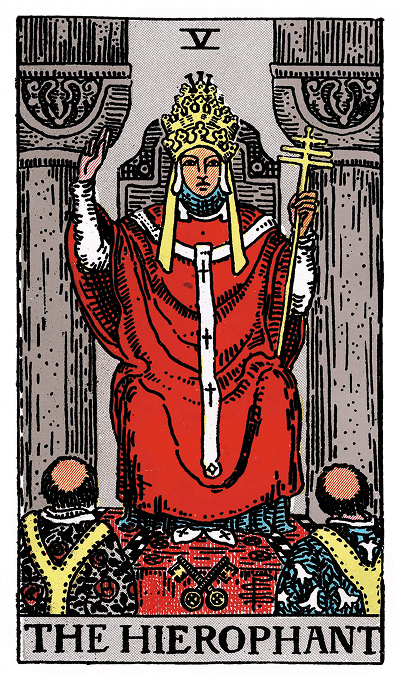
The The Hierophant — Rider-Waite-Smith version
Rider-Waite-Smith
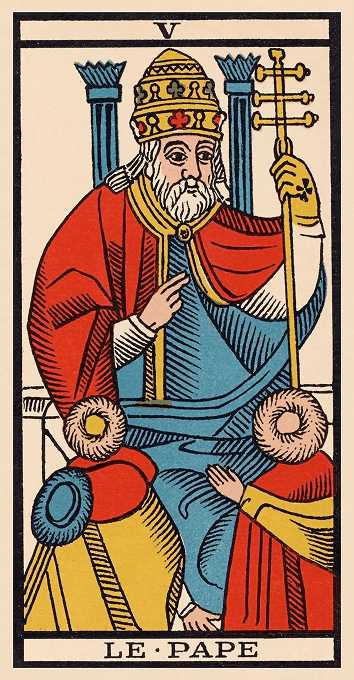
The The Hierophant — Marseille version
Marseille
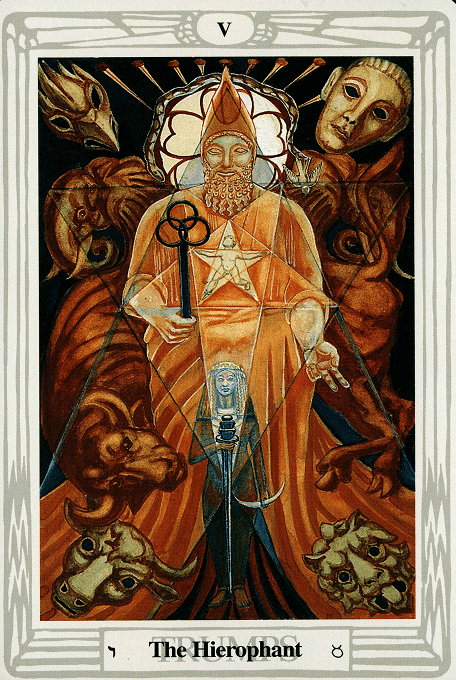
The The Hierophant — Thoth version
Thoth

In the Rider-Waite-Smith deck, the Hierophant sits enthroned between two pillars, echoing the High Priestess's card but framed very differently here: rather than a veiled threshold, this figure occupies a more public, ceremonial position, wearing a triple-tiered crown and raising two fingers in a gesture of blessing. Two clergy-like figures kneel before him, and two crossed keys rest at his feet. The core message concentrates in three details: the raised hand giving blessing, the two kneeling figures receiving instruction, and the keys, which suggest access to knowledge that's granted through an established structure rather than found alone. Together these describe a figure whose authority comes from a shared institution rather than from personal or private insight.

Waite's 1911 notes are notably careful here, describing the card as representing "the outer sense of the Sacraments" rather than any private mystical experience, a distinction modern readers sometimes miss when they read this card simply as "religion" in a general sense. It's worth comparing the Rider-Waite-Smith Hierophant to the Tarot de Marseille's Le Pape (the Pope), a similarly seated, blessing figure but rendered with less symbolic layering, closer to a plain depiction of church authority than to Waite and Smith's more esoteric framing involving the pillars and keys.

Upright Meaning

The Hierophant represents structured belief passed down through an established system rather than arrived at independently. His essential energy is connection to a shared tradition: a set of values, rules, or practices that a group holds in common and that a person learns by joining, studying, or being formally taught.

In everyday situations, this often shows up as learning from a mentor, teacher, or established program rather than figuring something out entirely alone. It can also describe participation in institutions more broadly, from a religious community to a workplace culture to any group with its own accepted norms and expectations. The card can additionally point to marriage or other formal commitments, given the ceremonial, sacrament-adjacent imagery Waite described.

A nuance beginners often miss is that the Hierophant isn't automatically about blind conformity. The card is often read as describing genuine value found in structured learning and shared meaning, not merely obedience for its own sake. Reading this card only as "follow the rules" skips over its equally strong connection to mentorship and the real benefits of learning within a tradition rather than reinventing everything from scratch.

Readers disagree somewhat on how central organized religion should be to this card's meaning. Some traditions keep the Hierophant closely tied to formal religious or spiritual institutions specifically, given the papal imagery both older and newer decks share. Other, more contemporary approaches read the card through any structured system of shared belief, including academic institutions, professional associations, or even long-standing family customs, deliberately widening the interpretation beyond religious contexts. Both readings share the underlying theme of learning within an established structure; they differ mainly in how literally to take the religious framing.

Reversed Meaning

Reversed, the Hierophant doesn't simply mean the total rejection of all tradition or structure. That would just negate the upright meaning. The more useful distinction is between healthy questioning of convention and structure that's become rigid or hollow. Rigid energy suggests dogma followed without genuine belief or understanding, rules enforced simply because they're rules, or an institution more concerned with maintaining appearances than serving the people within it.

A different shadow expression involves someone actively breaking from convention, choosing to build their own beliefs or practices rather than accepting an inherited framework. This can look like leaving a religious or professional tradition, questioning advice from a mentor, or generally deciding that an established path doesn't fit anymore. This is nearly the opposite of blind conformity, yet both meanings appear under a reversed Hierophant depending on the specifics of the reading.

The reversed card can also point to nonconformity that overcorrects into rejecting anything structured on principle, dismissing useful guidance or established knowledge simply because it comes from an institution. This differs from thoughtful independence; the issue here is reflexive rebellion rather than a considered choice to go a different way.

It's worth noting that some readers don't use reversals at all, reading every card only upright and relying on surrounding cards for nuance instead. If that's your approach, the rigidity and rebellion readings above still apply, held as tensions that can appear within an upright Hierophant, particularly in a reading that already suggests friction with convention.

In a daily reading

The Hierophant in a Daily Reading

As a single morning card, the Hierophant is worth reading as a nudge to notice where you're relying on, or resisting, some kind of established guidance today. It's a good day to ask whether a rule, tradition, or piece of advice you've been given still genuinely serves you, or whether you're following it out of habit alone.

Say you pull this card before a day that includes a meeting with a mentor, teacher, or someone more experienced in a field you're learning. The Hierophant doesn't promise the advice will be exactly right for you; it suggests approaching the conversation with openness to structured guidance, while still noticing whether what you're hearing actually resonates once you think it through yourself.

A daily-pull scenario

A Daily-Pull Scenario

Imagine pulling the Hierophant on a morning before a family gathering that includes some long-standing traditions you've started to feel unsure about. A beginner's first instinct might be to read this as a directive to simply go along with everything as usual, since the card is so associated with tradition. A more useful reading treats the card as a prompt to notice which parts of the tradition still feel meaningful to you and which feel like empty repetition. The card describes an opportunity to engage thoughtfully with shared structure, not an instruction to accept it uncritically.

Read with care

Common Misreadings

  • This card means I have to follow organized religion.

    The Hierophant is often tied to religious imagery, but many readers interpret it through any structured system of shared belief, including education, mentorship, or professional tradition, not religion specifically.

  • Reversed always means I should reject tradition entirely.

    Reversed can describe breaking from convention, but it can just as easily describe dogma turned rigid or hollow, a different problem. The specific shape of the tension matters more than a flat rejection of structure.

  • This card is only about blind obedience.

    The Hierophant does involve structure and shared rules, but it's equally connected to genuine mentorship and the real value of learning within an established tradition, not conformity for its own sake.

Combinations

Cards That Change Its Meaning

  • The HierophantThe Emperor

    Amplifies the theme of established structure, suggesting institutional authority reinforced by clear rules and discipline, often pointing to a situation where formal systems and hierarchy matter more than usual.

  • The HierophantThe Fool

    Tempers rigid tradition with a pull toward fresh, unstructured beginnings, suggesting a tension between following an established path and striking out on a new one without guaranteed guidance.

  • The HierophantThe Tower

    Redirects the card's stability toward sudden upheaval, suggesting a tradition, institution, or long-held belief that's about to be disrupted or challenged abruptly rather than continuing unquestioned.

Sit with it

Questions for Reflection

  1. 1

    What tradition, rule, or piece of inherited advice have I never actually examined for myself?

  2. 2

    Where might structured guidance or mentorship genuinely help me right now, instead of figuring things out alone?

  3. 3

    Is there a belief I hold mainly because it was handed to me, rather than because I've tested it myself?

  4. 4

    What would it look like to question a convention thoughtfully, rather than either accepting or rejecting it automatically?