Major ArcanaCard 7Cancer
Tarot Card Meaning

The Chariot

The Chariot tarot card means willpower, determination, and focused forward motion. Explore its upright and reversed meanings, symbolism, and daily-pull guidance.

The Chariot tarot card
At a glance

Quick Keywords

Upright
  • willpower
  • determination
  • forward motion
  • self-discipline
  • victory through control
  • direction
  • ambition
  • focus
Reversed
  • lack of direction
  • loss of control
  • aggression
  • being pulled in opposite directions
  • delays
  • burnout
  • overconfidence
Symbolism

What's in the Image

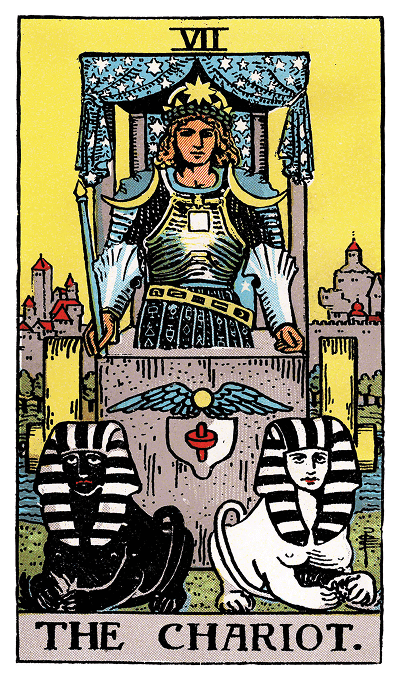
The The Chariot — Rider-Waite-Smith version
Rider-Waite-Smith
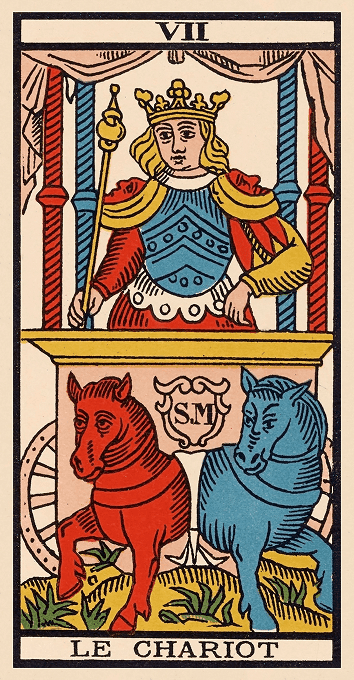
The The Chariot — Marseille version
Marseille
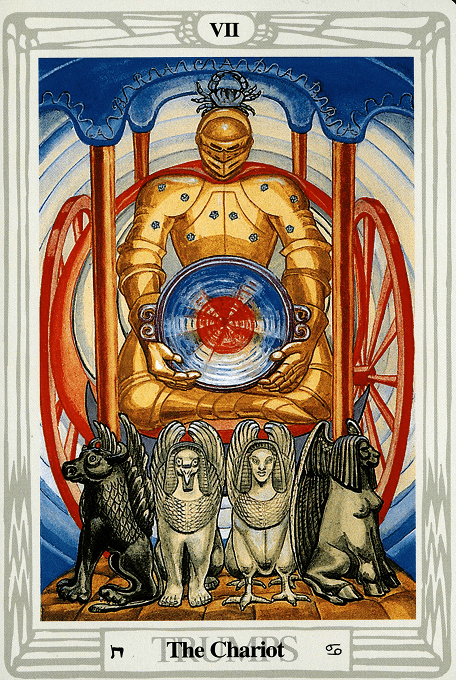
The The Chariot — Thoth version
Thoth

In the Rider-Waite-Smith deck, a figure in armor stands in a stone chariot pulled by two sphinxes, one black and one white, with no visible reins connecting the driver to them. Stars decorate a canopy overhead, and a city sits in the background behind the figure. The core message concentrates in three details: the two sphinxes facing in different directions, the missing reins, and the crescent-moon-and-star emblems on the figure's shoulders, echoing the High Priestess's lunar imagery. Together these describe control that comes from focus and will rather than from physical restraint, since the figure has to direct two opposing forces without anything literally holding them together.

Waite's 1911 description calls attention to the sphinxes' opposing colors as representing conflicting forces that must be brought into harmony, a detail that's easy to miss if the sphinxes are read simply as decorative animals. This differs meaningfully from the Tarot de Marseille's version, which typically shows two horses (sometimes mismatched in color, sometimes not clearly opposing forces at all) pulling a canopied chariot, without the sphinxes' more pointed symbolism of duality. The Marseille card reads more straightforwardly as triumphant travel or conquest, while Waite and Smith's redesign adds a specific challenge: directing two contrary impulses without any external mechanism forcing them into alignment.

Upright Meaning

The Chariot represents forward motion achieved through focused will rather than brute force. Its essential energy is disciplined determination: setting a clear direction and holding to it, even when the forces involved, whether external circumstances or your own conflicting impulses, aren't naturally pulling the same way.

In everyday situations, this often shows up as pushing through a demanding project by sheer focus, or successfully managing a situation with competing demands, like balancing two priorities that don't obviously fit together. It can also describe travel, both literal (a trip, a move) and figurative (progress toward a goal), especially when that progress requires active steering rather than simply drifting forward.

A nuance beginners often miss is that the Chariot isn't about controlling everything through force. Since the sphinxes in the image have no reins, the card is often read as being about mental and directional control rather than physical domination, meaning the "win" here comes from clarity of purpose and self-discipline rather than overpowering obstacles directly. Reading this card only as "push harder" misses its equally strong connection to focus and inner alignment.

Readers disagree somewhat on how much this card implies an actual victory versus simply the successful management of opposing forces. Some traditions treat the Chariot as a straightforward success card, tied to its Marseille roots in triumphant travel or conquest. Other, more psychologically oriented approaches emphasize the ongoing work of balancing the black and white sphinxes, treating the card less as a finished victory and more as a demonstration of the discipline required to keep moving forward despite internal or external tension. Both readings share a core theme of willed progress; they differ mainly in whether the card marks an endpoint or a continuing effort.

Reversed Meaning

Reversed, the Chariot doesn't simply mean failure or complete lack of progress. That would just negate the upright meaning. The more useful distinction is between a loss of direction and force applied without any real control. A loss of direction suggests uncertainty about where you're actually headed, or being pulled by competing priorities without a clear resolution, similar to the sphinxes facing opposite ways but with no driver actively steering them.

A different shadow expression involves aggression or overconfidence: pushing forward recklessly, without the discipline the upright card describes, in a way that might look like determination but actually lacks real direction or awareness of consequences. This can look like forcing a decision or plan through sheer stubbornness rather than clear-headed focus. This is nearly the opposite of feeling stuck, yet both meanings appear under a reversed Chariot depending on the reading's context.

The reversed card can also point to burnout: the cost of maintaining tight control for too long without any release, since the upright card's discipline can tip into rigidity or exhaustion if it isn't balanced with rest. This differs from simple stalling; here the issue is depletion after sustained effort rather than an absence of effort altogether.

It's worth noting that some readers don't use reversals at all, reading every card only upright and relying on surrounding cards for shading instead. If that's your approach, the direction-loss, overreach, and burnout readings above still apply, held as tensions that can appear within an upright Chariot, particularly in a reading that already suggests strain or uncertainty.

In a daily reading

The Chariot in a Daily Reading

As a single morning card, the Chariot is worth reading as a nudge to bring clear focus to competing demands today rather than letting them pull you in different directions without resolution. It's a good day to identify one clear priority and direct your energy there deliberately.

Say you pull this card before a day that includes juggling two deadlines that both feel urgent. The Chariot doesn't promise both will get done painlessly; it suggests approaching the day with a clear sense of sequence and focus, choosing where your attention goes first rather than splitting it evenly and accomplishing neither task well.

A daily-pull scenario

A Daily-Pull Scenario

Imagine pulling the Chariot on a morning before a competitive situation, like a job interview or a tryout. A beginner's first instinct might be to read this as a guarantee of winning, since the card is so associated with victory. A more useful reading treats the card as a prompt about your own composure and direction: are you walking in with clear focus and a steady sense of what you're aiming for, rather than scattered nerves or forcing an outcome through sheer pressure? The card describes disciplined presence, not a promised result.

Read with care

Common Misreadings

  • This card guarantees success or winning.

    The Chariot describes focused, disciplined effort, not a guaranteed outcome. What happens after that effort depends on factors outside the card's scope, including circumstances the reading doesn't address.

  • This card means using force to get what I want.

    The missing reins in the image suggest control through will and focus, not physical domination. Reading it as license to push through obstacles aggressively skips over its emphasis on inner discipline.

  • Reversed always means I've failed.

    Reversed can describe a loss of direction, but it can just as easily describe overreach or burnout after too much sustained effort, a different problem than simple failure or stagnation.

Combinations

Cards That Change Its Meaning

  • The ChariotThe Emperor

    Amplifies the theme of disciplined control, suggesting focused momentum backed by clear structure and long-term planning, often pointing to a goal pursued methodically rather than through sudden bursts of effort.

  • The ChariotThe Moon

    Tempers confident forward motion with uncertainty, suggesting the direction that feels clear on the surface may actually be harder to read than it appears, complicating a straightforward push toward the goal.

  • The ChariotThe Tower

    Redirects steady, controlled progress toward sudden disruption, suggesting momentum that's about to be interrupted or forced to change course abruptly, rather than continuing along the path currently being steered.

Sit with it

Questions for Reflection

  1. 1

    What competing priorities am I currently trying to hold together, and which one actually needs my focus first?

  2. 2

    Where have I been pushing forward through force rather than genuine clarity of direction?

  3. 3

    Is there an area where sustained effort has started to feel more like depletion than progress?

  4. 4

    What would disciplined, steady focus look like for me today, without needing to control everything around me?