Major ArcanaCard 14Sagittarius
Tarot Card Meaning

Temperance

The Temperance tarot card means balance, moderation, and patient integration. Explore its upright and reversed meanings, symbolism, and daily-pull guidance.

Temperance tarot card
At a glance

Quick Keywords

Upright
  • balance
  • moderation
  • patience
  • integration
  • blending
  • harmony
  • healing
  • middle ground
Reversed
  • imbalance
  • excess
  • impatience
  • misalignment
  • overcorrection
  • extremes
  • lack of coordination
Symbolism

What's in the Image

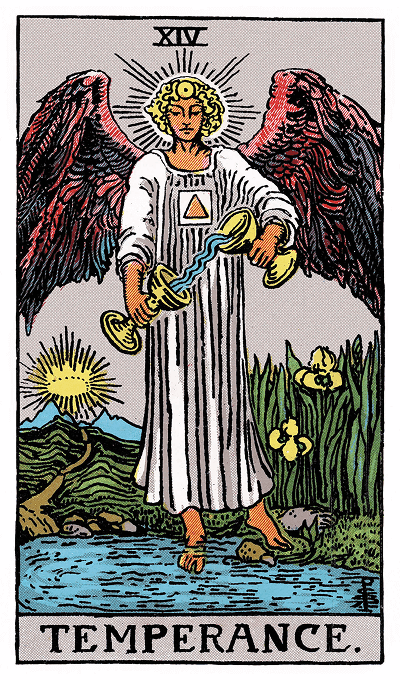
The Temperance — Rider-Waite-Smith version
Rider-Waite-Smith
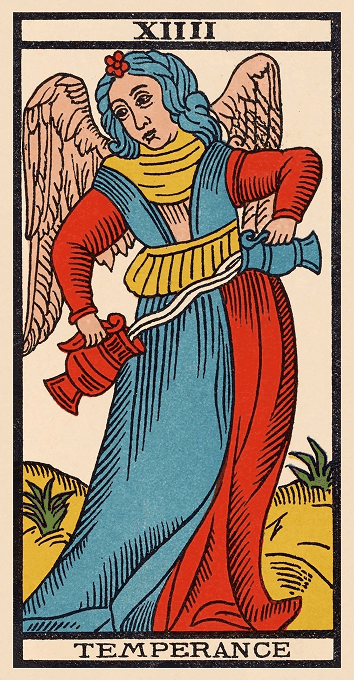
The Temperance — Marseille version
Marseille
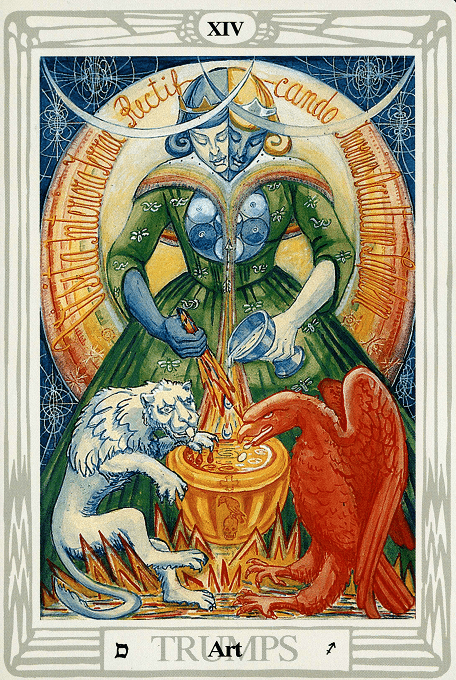
The Temperance — Thoth version
Thoth

In the Rider-Waite-Smith deck, a winged figure stands with one foot on land and one in water, pouring liquid between two cups held at different heights. Irises grow at the water's edge, a path leads toward distant mountains, and a triangle inside a square appears on the figure's chest. The core message concentrates in three details: the pouring between cups (an act suggesting blending and adjustment rather than a fixed, finished mixture), the one foot on solid ground and one in water (representing the figure's ability to bridge two different states at once), and the distant path toward the mountains, suggesting this balance is part of an ongoing journey rather than a final resting point. Together these describe patient, active balancing rather than balance as something achieved once and left alone.

Waite's 1911 description ties this figure to the idea of the "combination of elements" and to the workings of "time" more broadly, a connection modern readers often miss when they read Temperance purely as calm moderation, without also noticing the card's original emphasis on gradual, unhurried process. It's worth comparing this to the Tarot de Marseille's version, which similarly shows a winged figure pouring liquid between two vessels but keeps both feet on the ground, without the water-and-land duality Waite and Smith introduced. That addition specifically strengthens the sense that Temperance describes reconciling two different, sometimes opposing, states or forces, not just carefully combining similar things.

Upright Meaning

Temperance represents balance achieved through patient, ongoing adjustment rather than through a single decisive action. Its essential energy is integration: bringing together two things that might otherwise pull apart, whether that's competing priorities, different parts of your personality, or opposing needs in a relationship.

In everyday situations, this often shows up as finding a workable middle ground between extremes, like balancing work and rest, or reconciling two different approaches to a shared problem. It can also describe a slower, steadier pace after a period of intensity, a deliberate choice to blend things carefully rather than rush toward an outcome.

A nuance beginners often miss is that Temperance isn't about avoiding all extremes out of caution. The figure in the image actively bridges two different states, land and water, rather than staying safely in the middle of one single thing. Reading this card only as "stay moderate" misses its more active meaning: skillfully combining things that are genuinely different from each other, which takes more effort than simply avoiding excess.

Readers disagree somewhat on how much this card should be read as purely psychological balance versus something closer to alchemical or spiritual synthesis. Traditions closer to Waite's own language keep a stronger connection to the alchemical idea of combining opposing elements into something new, tying Temperance to genuine transformation through blending. Other, more everyday readings treat the card mainly as a practical reminder about pacing and moderation in daily decisions. Both readings share the underlying theme of careful combination; they differ mainly in how symbolic or how literal that combination is meant to be.

Reversed Meaning

Reversed, Temperance doesn't simply mean the opposite of balance, as though someone becomes uniformly extreme in every direction. That would just negate the upright meaning. The more useful distinction is between genuine excess and a temporary overcorrection made while searching for the right balance. Excess suggests one area of life has clearly overtaken the others, like overworking at the expense of rest, or leaning entirely on one solution while ignoring others that might also help.

A different shadow expression involves impatience: rushing a process that actually needs the slow, careful blending the upright card describes, forcing an outcome before the elements involved are genuinely ready to combine well. This can look like pushing a relationship, a project, or a decision faster than its natural pace allows. This is a distinct problem from outright excess, since impatience can happen even when someone is generally trying to find balance, just moving through the process too quickly.

The reversed card can also point to misalignment: two parts of a situation, or two people, that simply aren't combining well no matter how much patience or adjustment is applied, suggesting the mismatch may be more fundamental than a pacing issue. This differs from impatience; here the problem is the fit itself rather than the speed of the process.

It's worth noting that some readers don't use reversals at all, reading every card only upright and relying on surrounding cards for shading instead. If that's your approach, the excess, impatience, and misalignment readings above still apply, held as tensions that can appear within an upright Temperance, particularly in a reading that already suggests strain or a decision made too quickly.

In a daily reading

Temperance in a Daily Reading

As a single morning card, Temperance is worth reading as a reminder to move at a steady, unhurried pace today rather than pushing for a fast resolution. It's a good day to notice where two competing needs or priorities could actually be blended, rather than treating the choice as strictly either-or.

Say you pull this card before a day that includes balancing time between a demanding task and a personal commitment you don't want to skip. Temperance doesn't tell you exactly how to divide your time; it suggests approaching the day with patience, adjusting as you go rather than rigidly committing to a plan that doesn't leave room for both.

A daily-pull scenario

A Daily-Pull Scenario

Imagine pulling Temperance on a morning before mediating a disagreement between two coworkers or friends with different views. A beginner's first instinct might be to read this as a sign to simply stay neutral and avoid taking any position at all. A more useful reading treats the card as a prompt to actively find where the two perspectives might genuinely combine, rather than passively staying out of it, listening for what each side actually needs and looking for a workable blend rather than a forced compromise that satisfies no one.

Read with care

Common Misreadings

  • This card means staying passive or avoiding conflict.

    Temperance describes active blending, not passive neutrality. The figure in the image is doing something, pouring and adjusting, rather than simply standing back and avoiding engagement.

  • This card guarantees things will work out evenly.

    Temperance describes a process of balancing, not a finished, guaranteed outcome. The path toward the mountains suggests the work of integration is ongoing rather than already resolved.

  • Reversed always means total chaos or extremes.

    Reversed can describe genuine excess, but it can just as easily describe simple impatience or a mismatch that patience alone won't fully resolve, a more specific problem than blanket imbalance.

Combinations

Cards That Change Its Meaning

  • TemperanceThe Star

    Amplifies the sense of gentle healing and gradual improvement, suggesting the patient balancing this card describes is genuinely working and bringing real relief over time.

  • TemperanceFive of Pentacles

    Tempers smooth integration with hardship, suggesting the blending process is happening under real strain or scarcity, making the usual patience required here more difficult to sustain.

  • TemperanceThe Tower

    Redirects gradual balance toward sudden disruption, suggesting a slow process of integration is about to be interrupted by an abrupt change that forces a faster adjustment than usual.

Sit with it

Questions for Reflection

  1. 1

    Where in my life am I forcing an outcome instead of allowing a slower, more patient process?

  2. 2

    What two competing needs or priorities could I try to blend rather than choose between?

  3. 3

    Is there a situation where I've been rushing toward resolution before it was actually ready?

  4. 4

    What would a steadier, more balanced pace look like for me today?