SwordsAir
Tarot Card Meaning

Seven of Swords

The Seven of Swords means deception, strategy, and going it alone. Explore its upright and reversed meanings, symbolism, and daily-pull guidance.

Seven of Swords tarot card
At a glance

Quick Keywords

Upright
  • deception
  • strategy
  • avoidance
  • going it alone
  • getting away with something
  • cunning
  • incomplete effort
Reversed
  • confession
  • getting caught
  • coming clean
  • releasing deceptive tactics
  • self-deception exposed
  • resolving a hidden issue
Symbolism

What's in the Image

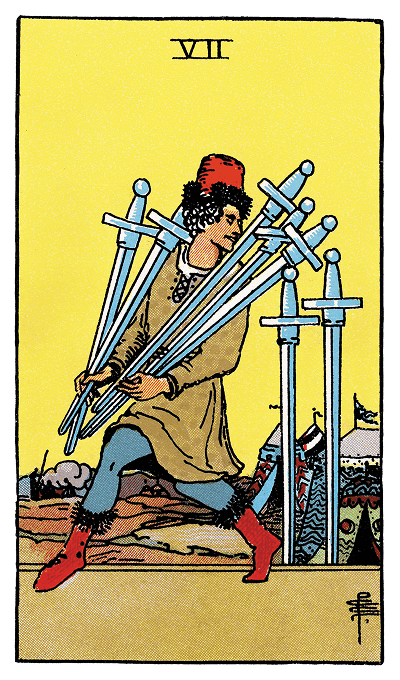
The Seven of Swords — Rider-Waite-Smith version
Rider-Waite-Smith
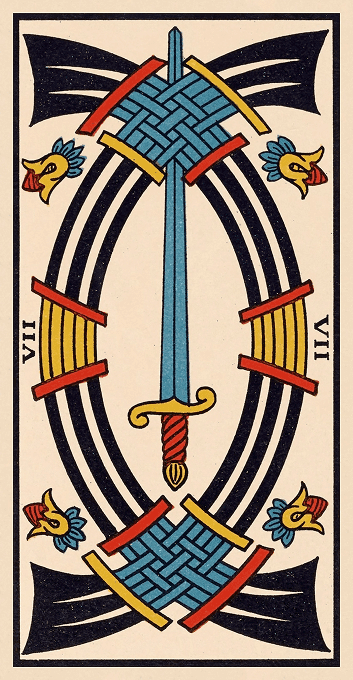
The Seven of Swords — Marseille version
Marseille
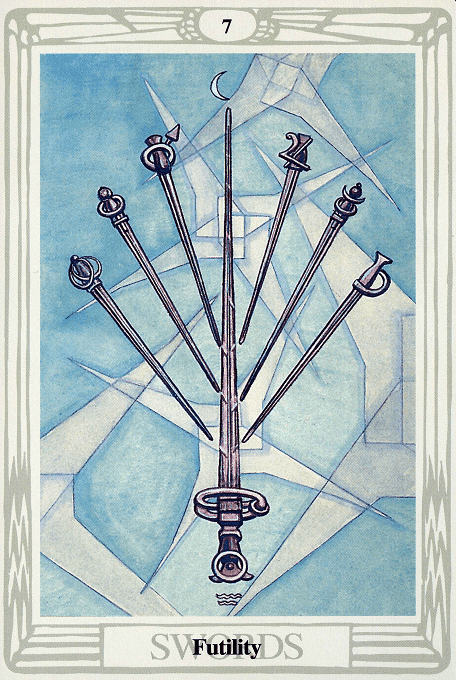
The Seven of Swords — Thoth version
Thoth

In the Rider-Waite-Smith deck, a man sneaks away from a camp of tents carrying five swords, glancing back over his shoulder, while two swords remain planted in the ground behind him. The core message concentrates in three details: his backward glance, suggesting awareness that he's doing something others wouldn't approve of, the two swords left behind, hinting at an incomplete effort, taking most but not all of what's there, and his solitary, quiet movement away from the camp, indicating an action taken alone and without others' knowledge. Together these describe a strategic, somewhat secretive maneuver, one that involves avoiding direct confrontation, whether through cleverness, avoidance, or outright deception.

Waite's 1911 notes describe this card in terms of "an unexpected attempt" or "a plan that may fail," specifically noting that the design shown may not succeed, an ambiguity modern readers sometimes skip past in favor of assuming the sneaking figure definitely gets away clean. Earlier decks, including the Tarot de Marseille, depict the sevens of each suit without any illustrated scene, typically showing simply seven swords arranged decoratively, meaning the specific image of a figure sneaking away from a camp is Waite and Smith's addition, chosen to visually represent strategy, avoidance, or deception rather than a neutral suit symbol alone.

Upright Meaning

The Seven of Swords represents a strategic, often secretive approach to a situation, one that involves avoiding direct confrontation, whether through clever maneuvering, avoidance, or outright deception. Its essential energy is calculated self-interest: acting alone, sometimes without others' full knowledge or approval, to get something done in a way that sidesteps a more direct or difficult approach.

In everyday situations, this often shows up as handling something independently rather than involving others, taking a shortcut that avoids a harder but more honest conversation, or simply being strategic about how and when you share information. It can also describe genuine deception, either being deceived by someone else or recognizing an impulse in yourself to avoid full honesty in a situation that would benefit from more transparency.

A nuance beginners often miss is that this card doesn't always describe outright dishonesty in a dramatic sense. Sometimes it points to more subtle avoidance, choosing not to involve others in a decision, or quietly working around an obstacle rather than confronting it directly. Reading this card only as "someone is definitely lying to me" oversimplifies a card that can just as easily describe your own quiet, independent strategizing, which isn't necessarily malicious, just private and somewhat guarded.

Readers disagree somewhat on how morally weighted this card should be read as being. Some traditions read the Seven of Swords fairly critically, emphasizing the deceptive, self-interested undertone of the sneaking figure and cautioning against dishonest or avoidant behavior. Other, more neutral readings treat the card as simply describing strategic independence, acting alone and quietly, without necessarily assuming bad intent, since sometimes handling something privately is a reasonable choice rather than a moral failing. Both readings share the underlying theme of quiet, independent action; they differ mainly in how much suspicion to attach to that independence.

Reversed Meaning

Reversed, the Seven of Swords doesn't simply mean total honesty has been restored instantly. That would just negate the upright meaning without describing the actual process involved. The more useful distinction is between choosing to come clean and being caught in a deception you'd rather have kept hidden. Coming clean suggests a deliberate choice toward honesty, deciding to reveal something you'd been keeping private or handling quietly, whether that's a decision, a mistake, or a piece of information.

A different shadow expression involves being caught: a hidden action or deception coming to light without your choosing, the backward glance in the upright image finally catching up with consequences. This differs from choosing honesty voluntarily, since here the revelation happens regardless of your own readiness or willingness.

The reversed card can also point to self-deception being exposed: recognizing a way you've been avoiding an honest look at your own behavior or motives, even if no one else is directly involved. This differs from both prior readings; here the dishonesty in question is internal, a story you'd been telling yourself rather than something hidden from others.

It's worth noting that some readers don't use reversals at all, reading every card only upright and relying on surrounding cards for shading instead. If that's your approach, the coming-clean, getting-caught, and self-deception readings above still apply, held as tensions that can appear within an upright Seven of Swords, particularly in a reading involving a situation that already feels like it involves some avoidance or hidden information.

In a daily reading

Seven of Swords in a Daily Reading

As a single morning card, the Seven of Swords is worth reading as a nudge to notice where you might be avoiding directness today, whether that's withholding information, handling something alone that could benefit from others' input, or simply being strategic in a way that's starting to feel uncomfortable. It's a good day to ask whether more honesty would actually serve you better than avoidance.

Say you pull this card before a day that includes deciding whether to share information about a decision you've made quietly. The Seven of Swords doesn't tell you what to do; it suggests examining honestly whether your instinct toward privacy here is reasonable, or whether it's closer to avoidance of a conversation that genuinely needs to happen.

A daily-pull scenario

A Daily-Pull Scenario

Imagine pulling the Seven of Swords on a morning before deciding whether to disclose a mistake at work that no one else has noticed yet. A beginner's first instinct might be to read this as permission to quietly let the mistake go unmentioned, since the sneaking figure in the image appears to be getting away with something. A more useful reading treats the card as an honest prompt to examine the cost of staying quiet, since Waite's own notes suggest this kind of plan may not actually succeed in the way it's intended, meaning the safer, more sustainable choice might be more direct honesty than the image's sneaking figure demonstrates.

Read with care

Common Misreadings

  • This card always means someone is lying to me.

    The Seven of Swords can describe deception, but it can just as easily describe your own quiet, independent strategizing, which isn't necessarily aimed at anyone else at all.

  • This card guarantees getting away with something.

    Waite's own notes specifically mention that the plan shown may fail. The card describes an attempt at avoidance or strategy, not a guaranteed successful outcome.

  • Reversed always means someone confessed everything.

    Reversed can describe voluntary honesty, but it can just as easily describe being caught unwillingly, or recognizing a form of self-deception that has nothing to do with anyone else finding out.

Combinations

Cards That Change Its Meaning

  • Seven of SwordsThe Hermit

    Amplifies solitary, private action, suggesting the independence described here is more about genuine introspection than deception, handling something alone for reflective rather than avoidant reasons.

  • Seven of SwordsJustice

    Tempers strategic avoidance with a pull toward honesty and fairness, suggesting a tension between handling something quietly and the value of a more transparent, accountable approach.

  • Seven of SwordsThe Tower

    Redirects a quiet, calculated maneuver toward sudden exposure, suggesting whatever has been handled privately may be revealed abruptly rather than staying hidden.

Sit with it

Questions for Reflection

  1. 1

    Where in my life am I avoiding directness in favor of a quieter, more private approach?

  2. 2

    Is there something I've been handling alone that would actually benefit from more openness with others?

  3. 3

    Am I being deceived in a situation, or am I the one avoiding full honesty?

  4. 4

    What would it look like to choose transparency today, even where avoidance feels easier?