SwordsAir
Tarot Card Meaning

Queen of Swords

The Queen of Swords means clear judgment, honesty, and independence. Explore its upright and reversed meanings, symbolism, and daily-pull guidance.

Queen of Swords tarot card
At a glance

Quick Keywords

Upright
  • clear judgment
  • honesty
  • independence
  • perceptiveness
  • direct communication
  • intellectual clarity
  • discernment
Reversed
  • coldness
  • harsh judgment
  • isolation
  • bitterness
  • overly critical thinking
  • guardedness
Symbolism

What's in the Image

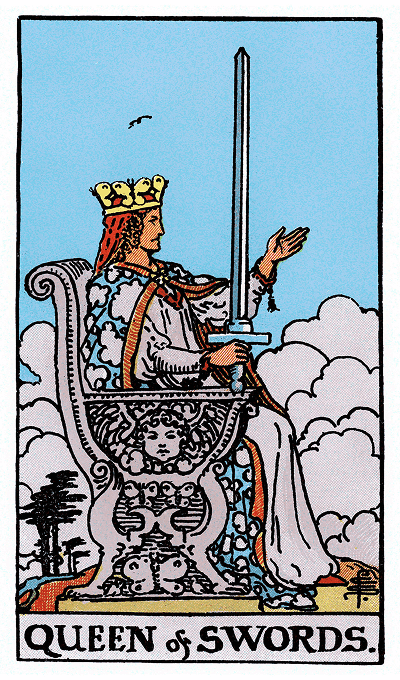
The Queen of Swords — Rider-Waite-Smith version
Rider-Waite-Smith
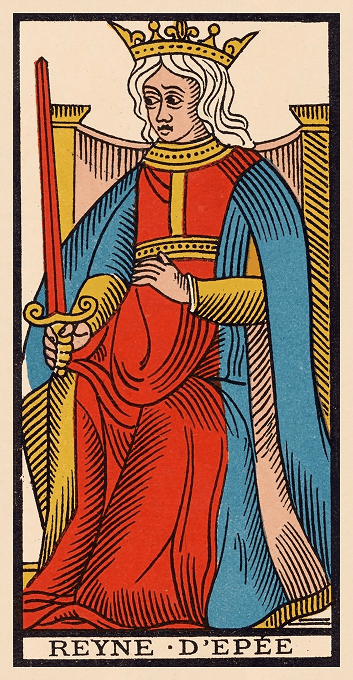
The Queen of Swords — Marseille version
Marseille
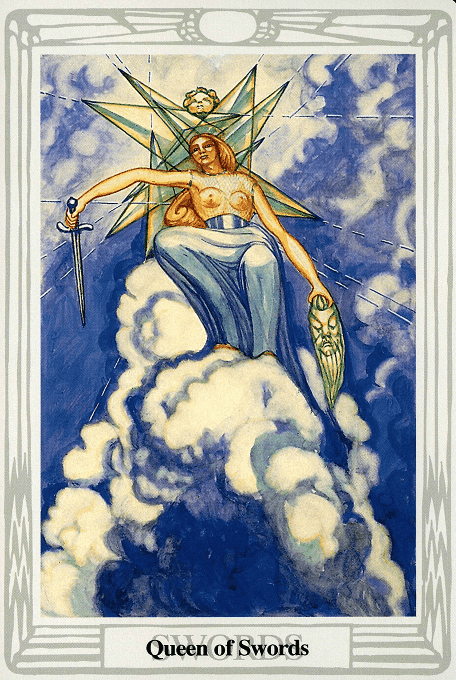
The Queen of Swords — Thoth version
Thoth

In the Rider-Waite-Smith deck, a queen sits on a throne carved with butterflies and a single cherub, holding an upright sword in one hand while her other hand extends outward, palm open, as though gesturing toward clarity or invitation. Clouds pass through the sky behind her, and her expression is composed but notably serious. The core message concentrates in three details: her upright sword, held with the same straightforward clarity as the Ace of Swords, suggesting judgment exercised cleanly rather than defensively, her open, extended hand, indicating a willingness to communicate and engage despite her serious demeanor, and the butterflies carved into her throne, associated with transformation and the ability to see clearly through difficult experience. Together these describe judgment sharpened by genuine experience, offered with directness rather than either coldness or excessive softness.

Waite's 1911 notes describe this queen as someone familiar with sorrow, someone who has "walked in the shadow of dark valleys," yet remains discerning and quick in her perceptions as a result, tying her sharp judgment directly to lived experience rather than detached intellect alone, a nuance modern readers sometimes miss when reading her only as coolly analytical. Court cards in the Tarot de Marseille also include queens across the suits, but typically without this specific throne imagery or extended hand gesture, which is Waite and Smith's own addition, chosen to characterize this queen's clarity as hard-won rather than simply innate.

Upright Meaning

The Queen of Swords represents clear, honest judgment developed through genuine life experience, including experience with hardship. Its essential energy is discerning clarity: seeing a situation for what it actually is, and communicating that understanding directly, without unnecessary softening or evasion.

In everyday situations, this often shows up as offering honest, clear-eyed advice, even when it isn't what someone wants to hear, making decisions based on genuine evidence rather than wishful thinking, or maintaining healthy independence and boundaries in a relationship or situation. As with other court cards, some readers interpret the Queen of Swords as representing an actual person, often someone direct, perceptive, and independent, entering the situation, rather than describing a general quality available to anyone.

A nuance beginners often miss is that this queen's clarity is explicitly connected to having weathered real difficulty, not simply a naturally cool or detached temperament. Waite's own language ties her sharp perception to having "walked in the shadow of dark valleys," suggesting her directness comes from hard-earned wisdom rather than an absence of feeling. Reading this card only as "cold and unemotional" misses the more accurate meaning: clarity that exists precisely because she has felt deeply and learned from it, not because she avoids feeling altogether.

Readers disagree somewhat on how much weight this card should place on independence and self-reliance specifically versus honest communication with others more broadly. Some traditions emphasize this queen's solitary strength, reading the card as encouragement toward greater self-reliance and clear personal boundaries. Other readings focus more on her extended, open hand, emphasizing her willingness to communicate honestly and directly with others despite her serious demeanor. Both readings share the theme of clarity earned through experience; they differ mainly in whether that clarity is directed primarily inward or outward.

Reversed Meaning

Reversed, the Queen of Swords doesn't simply mean total coldness or complete emotional shutdown. That would just negate the upright meaning too flatly. The more useful distinction is between judgment that's become genuinely harsh and guardedness that's protecting against further hurt. Harsh judgment suggests the upright card's honest clarity tipping into unnecessary cruelty or excessive criticism, losing the compassion that should accompany honest perception.

A different shadow expression involves guardedness or isolation: withdrawing behind sharp, defended boundaries not out of genuine independence, but out of fear of being hurt again, echoing the queen's history of hardship but without the clear-eyed strength the upright card describes. This can look like keeping people at a distance more out of self-protection than genuine need for solitude.

The reversed card can also point to bitterness: past hardship curdling into ongoing resentment rather than the wisdom and clarity the upright card describes, letting difficult experience harden into cynicism rather than genuine discernment. This differs from both harsh judgment and guardedness; here the issue is unresolved pain coloring perception rather than either cruelty or self-protective distance.

It's worth noting that some readers don't use reversals at all, reading every card only upright and relying on surrounding cards for shading instead. If that's your approach, the harsh-judgment, guardedness, and bitterness readings above still apply, held as tensions that can appear within an upright Queen of Swords, particularly in a reading involving someone who's been through real hardship and is still processing its effects.

In a daily reading

Queen of Swords in a Daily Reading

As a single morning card, the Queen of Swords is worth reading as encouragement to approach a situation today with honest, clear-eyed judgment, even if that means saying something direct rather than softening it unnecessarily. It's a good day to trust your own perceptiveness, especially if it's been shaped by real experience.

Say you pull this card before a day that includes giving honest feedback or advice to someone who's asked for your perspective. The Queen of Swords doesn't tell you exactly what to say; it suggests offering your honest assessment clearly and directly, while remaining aware that clarity and compassion aren't opposites.

A daily-pull scenario

A Daily-Pull Scenario

Imagine pulling the Queen of Swords on a morning before a conversation where you need to set a clear boundary with someone who's been overstepping. A beginner's first instinct might be to read this as permission to be as blunt or harsh as possible. A more useful reading treats the card as encouragement to communicate the boundary clearly and directly, drawing on the queen's own extended, open hand in the image, which suggests directness paired with genuine willingness to engage, not coldness for its own sake.

Read with care

Common Misreadings

  • This card means being cold or unemotional.

    Waite's own notes tie this queen's clarity to having experienced real hardship, not to an absence of feeling. Her directness comes from lived experience, not emotional detachment.

  • This card always means a specific sharp-tongued woman is entering my life.

    Some traditions read court cards as literal people, but many contemporary readers treat the Queen of Swords as describing a clear, honest judgment available to anyone, regardless of gender.

  • Reversed always means someone is being deliberately cruel.

    Reversed can describe harsh judgment, but it can just as easily describe guardedness born from past hurt, or bitterness that hasn't been fully processed, different problems than intentional cruelty.

Combinations

Cards That Change Its Meaning

  • Queen of SwordsJustice

    Amplifies clear, fair judgment, suggesting the honest assessment described here is being applied with genuine balance and impartiality.

  • Queen of SwordsQueen of Cups

    Tempers sharp clarity with emotional warmth, suggesting the honest perspective being offered is paired with real compassion and sensitivity to feeling.

  • Queen of SwordsThe Tower

    Redirects composed, clear-eyed judgment toward a sudden, difficult realization, suggesting the honest truth being recognized may arrive abruptly rather than through calm reflection.

Sit with it

Questions for Reflection

  1. 1

    Where in my life could I benefit from more honest, direct communication rather than softening the truth unnecessarily?

  2. 2

    Is there wisdom I've gained from a difficult experience that I could trust more fully?

  3. 3

    Am I keeping people at a distance out of genuine need for independence, or out of fear of being hurt again?

  4. 4

    What would it look like to offer someone honest feedback today with both clarity and compassion?