Major ArcanaCard 11Libra
Tarot Card Meaning

Justice

The Justice tarot card means fairness, truth, and accountability. Explore its upright and reversed meanings, symbolism, and daily-pull guidance.

Justice tarot card
At a glance

Quick Keywords

Upright
  • fairness
  • truth
  • cause and effect
  • accountability
  • balance
  • clarity
  • decisions
  • objectivity
Reversed
  • unfairness
  • dishonesty
  • avoiding accountability
  • imbalance
  • bias
  • unresolved consequences
  • delayed outcomes
Symbolism

What's in the Image

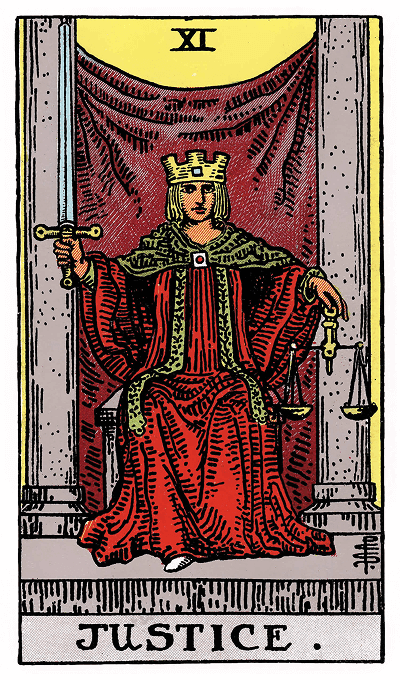
The Justice — Rider-Waite-Smith version
Rider-Waite-Smith
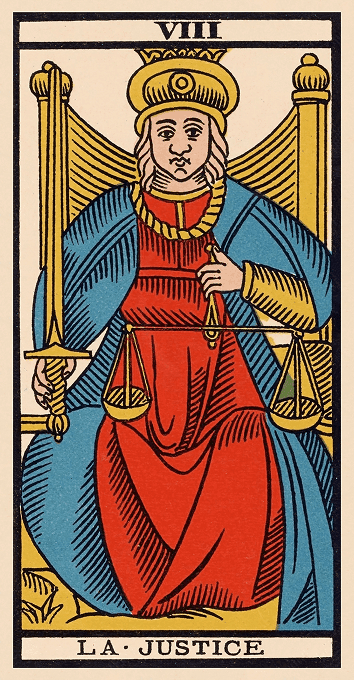
The Justice — Marseille version
Marseille
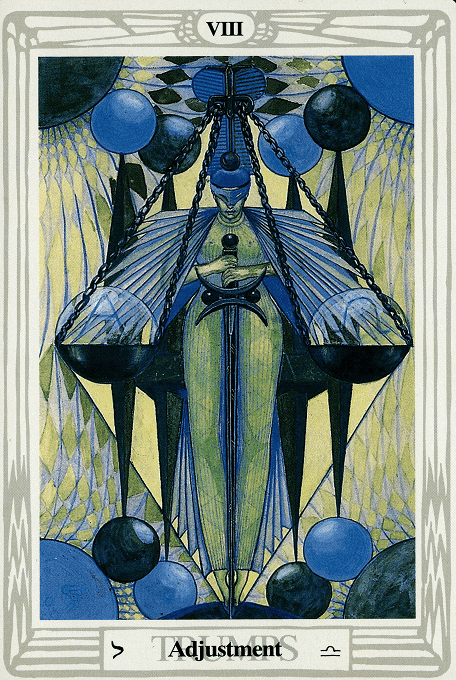
The Justice — Thoth version
Thoth

In the Rider-Waite-Smith deck, a robed figure sits on a stone throne between two gray pillars, holding an upright sword in one hand and a set of balanced scales in the other. A purple cloth hangs behind the throne, and the figure's expression is calm and direct rather than stern or theatrical. The core message concentrates in three details: the sword held upright rather than raised to strike, the scales held level rather than tipped toward either side, and the pillars framing the figure the same way they frame the High Priestess and the Hierophant, tying Justice to that same idea of a threshold or gateway to deeper understanding. Together these describe judgment that's steady and impartial rather than harsh or reactive.

Waite's 1911 placement of this card is itself notable: in most modern decks, Justice appears as card eleven, but Waite moved it from its traditional position (card eight in the Tarot de Marseille) to sit after Strength instead, a change modern readers rarely think about even though Waite discussed his reasoning explicitly, tying it to the correspondences he saw between the Major Arcana and the Hebrew alphabet. The Marseille version of the card, by contrast, presents Justice in a visually similar way, seated with sword and scales, but keeps it earlier in the sequence and without the pillars, giving it a more straightforwardly civic, courtroom-like feel rather than the added mystical framing Waite introduced.

Upright Meaning

Justice represents clear-eyed fairness: seeing a situation as it actually is, weighing it honestly, and accepting the natural consequences that follow from choices already made. Its essential energy is accountability, both toward yourself and in how you treat others.

In everyday situations, this often shows up as a decision that requires objectivity rather than emotional reaction, like resolving a disagreement fairly or evaluating a situation without letting personal bias distort the facts. It can also describe consequences catching up with a previous choice, whether that's a positive result from consistent effort or a less welcome outcome from something overlooked or avoided.

A nuance beginners often miss is that Justice isn't primarily about punishment. The sword is held upright, not raised to strike, and the scales are balanced rather than tipped, suggesting measured evaluation rather than a verdict already decided against you. Reading this card only as "you're about to be punished" misses its equally strong connection to simple, honest cause and effect, which can just as easily work in your favor.

Readers disagree somewhat on how much this card should be read through a legal or contractual lens versus a broader ethical one. Some traditions keep Justice closely tied to literal fairness in agreements, disputes, and formal decisions, echoing its Marseille roots in more straightforward courtroom imagery. Other, more introspective approaches read the card primarily as personal accountability and honest self-assessment, less about external judgment and more about seeing your own choices and their effects clearly. Both readings share the core theme of balanced, honest evaluation; they differ mainly in whether that evaluation is aimed outward or inward.

Reversed Meaning

Reversed, Justice doesn't simply mean unfairness as the flat opposite of fairness. That would just negate the upright meaning. The more useful distinction is between an external imbalance you're facing and an internal avoidance of accountability. External imbalance suggests a situation that's genuinely unfair, where facts have been distorted, a decision has been biased, or consequences have landed unevenly regardless of what you've done.

A different shadow expression involves avoiding accountability yourself: sidestepping responsibility for a choice, rationalizing a decision rather than examining it honestly, or resisting facing the natural consequences of something you've done. This can look very different from being treated unfairly by someone else, yet both fall under a reversed Justice depending on the specifics of the situation.

The reversed card can also point to delayed outcomes: consequences that haven't yet caught up with a choice, leaving a situation feeling unresolved rather than clearly unjust. This differs from active unfairness; here the issue is timing, a sense that the natural balance hasn't settled yet rather than that it's been distorted.

It's worth noting that some readers don't use reversals at all, reading every card only upright and relying on surrounding cards for shading instead. If that's your approach, the external-imbalance, avoided-accountability, and delayed-outcome readings above still apply, held as tensions that can appear within an upright Justice, particularly in a reading involving an unresolved decision or dispute.

In a daily reading

Justice in a Daily Reading

As a single morning card, Justice is worth reading as a nudge to look honestly at a situation today rather than letting emotion or convenience shape your view of it. It's a good day to ask whether you're seeing something clearly, including your own role in it, rather than only the parts that are easiest to accept.

Say you pull this card before a day that includes resolving a disagreement with a friend or colleague where you're not entirely sure who's right. Justice doesn't tell you who's correct; it suggests approaching the conversation with genuine fairness, willing to weigh both sides honestly rather than assuming your own perspective is automatically the accurate one.

A daily-pull scenario

A Daily-Pull Scenario

Imagine pulling Justice on a morning before reviewing a budget or a contract you need to sign. A beginner's first instinct might be to read this as a sign that legal or financial matters will resolve favorably, treating the card as a kind of guarantee. A more useful reading treats the card as a prompt to read the details carefully and honestly, weighing the actual terms rather than what you'd prefer them to say, and to accept whatever the facts show rather than looking for reassurance the card isn't equipped to give.

Read with care

Common Misreadings

  • This card means I'm about to be punished.

    Justice describes balanced evaluation, not automatic punishment. The sword held upright and the level scales suggest measured judgment, which can just as easily confirm you're in the right as reveal a problem.

  • This card guarantees a favorable legal or financial outcome.

    Justice points to fairness and honest evaluation of facts, not a specific result. It doesn't predict how a legal, medical, or financial matter will actually resolve.

  • Reversed always means someone is being unfair to me.

    Reversed can describe external unfairness, but it can just as easily describe your own avoidance of accountability or a natural consequence that simply hasn't caught up yet.

Combinations

Cards That Change Its Meaning

  • JusticeThe Emperor

    Amplifies the theme of structured accountability, suggesting a decision or evaluation grounded firmly in established rules or authority, often pointing to a formal process rather than an informal judgment call.

  • JusticeThe Moon

    Tempers clear-eyed fairness with uncertainty, suggesting the facts of a situation aren't as clear-cut as they first appear, complicating any confident, objective read on what's actually true.

  • JusticeThe Tower

    Redirects steady, measured evaluation toward sudden reckoning, suggesting consequences that arrive abruptly and forcefully rather than through a calm, deliberate weighing of the facts.

Sit with it

Questions for Reflection

  1. 1

    Where in my life am I avoiding an honest look at my own role in a situation?

  2. 2

    Is there a decision I've been putting off that needs a clearer, less emotional evaluation?

  3. 3

    What would it look like to weigh both sides of a disagreement fairly, including the side I don't want to hear?

  4. 4

    Are there consequences I've been expecting that simply haven't caught up yet?