WandsFire
Tarot Card Meaning

Five of Wands

The Five of Wands means competition, conflict, and spirited challenge. Explore its upright and reversed meanings, symbolism, and daily-pull guidance.

Five of Wands tarot card
At a glance

Quick Keywords

Upright
  • competition
  • conflict
  • disagreement
  • minor struggle
  • differing viewpoints
  • friction
  • spirited challenge
Reversed
  • avoiding conflict
  • resolving disagreement
  • inner conflict
  • unnecessary competition
  • tension easing
Symbolism

What's in the Image

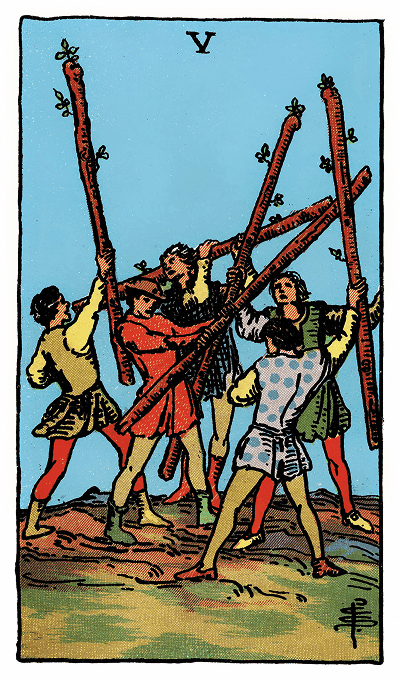
The Five of Wands — Rider-Waite-Smith version
Rider-Waite-Smith
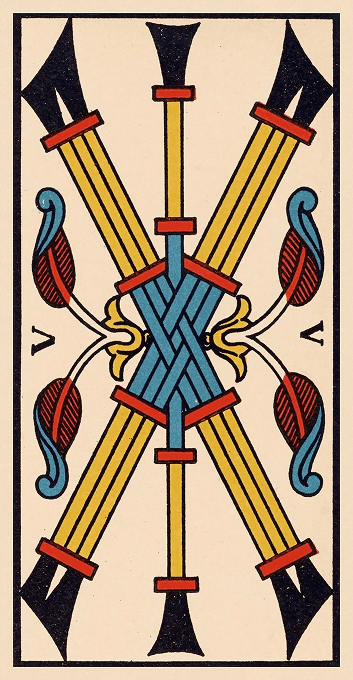
The Five of Wands — Marseille version
Marseille
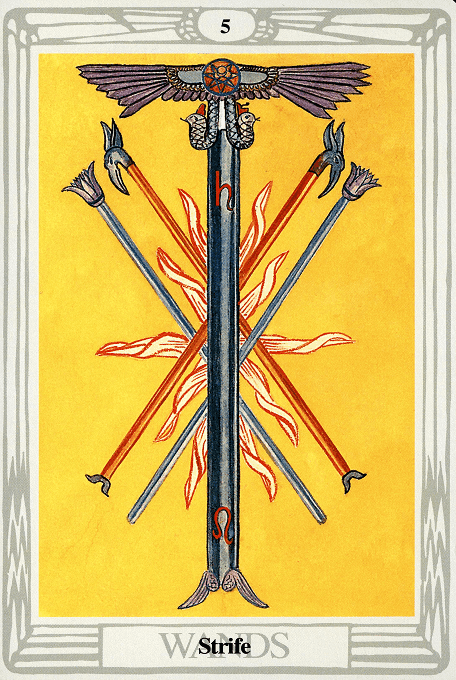
The Five of Wands — Thoth version
Thoth

In the Rider-Waite-Smith deck, five young figures each hold a wand and appear to be in the middle of a chaotic, overlapping scuffle, their staffs crossing at odd angles without any clear sense of coordinated attack or organized battle. The core message concentrates in three details: the disorganized, overlapping arrangement of the wands, suggesting confusion and clashing effort rather than a clean, decisive fight, the figures' varied postures and directions, indicating differing approaches or perspectives rather than two clearly opposed sides, and the absence of any visible injury or serious harm in the scene, hinting that this conflict, while real, may be more about friction and competing energy than genuine danger. Together these describe a lively, chaotic clash of differing viewpoints or competitive energy, contentious but not necessarily destructive.

Waite's 1911 notes describe this card as relating to "the strife of life" more generally, along with competition and struggle in a fairly broad sense, without specifying a particular cause or outcome, a deliberate openness modern readers sometimes narrow into assuming a single, specific dispute. Earlier decks, including the Tarot de Marseille, depict the fives of each suit without any illustrated scene, typically showing simply five wands arranged decoratively, meaning the specific image of a chaotic, multi-figure scuffle is Waite and Smith's addition, chosen to visually represent competing energies and minor conflict rather than a plain suit symbol alone would.

Upright Meaning

The Five of Wands represents friction or competition arising from differing viewpoints, approaches, or goals. Its essential energy is spirited conflict: disagreement or rivalry that's real and sometimes frustrating, but generally more about clashing energy than deep, lasting harm.

In everyday situations, this often shows up as a disagreement among coworkers or family members with different ideas about how to approach something, healthy competition that pushes everyone involved to perform better, or simply a chaotic, contentious stretch where multiple people are pulling in different directions at once. It can also describe internal conflict, competing priorities or desires within yourself that don't easily align.

A nuance beginners often miss is that this card's conflict, while genuine, doesn't necessarily indicate serious harm or lasting damage. The chaotic, overlapping scene lacks any clear sign of injury, suggesting the struggle shown is more about competing energy and differing approaches than outright hostility or danger. Reading this card only as "a dangerous fight is coming" misses its more accurate, and often more manageable, meaning: real but survivable friction, the kind that can arise naturally when multiple perspectives or interests come into contact.

Readers disagree somewhat on how much this card should be read as purely negative versus containing a genuinely productive, even valuable, kind of competitive energy. Some traditions read the Five of Wands mainly as unwanted conflict or disruption, something to be managed or resolved. Other readings note that competition and differing viewpoints can also spur growth, creativity, or better outcomes when handled well, treating the friction as potentially productive rather than purely negative. Both readings share the underlying theme of clashing energy or perspectives; they differ mainly in how much value they see in that clash itself.

Reversed Meaning

Reversed, the Five of Wands doesn't simply mean all conflict has vanished. That would just negate the upright meaning without describing what's actually happening instead. The more useful distinction is between genuine resolution of a disagreement and avoiding conflict that still needs to be addressed. Genuine resolution suggests real movement toward settling a disagreement, finding common ground, or reaching a workable compromise among differing viewpoints.

A different shadow expression involves avoidance: sidestepping a disagreement rather than actually resolving it, letting tension go unaddressed instead of working through the friction the upright card describes. This can look like surface calm that doesn't reflect any real progress toward addressing the underlying issue, a different problem from actual resolution.

The reversed card can also point to internal conflict: competing desires or priorities within yourself that haven't yet been reconciled, requiring more self-reflection rather than the external competition the upright card more often describes. This differs from both resolution and avoidance; here the friction lives inside a single person rather than between multiple people or perspectives.

It's worth noting that some readers don't use reversals at all, reading every card only upright and relying on surrounding cards for shading instead. If that's your approach, the genuine-resolution, avoidance, and internal-conflict readings above still apply, held as tensions that can appear within an upright Five of Wands, particularly in a reading involving a disagreement that already feels unresolved or complicated.

In a daily reading

Five of Wands in a Daily Reading

As a single morning card, the Five of Wands is worth reading as a nudge to expect some friction or disagreement today, and to approach it as a normal part of differing perspectives rather than a sign that something is fundamentally wrong. It's a good day to stay engaged with a disagreement rather than avoiding it outright.

Say you pull this card before a day that includes a meeting or gathering where you expect some disagreement among the people involved. The Five of Wands doesn't guarantee the friction will resolve easily; it suggests staying engaged with the differing viewpoints rather than shutting down or avoiding the conversation altogether.

A daily-pull scenario

A Daily-Pull Scenario

Imagine pulling the Five of Wands on a morning before a team meeting where you know several people have different opinions about how to proceed on a shared project. A beginner's first instinct might be to read this as a warning that the meeting will turn into a serious, damaging conflict. A more useful reading treats the card as an indication that some spirited disagreement is likely, and possibly even productive, since the chaotic scene in the image shows no clear injury or lasting harm, meaning the friction described here is often survivable and even useful when the different viewpoints get a genuine hearing.

Read with care

Common Misreadings

  • This card means a serious, damaging fight is coming.

    The chaotic scene lacks any clear sign of injury or lasting harm. This card more often describes lively friction or disagreement rather than a dangerous or destructive conflict.

  • This card means competition is always bad.

    Some readings treat this friction as purely negative, but many contemporary approaches recognize that healthy competition or differing viewpoints can also produce better outcomes when handled constructively.

  • Reversed always means all conflict has been resolved.

    Reversed can describe genuine resolution, but it can just as easily describe avoiding a disagreement that still needs attention, or internal conflict that hasn't yet been reconciled.

Combinations

Cards That Change Its Meaning

  • Five of WandsTwo of Swords

    Amplifies the sense of an unresolved standoff, suggesting the friction described here is being avoided rather than actively worked through, similar to a stalemate maintained through avoidance.

  • Five of WandsJustice

    Tempers chaotic conflict with a pull toward fair resolution, suggesting the disagreement described here has real potential to be settled through honest, balanced consideration of each perspective.

  • Five of WandsThe Tower

    Redirects manageable friction toward sudden, more serious disruption, suggesting the disagreement may escalate more abruptly than the upright card alone would suggest.

Sit with it

Questions for Reflection

  1. 1

    What disagreement or friction in my life could actually benefit from more direct engagement rather than avoidance?

  2. 2

    Is there healthy competition in my life that's pushing me toward growth rather than simply causing stress?

  3. 3

    Am I experiencing internal conflict between competing priorities that needs more honest self-reflection?

  4. 4

    What would it look like to stay engaged with a disagreement today rather than shutting down or walking away?