Upright Meaning
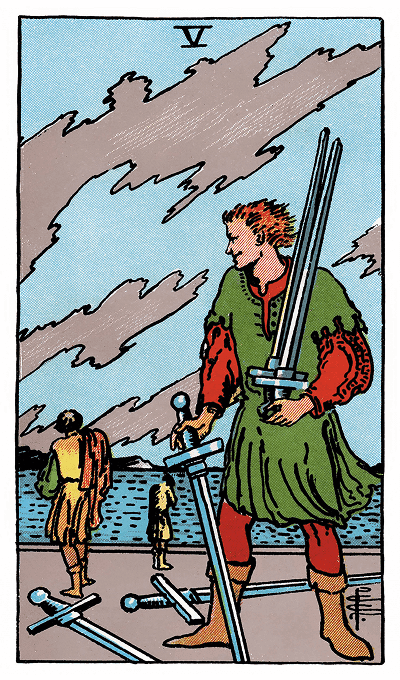
The Five of Swords represents conflict that ends with someone winning, but at a cost that makes the victory feel hollow rather than genuinely satisfying. Its essential energy is discord: a dispute where self-interest takes priority over relationship or mutual respect, leaving lingering tension even after the immediate confrontation ends.
In everyday situations, this often shows up as an argument won through stubbornness or manipulation rather than honest resolution, a disagreement where "winning" damages a relationship more than it settles anything meaningful, or simply a tense situation where everyone involved walks away feeling worse rather than resolved. It can also describe recognizing when a conflict genuinely isn't worth continuing, choosing to walk away rather than keep fighting for a point that's costing more than it's worth.
A nuance beginners often miss is that this card doesn't automatically identify the person receiving the reading as the victor or the defeated party. The scene raises real questions about whether "winning" here is actually admirable, since Waite's own notes suggest the central figure may have won through questionable means. Reading this card only as "you'll win the argument" misses its more complicated, honest meaning: sometimes winning a conflict isn't the same as handling it well, and the cost of victory matters just as much as the outcome itself.
Readers disagree somewhat on which figure in the scene the person receiving the reading is meant to identify with. Some traditions suggest the card asks you to examine whether you're the one holding the swords, winning through means you might not be proud of upon reflection. Other readings suggest identifying instead with the departing figures, recognizing when a conflict isn't worth continuing and choosing to walk away with your dignity intact, even if that means not winning outright. Both readings share the underlying theme of a conflict with real costs; they differ mainly in which role the card is prompting you to examine.